Most moths fly at night and spend the day sitting still in the open. Birds hunt by sight, so a resting moth survives by looking like something a bird has no reason to peck at. For a great many species that means a dead leaf, a patch of bark or a broken twig.
Which of these moths you can find depends on where you live. The angle shades, lappet and buff-tip are European. The underwings and the peppered moth have relatives on both sides of the Atlantic. A few of the most extreme leaf mimics live in East Asia and the tropics.
| Looks like | Example | Where it lives | What gives it away |
|---|---|---|---|
| Withered leaf | Angle shades (Phlogophora meticulosa) | Europe, including Britain and Ireland | Forewings creased lengthwise, pinkish-brown and olive V-shaped marks |
| Bunch of dead oak leaves | Lappet (Gastropacha quercifolia) | Europe and Asia; local in southern Britain | Large, dark red-brown, scalloped wings, hindwings poking out below the forewings |
| Cluster of dead leaves | Poplar hawk-moth (Laothoe populi) | Europe and across temperate Asia | Hindwings held forward of the forewings, abdomen curled upward |
| Dead leaf | American lappet (Phyllodesma americana) | Much of North America | Small, scalloped wing edges, forewings tented with hindwings sticking out sideways |
| Tree bark | Underwing moths (Catocala) | North America, Europe and Asia | Grey-brown wavy-lined forewings covering bright banded hindwings |
| Lichen-covered bark | Peppered moth (Biston betularia) | Europe, Asia and North America | White wings peppered with black, held flat and out to the sides |
| Broken birch twig | Buff-tip (Phalera bucephala) | Europe and into Asia | Silver-grey wings rolled round the body, pale buff patch at each end |
Two ways a moth can hide
Not all of these moths are doing the same thing, and the difference helps when you are trying to work out what you have found.
Some moths blend in. Their colours and lines match the surface they rest on, so a predator simply fails to pick them out. Bark-patterned moths such as the underwings work this way. Take one off the trunk and put it on a white wall and it is obvious.
Others pass for a particular object. Biologists call this masquerade. The moth may be in plain view, but it is taken for a leaf or a twig and ignored. A buff-tip on a white wall still looks like a piece of stick. Experiments with twig-like caterpillars have shown that birds really do mistake them for twigs, rather than just failing to see them.
In both cases the pattern is only half of it. Posture and position do the rest. In one study, researchers let bark-coloured moths land on tree trunks and watched what they did next. Many of them walked and turned until they settled, and people shown photographs found the moths harder to spot in their final positions than where they first landed.
Moths that look like leaves
Dead leaves are everywhere, they come in every size, and nothing eats them. That makes them a good thing to resemble, and leaf-like moths turn up in several unrelated families.
Angle shades
The angle shades is the leaf moth most people in Britain and Ireland meet first. It is medium-sized, with a wingspan of about 42 to 50 mm. At rest it folds its forewings lengthwise so that they crease and curl, and the pinkish-brown and olive markings finish the picture of a withered leaf.
It often rests by day in the open on walls, fences and low plants, which is why it gets noticed. Adults fly mainly from May to October.
Lappet and American lappet
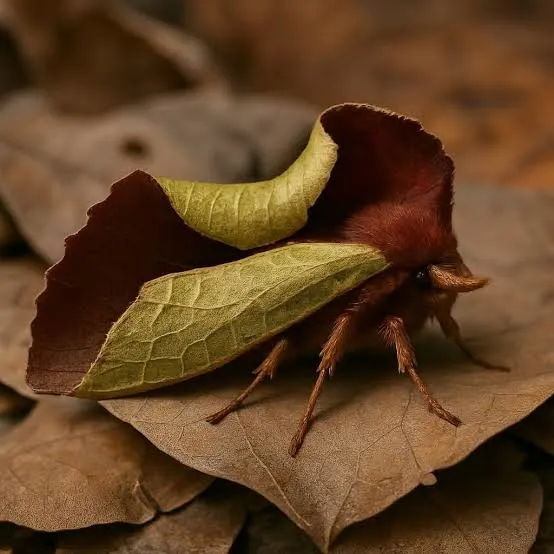
The European lappet is a big, heavy moth. Females can reach a wingspan of 90 mm. Its scientific name quercifolia means oak-leaved, and it refers to how the resting moth looks, not to what the caterpillar eats. With the hindwings pushed out beneath the scalloped forewings, it resembles a small bunch of dried oak leaves. In Britain it is found locally in the south and south-east and flies in June and July.
North America has a smaller relative, the American lappet, with a wingspan of roughly 29 to 49 mm. It rests in a similar way, forewings tented over the body and hindwings sticking out to the sides, and is well hidden when it sits among dead leaves. Its colour varies from reddish to blue-grey to yellowish brown, so do not rely on colour alone.
Poplar hawk-moth
The poplar hawk-moth is large, 65 to 90 mm across, and rests in a way that is unusual for a hawk-moth. The hindwings sit forward of the forewings and the tip of the abdomen curls up. The result is a ragged outline that is often compared to a cluster of dead poplar leaves. If it is disturbed it can flash a reddish-brown patch at the base of the hindwings.
Flat wings that look curled
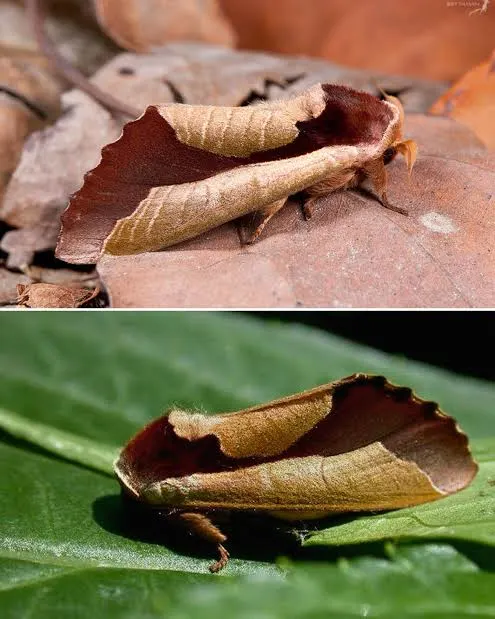
Two Asian species take leaf mimicry further. Uropyia meticulodina, an East Asian moth with a wingspan of about 45 to 55 mm, appears to be a dead leaf rolled into a tube. Its wings are flat. The curl is painted on with shading.
The fruit-sucking moth Eudocima aurantia, from Southeast Asia and northern Queensland, does something similar. A 2025 study found that tiny structures in its wing scales reflect light the way a smooth curved surface would. The shiny patches sit exactly where a real leaf would bulge, so a flat wing reads as a crumpled leaf with a raised midrib.
Plain tan geometers
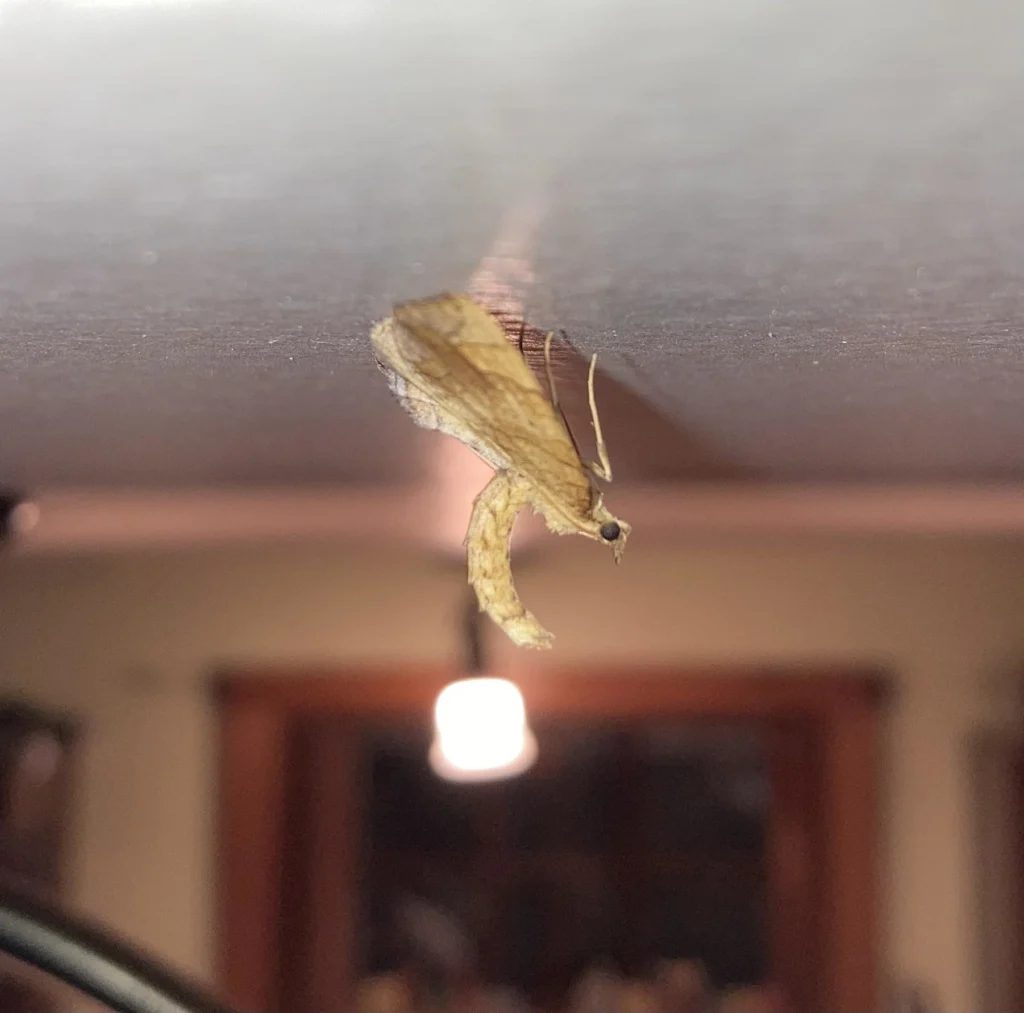
Not every leaf-like moth is dramatic. Many geometer moths rest with all four wings spread flat and are simply the colour and outline of a dry leaf. In Missouri, for example, the juniper-twig geometer is described as one of many geometrids that look like a dried-up leaf. These are much harder to name from appearance alone. See our guide to moth identification by wing pattern for how to read the lines that run across their wings.
Moths that look like bark
Bark camouflage is the commonest disguise of all. Hundreds of grey and brown moths carry some version of it, which is exactly why a bark-coloured moth is hard to name from a photo. A few groups are worth knowing.
Underwing moths
Underwings in the genus Catocala rest on tree trunks by day with the forewings closed like a tent. Those forewings are dull grey, tan or brown, crossed by wavy lines that copy the random pattern of bark. Hidden underneath are hindwings banded in orange, red, yellow or pink with black.
If the moth is found and disturbed, the bright hindwings appear suddenly. The flash can startle a bird for long enough for the moth to get away. So an underwing uses two defences in sequence: hide first, surprise second.
There are a lot of them. Missouri alone has more than 60 Catocala species, and the markings vary even within one species. Treat “an underwing” as a perfectly good answer unless you have clear photos of both the forewings and the hindwings. Our moth species with pictures guide includes an underwing among its examples.
Peppered moth
The peppered moth has a wingspan of about 44 to 56 mm and long, narrow wings that it holds flat and straight out to the sides. The usual form is white, finely speckled with black, and it disappears against lichen-covered bark.
It is also the best-known example of camouflage changing over time. In parts of industrial Britain, soot killed the lichens and darkened the trees, and an all-black form of the moth became the common one. Both forms still exist, and intermediate ones too, so colour alone will not confirm this species.
Geometers that pick their spot
Many geometer moths rest flat against a trunk with their wing lines running across the body. On furrowed bark, those lines only disappear if the moth is turned the right way. The tree-trunk study mentioned above was carried out by researchers in Seoul on two such species, and the moths found their own best position and angle. If you see a flat grey moth sitting sideways or head-down on a trunk, the odd angle is probably part of the disguise.
Moths that look like twigs
Buff-tip
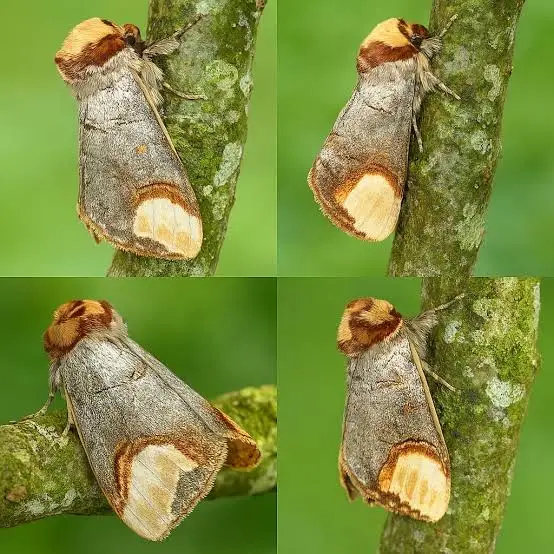
The buff-tip is the moth to beat in this category. It is silvery grey, with a wingspan of 44 to 68 mm, and it rolls its wings tightly around its body so that it becomes a short cylinder. The head is square-cut and buff, and there is a matching buff patch at the wing tips. Both ends look like pale, freshly snapped wood, and the whole moth passes for a broken piece of birch twig.
It is common and widespread in Britain and flies at night from May to July. Because the disguise is so specific, it is one of the few camouflaged moths a beginner can name with confidence, provided the location fits.
Twig caterpillars
The most convincing twigs are not adult moths at all. They are the caterpillars of geometer moths, often called inchworms or loopers. They have legs only at the front and rear of the body. To rest, a caterpillar grips with the rear pair and holds the rest of its body out straight and stiff at an angle, like a side shoot.
Peppered moth caterpillars add another layer. They slowly change colour to match the twigs of the plant they are feeding on. Researchers covered the eyes of some caterpillars and found they could still match their background, and that genes used in vision were active in the skin. In effect the caterpillar senses the colour of its twig through its body surface.
Position matters here too. In experiments with early thorn caterpillars, the twig disguise fooled birds best where real twigs were plentiful, and the caterpillars chose twig-rich spots to rest in by day.
If you find a twig that walks, the adult it turns into will usually look nothing like it. Our guide to moth life cycle stages explains how the two fit together.
How to identify a camouflaged moth
“It looks like a leaf” narrows things down less than you might hope. Use the disguise as a starting point and then add the details that actually separate species.
- Note what it resembles and what it is sitting on. A bark-patterned moth on bark is blending in. A leaf-shaped moth on a painted wall is relying on its shape.
- Look at the resting posture. Wings rolled round the body, tented over it, spread flat, creased lengthwise, or hindwings showing in front of or below the forewings each point to different groups.
- Estimate the size. Compare it with a coin or your thumbnail if you cannot measure it.
- Record where and when. Country or state and month rule out more candidates than any marking. A buff-tip is not an option in North America, and an American lappet is not an option in Europe.
- Photograph it from directly above and from the side before it moves. Do not prod it to see the hindwings. If it flies on its own, note any colour you glimpse.
If those details still fit several species, say so. “A geometer with dead-leaf colouring” or “an underwing, species not confirmed” is an honest result. Our beginner’s guide to identifying a moth covers the full method, and the moth identification hub lists the other feature guides.
On a wall or fence near the house
Camouflage only works on the right background. A moth that came to a porch light overnight and stayed put on brick or paintwork is suddenly easy to see, which is how most people come across these species. It is an outdoor moth resting until dusk, and it is not a sign of pantry or clothes moths. Leave it where it is, and see large moth on outside wall at night if you want to work out what it is.
Frequently asked questions
What is the moth that looks like a dead leaf?
It depends on where you are. In Britain and much of Europe the usual answer is the angle shades, with the lappet and poplar hawk-moth as larger possibilities. In North America the American lappet is one candidate among several. In East Asia, Uropyia meticulodina is the moth that looks like a curled dead leaf.
What moth looks like a broken twig?
In Europe, the buff-tip. Its rolled silver-grey wings and buff ends make it look like a snapped birch twig. Twig-like caterpillars are a separate thing and belong mostly to geometer moths.
Why do so many moths look like bark?
Most moths rest by day on trunks, branches and fences, and the birds that eat them hunt by sight. Any moth that was slightly harder to pick out on bark was slightly more likely to survive and breed, and over many generations that adds up to a very close match.
Do moths choose where to land so that they match?
At least some do. Bark-patterned moths have been shown to shift position and turn after landing until they are harder to see, and twig-like caterpillars rest where twigs are common.
Are leaf and bark moths harmful?
Most adult moths are harmless to people, and these ones are no exception. They do not bite or sting. The kindest thing is to look, take a photo and leave the moth where it is.
References
- Angle Shades, Butterfly Conservation
- Angle Shades, Phlogophora meticulosa, National Museums Northern Ireland
- The Lappet, Gastropacha quercifolia, UKMoths
- American Lappet Moth, Phyllodesma americana, BugGuide, Iowa State University
- Poplar Hawk-moth, Butterfly Conservation
- Buff-tip moth, Kent Wildlife Trust
- Underwing Moths, Missouri Department of Conservation
- Juniper-Twig Geometer, Missouri Department of Conservation
- Peppered moth, The Wildlife Trusts species profile
- Caterpillars perceive colour through their skin, Max Planck Society, on Eacock et al. 2019, Communications Biology
- Skelhorn et al. 2010, Masquerade: camouflage without crypsis, Science
- Caterpillars aren’t so bird brained after all, University of Exeter
- Camouflage of moths: moths actively seek out best hiding places, ScienceDaily, on Kang et al. 2012
- Kelley et al. 2025, A leaf-mimicking moth uses nanostructures to create 3D leaf shape appearance, Current Biology