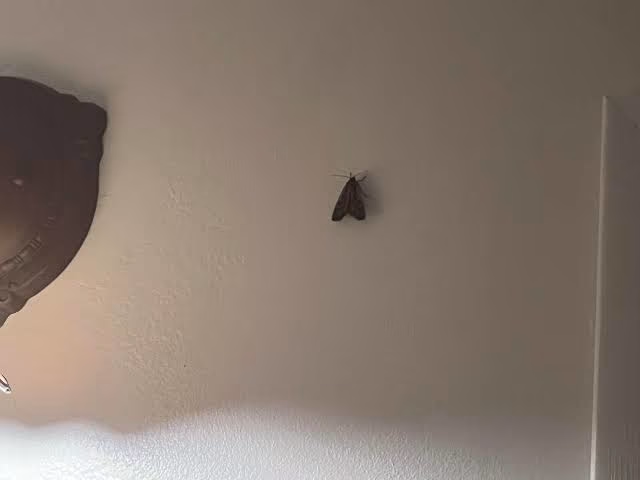
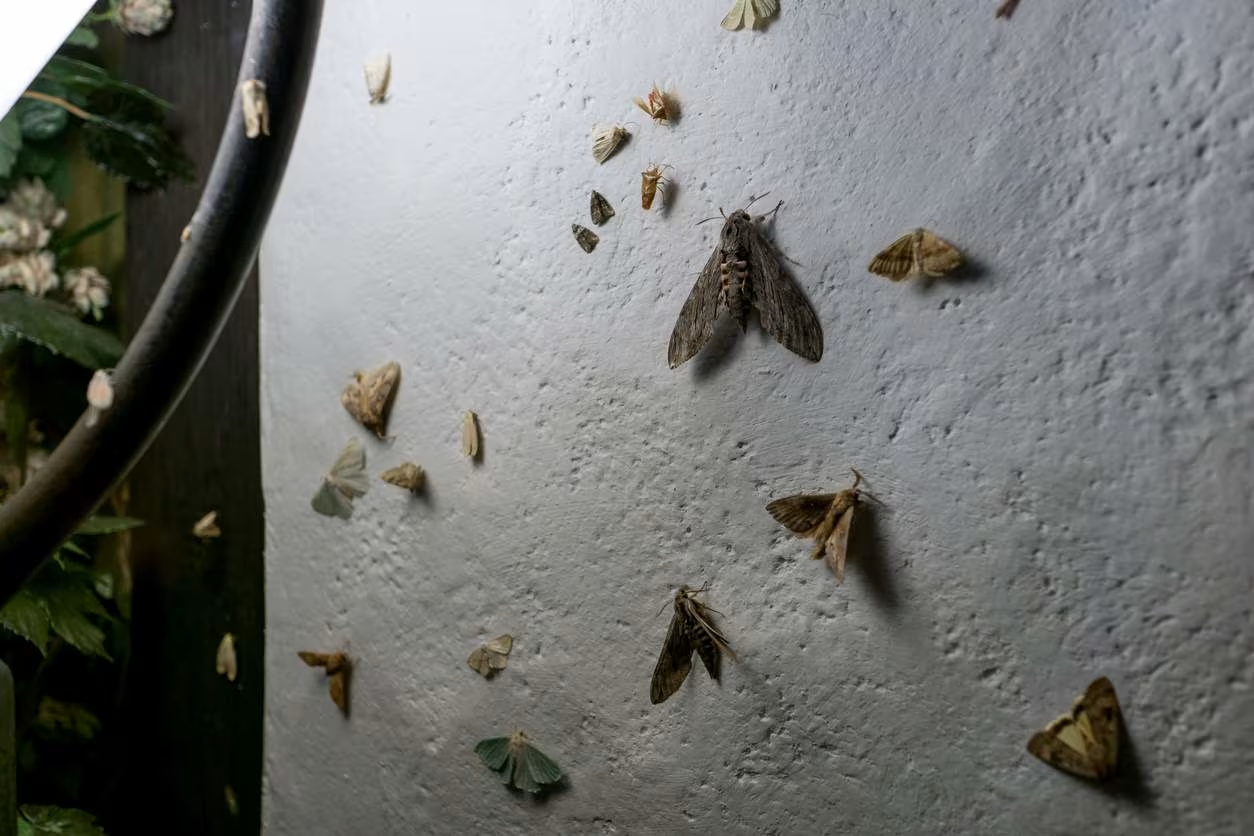
A large moth on an outside wall at night is usually an outdoor visitor that has approached a porch light, security light, illuminated window, or other artificial light source. Its location alone cannot confirm the species, but its size, wing shape, markings, antennae, resting posture, geographic location, and the date of the sighting can narrow the possibilities considerably.
One large moth outside does not normally indicate pantry moths, clothes moths, or an infestation inside the house. In most cases, you can photograph it, reduce unnecessary nearby lighting, and leave it where it is.
Quick Identification Overview
Large moths found on exterior walls commonly belong to one of several broad groups:
- Giant silk moths, which often have broad wings, thick bodies, feathery antennae, eyespots, transparent wing patches, or long hindwing tails.
- Sphinx or hawk moths, which usually have long, pointed forewings and streamlined, powerful bodies.
- Underwing and other owlet moths, which are frequently brown or gray at rest and may conceal colorful hindwings.
- Large tiger moths, which may have fuzzy bodies and bold spots, bands, or contrasting colors.
- Large geometrid moths, which often have comparatively slender bodies and broad wings marked with fine crosslines.
The exact species depends heavily on where you live. A large moth found in North America may be completely unrelated to a similar-looking moth in Europe, Asia, Australia, Africa, or South America.
Why Is a Large Moth Sitting on the Outside Wall?
The wall is usually not a food source. It is more likely a temporary resting surface near artificial light, shelter, warmth, or suitable nighttime habitat.
Artificial Light May Have Brought It to the Building
Many night-flying insects gather around porch lights, security lights, garage lights, and illuminated windows. A 2024 flight study found that insects near artificial point lights did not simply steer directly toward the bulb. Instead, they tended to orient their backs toward the light, which could produce orbiting, stalling, and other disrupted flight paths.
After flying around a light, a moth may settle on:
- Brick, stucco, or exterior siding
- A door frame or window screen
- The underside of a porch roof
- A garage wall
- A fence or post near the light
A moth beside a bright fixture may therefore have arrived because of the lighting rather than because of anything living inside the wall.
The Wall Provides a Resting Surface
A vertical wall offers a stable place to stop after flight. Some moths remain there for several hours, especially as the night cools or daylight approaches.
Many nocturnal moths are inactive during the day. A moth that remains motionless the following morning may simply be resting until conditions become suitable for flight again. Remaining still may also help a well-camouflaged moth avoid detection by predators.
Nearby Habitat Matters
Trees, shrubs, gardens, woodland edges, meadows, wetlands, and agricultural land can support moth caterpillars and adults. A house beside suitable habitat may receive more moth visitors than a building surrounded by little vegetation.
The wall does not reveal which plant the caterpillar used. It only tells you where the adult happened to stop.
Most Likely Types of Large Moths on Exterior Walls
“Large moth” is not a scientific category. The description can refer to many unrelated species, and a moth that seems enormous to one observer may be considered medium-sized in a field guide.
The following comparison can help you identify the most plausible family or visual group before searching for an exact species.
| Possible group | Body and wing shape | Common visible clues | Typical resting appearance |
|---|---|---|---|
| Giant silk moths | Thick or furry body with broad wings | Eyespots, pale windows, bold bands, long tails, or feathery antennae | Wings may be spread broadly, angled outward, or held in a wide tent |
| Sphinx or hawk moths | Long, muscular, streamlined body | Long pointed forewings, narrow profile, and wing or abdominal stripes | Often resembles a small aircraft, dart, wedge, or dry leaf |
| Underwing and large owlet moths | Stout body with broad triangular forewings | Gray or brown camouflage; brighter hindwings may remain hidden | Usually appears bark-like until it moves or flies |
| Large tiger moths | Fuzzy or robust body | Spots, stripes, bands, or strong white, black, orange, or cream contrasts | Wings may form a roof over the body or remain partly open |
| Large geometrid moths | Usually a thinner body with comparatively broad wings | Wavy crosslines, scalloped edges, and leaf-like markings | Wings are often held flat against the wall |
These are identification starting points rather than final species identifications.
Giant Silk Moths
Giant silk moths belong to the family Saturniidae. Many are conspicuously large and attract attention when they appear near windows or exterior lights. North American examples include luna moths, cecropia moths, Polyphemus moths, imperial moths, and related species. Other members of the family occur in many regions of the world.
Look for:
- Broad, rounded wings
- A thick or furry body
- Feathery or comb-like antennae, especially in some males
- Circular eyespots
- Clear or translucent wing windows
- Crescent-shaped markings
- Long tails on the hindwings
- A resting width much greater than the body length
Do not identify every large moth with eyespots as a giant silk moth. Several unrelated moth and butterfly groups also have eyespot-like markings.
Sphinx or Hawk Moths
Sphinx moths, also called hawk moths, belong to the family Sphingidae. They are usually strong fliers with stout abdomens and forewings that are longer and more pointed than their hindwings. Some species hover while feeding at flowers, although a resting moth will not show that behavior.
Look for:
- A long, tapered, or cigar-shaped abdomen
- Narrow, swept-back forewings
- A streamlined outline
- Long stripes running toward the wing tips
- Colored bands along the abdomen in some species
- Relatively small hindwings
- Rapid, powerful flight when active
A sphinx moth resting on brick or siding may resemble a dry leaf, a wedge of bark, or a small aircraft.
Underwing and Large Owlet Moths
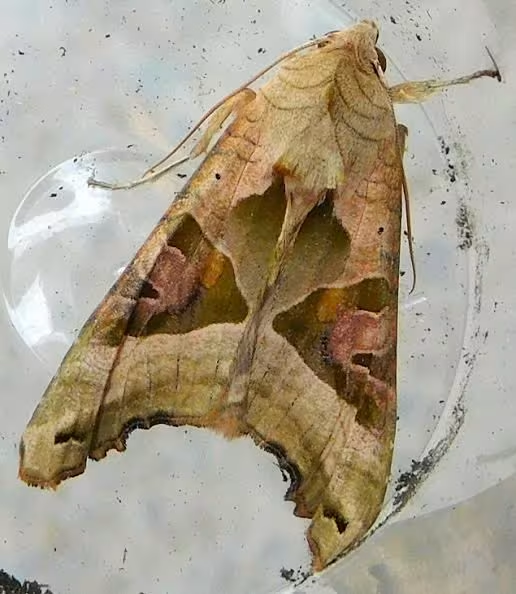
Many moths in the broad owlet-moth group have gray or brown forewings that blend into bark, stone, and weathered walls. Underwing moths can be especially deceptive because their brighter hindwings are normally covered while they rest.
Look for:
- Broad triangular forewings
- Mottled gray, tan, black, or brown patterns
- Kidney-shaped or oval marks
- Wavy crosslines
- Scalloped wing edges
- A flash of orange, pink, red, yellow, or black when the moth flies
A photograph showing only the resting forewings may miss the moth’s most recognizable colors. Do not force it to open its wings for a photograph.
Large Tiger Moths
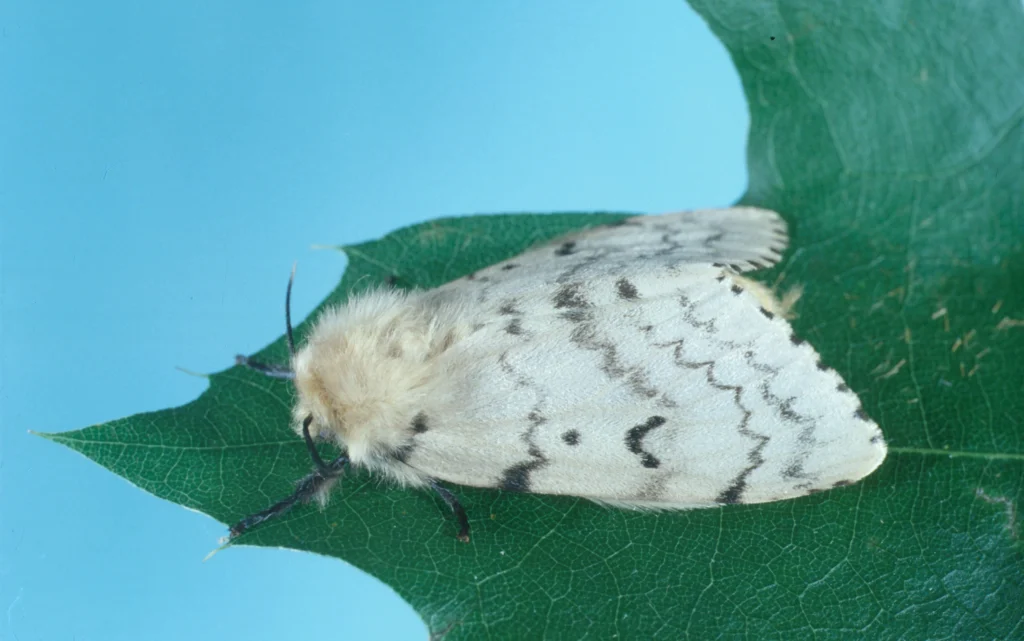
Tiger moths vary greatly in size and appearance. Some have white wings with dark spots, while others display orange, black, cream, red, or strongly contrasting patterns.
Possible clues include:
- A noticeably fuzzy thorax
- White wings with dark spots
- Strong black-and-orange contrasts
- A striped or spotted abdomen
- Wings held in a shallow roof over the body
A spotted moth should not be assigned to this group based on spots alone. Wing shape, body structure, geographic region, and season still matter.
How to Identify a Large Moth on an Outside Wall at Night
Before searching image results, record the sighting. Details that seem unimportant at first may eliminate most incorrect matches.
Record the Geographic Location
Write down the country and the nearest useful region, such as the state, province, county, island, prefecture, or nearest city.
Location is one of the strongest identification filters. Similar-looking moths may live on different continents, and some species have limited regional ranges.
Avoid choosing a species simply because its photograph looks similar. First confirm that reliable records place it in your region.
Record the Date and Time
Note the complete date rather than writing only “summer” or “last night.” Moth activity can vary according to season, latitude, elevation, rainfall, temperature, local plant growth, and the timing of each species’ adult flight period.
A species active in spring may be an unlikely match for a moth photographed late in autumn, even when the colors appear similar.
Estimate Its Size
Photographs without scale often make moths appear larger or smaller than they really are.
Estimate:
- Body length from the head to the tip of the abdomen
- Visible width across the resting wings
- Wingspan only when the wings are naturally open
Use a nearby brick, screw head, door hinge, ruler, or another known object for scale. Do not move an object so close that it disturbs the moth.
Descriptions such as “about as wide as a credit card” or “slightly longer than my thumb” are more useful than “huge.”
Examine the Wing Shape
Shape often narrows the possibilities more effectively than color.
Ask whether the wings are:
- Broad and rounded
- Long and sharply pointed
- Triangular
- Leaf-shaped
- Scalloped along the edges
- Extended into long tails
- Wrapped closely around the body
- Spread flat against the wall
- Held like a roof over the abdomen
Long, swept-back wings suggest a different group from wide wings with rounded margins.
Describe the Wing Pattern Precisely
Instead of recording only “brown moth,” look for repeatable details:
- Straight or wavy crosslines
- One pale stripe on each wing
- Circular eyespots
- Transparent wing windows
- White crescent marks
- Dark kidney-shaped patches
- Zigzag borders
- Rows of dots
- A contrasting outer wing edge
- A pale collar behind the head
- Hidden colors revealed naturally during movement
Patterns should be compared in the same resting posture. A moth photographed with its wings closed can look very different from a museum specimen displayed with all four wings open.
Look at the Body
The body may be thick and furry, smooth and tapered, long and narrow, short and heavy, strongly striped, spotted, similar in color to the wings, or brighter than the visible forewings.
A thick body with broad wings may suggest a giant silk moth. A long, tapered body with pointed wings is more suggestive of a sphinx moth.
Photograph the Antennae
Antennae can be useful, but one antenna rule does not distinguish every moth from every butterfly.
Moth antennae may be:
- Thin and threadlike
- Feathery
- Comb-like
- Saw-edged
- Gradually thickened toward the tips
- Partly hidden beneath the wings or body
Many butterflies have clearly clubbed antennae, but exceptions and intermediate forms exist. Body shape, wing posture, activity, and antennae should be considered together.
For a broader observation process, use the beginner’s guide to identifying a moth.
Why Color Alone Cannot Identify the Moth
A brown moth may belong to numerous unrelated families. A green moth is not automatically a luna moth, and a dark moth is not automatically a black witch moth.
Color can be misleading because:
- Different species share similar camouflage colors
- Males and females may differ
- Individuals within one species can vary
- Wing scales can wear away as the moth ages
- Warm porch lights may make gray wings appear brown or orange
- Phone cameras may brighten or oversaturate colors
- Forewings may cover brightly colored hindwings
- A wet moth can appear darker
- Shadows can hide pale lines or spots
Use color to create a shortlist. Confirm that shortlist with wing shape, markings, geographic range, season, antennae, size, body structure, and resting posture.
The moth identification by color guide can help you organize possible matches without relying on color alone.
Is a Large Moth on the Wall Dangerous?
A large adult moth resting outside is usually not dangerous to people or pets. Its size does not make it aggressive, venomous, or capable of damaging a wall.
Avoid unnecessary handling because:
- The wings are delicate
- Wing scales can rub away
- The moth may injure itself while struggling
- An exact identification has not yet been confirmed
The safety rule is different for caterpillars. Some unidentified fuzzy, hairy, or spiny caterpillars can irritate skin, and certain species have defensive spines. Do not handle an unknown hairy or spiny caterpillar with bare hands.
Does One Large Moth Mean There Is an Infestation?
One large moth outside does not indicate a pantry moth or clothes moth infestation.
Household moth concerns usually involve a different pattern:
- Repeated small moths inside a kitchen or pantry
- Larvae or silk webbing in dry foods
- Small pale moths repeatedly appearing in dark closets
- Larvae, cases, frass, or damage on wool and other animal-based fibers
A large patterned moth beside an outdoor light is much more likely to be part of the surrounding outdoor ecosystem.
If moths are repeatedly appearing indoors, use the moths around the home identification guide to separate accidental outdoor visitors from possible stored-food or fabric moth activity.
What Should You Do with the Moth?
Leave It Alone When Possible
If the moth is outside and not in immediate danger, the simplest response is to leave it where it is.
It may fly away later that night, remain until the following evening, or move to a more sheltered surface. A motionless moth is not necessarily dead or trapped.
Avoid:
- Spraying it with insecticide
- Touching or rubbing its wings
- Forcing the wings open
- Repeatedly shining a bright flash at close range
- Picking it up by a wing, leg, or antenna
- Moving it only to obtain a better photograph
Reduce Nearby Lighting
Turning off an unnecessary exterior light may allow the moth to leave and can reduce the number of additional insects gathering around the doorway.
Practical options include:
- Switching off outdoor lights when they are not needed
- Using motion sensors or timers
- Closing curtains behind brightly illuminated windows
- Shielding fixtures so light points downward
- Using the lowest practical brightness
- Preventing light from spilling into nearby trees and vegetation
Move It Only When Necessary
A moth may need to be moved if it is resting on a door that must be used, where it may be stepped on, or within easy reach of a pet.
Place a roomy container over the settled moth without pressing against its wings. Slide a piece of stiff paper beneath the container, then move it to a sheltered vertical surface near vegetation and away from bright light.
Direct handling should be avoided.
How to Photograph a Large Wall Moth for Identification
A useful identification record normally contains more than one photograph.
- Take a direct photograph showing the complete visible wing pattern.
- Take a side view showing the thickness and shape of the body.
- Photograph the antennae if they are visible.
- Take a wider photograph showing the wall, light, and surrounding habitat.
- Include a known object nearby for scale without disturbing the moth.
Also record:
- Country and region
- Complete date
- Approximate time
- Estimated size
- Weather conditions
- Nearby habitat and plants
- Whether the moth was alone
- Whether it flew rapidly, fluttered slowly, or remained still
- Any colors revealed naturally when it moved
Avoid posting only a tightly cropped wing photograph. A detailed image without location, date, scale, or body shape may still be impossible to identify confidently.
Common Identification Mistakes
Selecting the First Similar Search Image
Search results may show moths from another continent or photographs with incorrect labels. A visual resemblance is only the beginning of an identification. Confirm the geographic range and flight season before accepting a match.
Treating “Large” as an Exact Measurement
Perspective can make a moth look enormous. Exterior walls often provide few familiar scale cues, especially in close photographs. Record an approximate measurement whenever possible.
Assuming Every Large Green Moth Is a Luna Moth
Luna moths have a specific combination of pale green wings, eyespots, and long hindwing tails. Other green moths may lack one or more of these features or may occur outside the luna moth’s documented range.
Assuming Every Large Brown Moth Is a Household Pest
Pantry and clothes moth identification depends on indoor context, evidence of larvae, food or fabric associations, adult size, and wing pattern. A large brown moth resting outside beside a porch light is a different situation.
Ignoring Hidden Hindwings
Underwing and related moths can appear plain at rest while concealing vivid colors. Wait for natural movement rather than attempting to spread the wings.
Forcing a Species-Level Answer
Some photographs support only a family-level conclusion such as “likely a sphinx moth” or “possibly a giant silk moth.” That is still useful. It is better than assigning an unsupported species name.
When to Ask for Expert Identification
Consider contacting a regional moth group, natural history museum, university extension service, biological recording program, or experienced local naturalist when:
- The moth may be outside its documented range
- The photograph shows an unusual pattern
- Several local species look nearly identical
- The sighting may represent a significant regional record
- You need confirmation for education, research, or wildlife recording
- Repeated indoor sightings are accompanied by food or fabric damage
Provide the original photographs rather than screenshots, along with the location, date, size estimate, habitat, and behavior.
A regional expert may identify the moth to species, but some moth groups require examination of details that are not visible in an ordinary wall photograph.
Common Questions About Large Moths on Outside Walls
Why has the moth stayed in the same place all day?
Many nocturnal moths remain still during daylight and become active after dark. Cool temperatures, rain, wind, recent emergence, exhaustion, injury, or the natural end of the adult life stage can also reduce movement. A photograph alone may not reveal which explanation applies.
Should I give the moth food or water?
Usually not. Adult diets differ among species, and some large moths do not feed as adults. Pouring water or offering unsuitable food may wet or damage the wings. An outdoor moth is normally best left undisturbed.
Will the moth lay eggs on the wall?
A female could pause or occasionally deposit eggs on a human-made surface, but the presence of a moth on a wall does not prove that it is laying eggs. Do not assume that small marks nearby belong to the moth unless the behavior was observed clearly.
Will the moth come inside?
It may enter through an open door or window if bright indoor lighting is visible. Closing doors, repairing screens, drawing curtains, and reducing light around entryways can reduce accidental entry.
Could it be a butterfly rather than a moth?
Possibly. Nighttime activity, a thick body, non-clubbed antennae, and resting near a light often suggest a moth, but these are tendencies rather than universal rules. Compare several features together.
How can I see other possible species?
Browse the moth species with pictures guide, then limit possible matches by geographic location, season, size, wing shape, and markings.
The Most Useful Next Step
A large moth on an outside wall at night is usually a temporary outdoor visitor, not evidence that something is damaging the house. Record its location, date, size, wing shape, markings, antennae, body structure, and resting posture before searching for a name.
Start at the family or visual-group level. Broad wings and a heavy, furry body may suggest a giant silk moth. Long, pointed wings and a streamlined abdomen may indicate a sphinx moth. Camouflaged forewings with hidden bright hindwings may point toward an underwing moth.
Photograph it carefully, reduce unnecessary outdoor lighting, and allow it to leave on its own.
References and Further Reading
- Why Flying Insects Gather at Artificial Light — Nature Communications
- Giant Silkworm Moths — University of Kentucky Department of Entomology
- White-Lined Sphinx Moth Identification — University of Minnesota Extension
- Spot the Difference: Butterfly or Moth? — Natural History Museum, London
- How to Reduce Light Pollution at Home — Butterfly Conservation
- Finding Moths — Butterfly Conservation