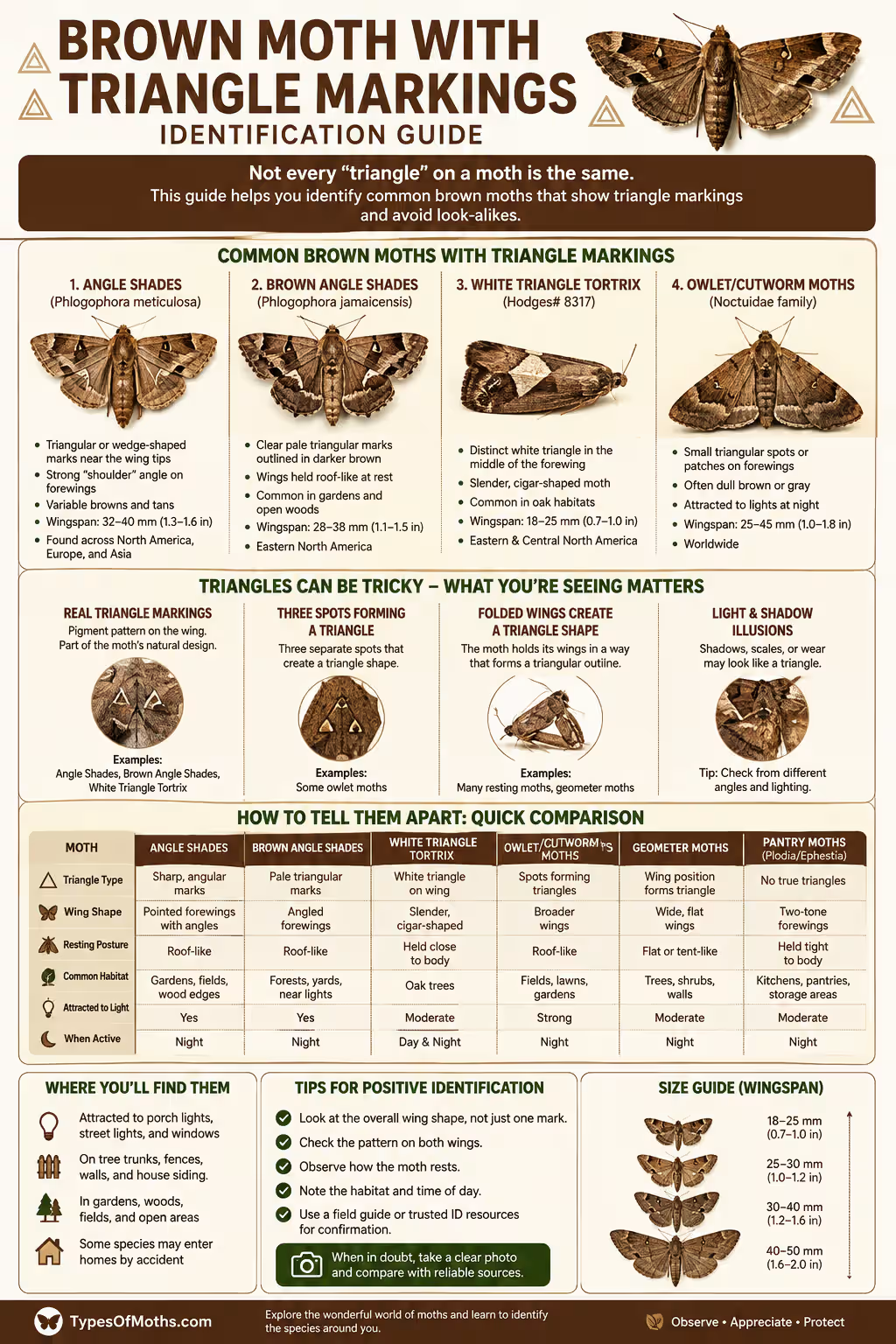
A brown moth with triangle markings cannot be identified from that feature alone, but the description points to several useful possibilities. The strongest candidates include angle shades moths with bold V-shaped patches, tiny tortrix moths with a pale triangular wedge, and owlet moths whose ordinary wing spots appear to form a triangle. First determine whether the “triangle” is an actual colored mark, three separate dots, or simply the outline created by folded wings. Size, location, season, and resting posture usually narrow the answer faster than brown color alone.
Quick Identification Overview
The phrase “triangle markings” can describe several different visual features. A moth may have one dark triangle in the center of each forewing, a pale wedge entering from the front edge of the wing, a V-shaped band that becomes diamond-like when both wings meet, or three dots that form the corners of an imaginary triangle. In other cases, the moth has no triangular mark at all: its folded wings simply make the entire insect look triangular.
This distinction matters because unrelated moth families can share the same brown camouflage. A medium leaf-like moth with a strong central V belongs to a different identification path from a tiny smooth-winged moth with a white wedge. A broad moth resting flat with wavy lines may be a geometer, while a narrow moth in a kitchen may require a check of stored food.
Use the triangle as a starting clue, then compare it with the broader process in the site’s moth identification by wing pattern guide.
What Kind of Triangle Marking Is on the Moth?
A single dark V or arrowhead
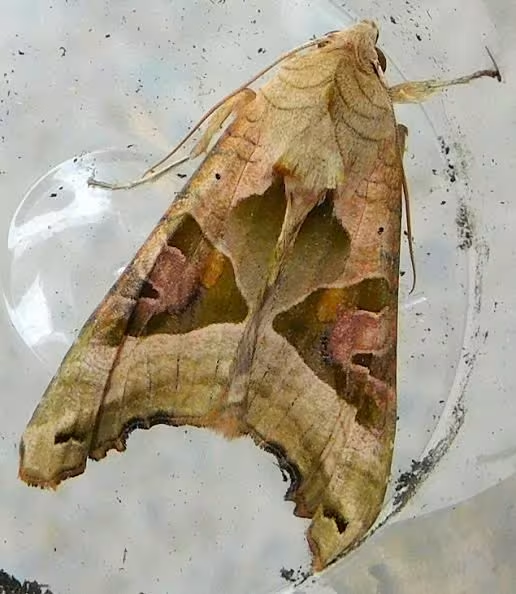
A dark V-shaped or arrowhead-like median patch is one of the strongest clues for angle shades moths. The mark may look like two opposing triangles, a wide chevron, or a sharply angled band across the folded forewings. The surrounding wings often contain pinkish, olive, tan, or warm brown shades.
A pale triangle entering from the wing edge
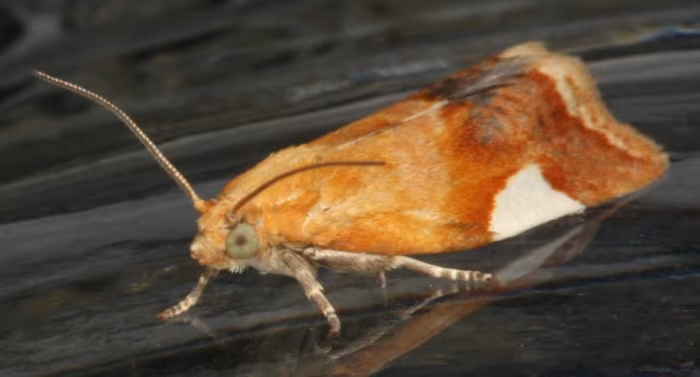
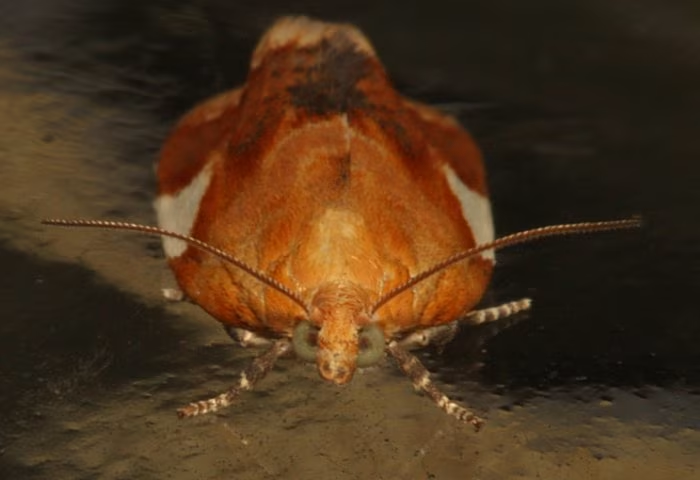
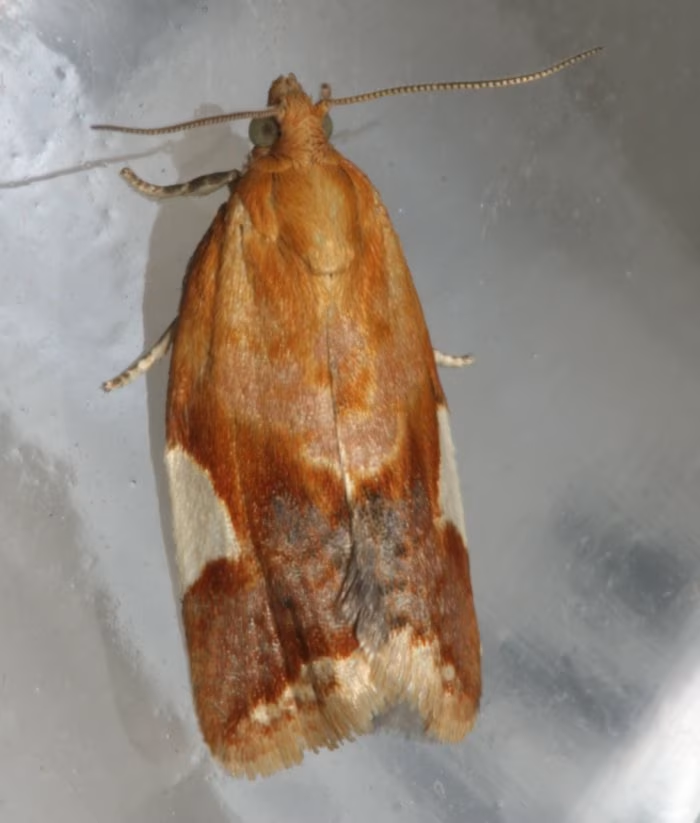
Some small tortrix moths have a pale triangular patch that begins along the leading edge of the forewing and points inward. The white triangle tortrix, Clepsis persicana, is a North American example. BugGuide describes a white outward-curving triangular patch near the center of the forewing’s front edge, with brown and light orange areas around it.[5]
Three spots that form an imaginary triangle
Many owlet and cutworm moths have standard forewing marks rather than a literal triangle. A round spot, kidney-shaped mark, and smaller dash can appear as three dark points. Lighting, wing angle, and scale wear may make those separate marks look like one geometric pattern. This is common enough that a triangle made from dots should be treated as a pattern description, not a species diagnosis.
A broad triangle made by the whole moth
Moths often hold their wings roof-like or swept back, producing a triangular silhouette when viewed from above. The Missouri Department of Conservation notes that moths commonly look triangular because of their resting wing position, and that many species require detailed examination for species-level identification.[6]
Most Likely Brown Moths With Triangle or V-Shaped Markings
Angle Shades
The angle shades, Phlogophora meticulosa, is a strong candidate in Britain and Ireland when the moth is medium-sized, leaf-like, and marked with bold angular patches. Butterfly Conservation describes it as a distinctive moth with pinkish-brown markings and folded wings that resemble a withered autumn leaf. Its recorded wingspan is about 42–50 millimeters.[1]
The species is especially convincing when the “triangle” is a broad central V rather than a small isolated spot. Its crumpled resting shape and angular pattern disrupt the normal moth outline, helping it blend with dry leaves and bark.[2]
Brown Angle Shades
In North America, the brown angle shades moth, Phlogophora periculosa, is a related possibility. Pacific Northwest Moths, a resource from Western Washington University, describes a moderately large brown noctuid with a darker V-shaped median area, long triangular forewings, and strongly scalloped outer margins. The forewing length is reported as approximately 19–22 millimeters.[3]
This candidate is more plausible in moist forest regions and for a moth that comes to light during summer. Its colors can include brown, warm pink, olive, or greenish tones, so a photograph taken under artificial light may not show the same colors as a museum specimen.
White Triangle Tortrix
The white triangle tortrix, Clepsis persicana, is much smaller than either angle shades species. Its forewing is only about 8.5–11 millimeters long. The important clue is a clean white or cream triangular patch entering from the costa, the front edge of the forewing, against a brown or orange-brown background.[5]
This is a better match when the moth is fingernail-sized or smaller, has a smooth compact appearance, and holds its wings tightly over the body. A phone photograph may make the pale triangle appear larger or brighter than it is.
Owlet and Cutworm Moths
Owlet moths in the family Noctuidae often have complex brown forewings containing rounded, kidney-shaped, dagger-like, or wedge-shaped marks. Three marks can visually form a triangle even when no single triangular patch exists. The green cutworm moth, Anicla infecta, is one North American species that appears in verified regional records and photo databases, but the apparent triangle of spots is not enough by itself to confirm it.[4]
For an owlet moth, look beyond the triangle. Check whether the body is relatively thick, the forewings are long and narrow, the hindwings are mostly hidden, and the central marks include a round spot and a kidney-shaped mark. Closely related species can require specialist examination.
Geometer, Pyralid, and Other Broad-Winged Moths
A brown geometer may look triangular because it rests with broad wings spread flat. Its most useful markings are usually continuous wavy lines crossing both forewings and hindwings, not a single triangle. Pyralid and crambid moths can also appear as wide triangles at rest, while some hold their wings narrow or rolled around the abdomen.
When the “triangle” disappears as soon as the moth changes posture, you are probably describing the resting silhouette rather than a diagnostic wing mark.
Brown Moth With Triangle Markings: Visual Comparison
| Possible identification | Approximate size | Triangle clue | Resting shape | Context that helps |
|---|---|---|---|---|
| Angle shades Phlogophora meticulosa | Medium; about 42–50 mm wingspan | Large central V, chevron, or opposing angular patches | Folded and crumpled like a dry leaf | Britain or Ireland; gardens, hedgerows, woodland, walls, vegetation |
| Brown angle shades Phlogophora periculosa | Moderately large; forewing about 19–22 mm | Dark V-shaped median area | Long triangular forewings with scalloped edges | North American moist forests; summer; attracted to light |
| White triangle tortrix Clepsis persicana | Very small; forewing about 8.5–11 mm | White triangular wedge entering from the leading wing edge | Compact, smooth, roof-like forewings | North America; porch light, vegetation, or outdoor wall |
| Owlet or cutworm moth | Small to medium, depending on species | Three separate dots or standard forewing spots appear triangular | Forewings folded over a thicker body | Garden, grassland, field edge, porch light, or window |
| Geometer or pyralid moth | Highly variable | The entire moth is triangular; markings are often lines or bands | Flat and broad, tent-like, or swept back | Compare the lines across both wings and record the natural resting posture |
| Indianmeal moth | Small; about 13–16 mm wingspan | Usually two-toned rather than truly triangle-marked | Narrow wings folded over the body | Repeated sightings near dry food, plus larvae or webbing |
The table is a shortlist, not a species key. Region is decisive: a convincing European match may be impossible for a moth photographed in western North America, and the reverse is also true.
How to Narrow a Brown Moth With Triangle Markings Identification
Record size before searching photographs
Measure the body length or photograph the moth beside a ruler or familiar object without touching it. “Small” can mean 5 millimeters to one observer and 30 millimeters to another. Size quickly separates a tiny tortrix from an angle shades moth.
Describe where the triangle begins and ends
Write a precise description:
- One dark V across the center
- A white wedge entering from the front wing edge
- Three black dots forming a triangle
- Two opposing triangles meeting near the body
- A triangular dark area at the wing tip
- No true mark; the entire folded moth is triangular
A close-up photograph should show whether the mark crosses a wing vein, reaches the edge, repeats symmetrically, or is made from several separate elements.
Compare wing shape and outer edges
Angle shades moths have an angular, leaf-like profile. A tortrix usually looks compact and neatly folded. Many geometers have thin bodies and broad wings held open. Noctuid moths often have heavier bodies with the forewings covering the hindwings.
Also check the outer margin. A strongly scalloped edge supports a different shortlist from a smooth narrow wing. The site’s beginner moth identification guide explains how wing position, body shape, and antennae work together.
Check the antennae and body
Threadlike antennae occur in many moth groups and usually do not identify a species alone. Strongly feathered antennae may indicate a male in certain families. Note whether the thorax is smooth, hairy, or crested and whether the abdomen is thick, slender, raised, or completely hidden.
Record country, region, date, and habitat
A useful record includes the nearest city or county, the date, and the setting. A moth found in a damp forest in July suggests a different group from one found in a dry pantry in January. Compare only with species documented in the same region and active during the relevant season.
Photograph the moth in its natural resting posture
Take one photograph directly from above and another from the side. Do not force the wings open. The resting position may be one of the most useful clues, and handling can remove scales or change the posture that made the moth recognizable.
Brown color is useful only as an initial filter. The site’s moth identification by color guide explains why lighting, wear, and individual variation can change the apparent shade.
What If the Brown Triangular Moth Is Inside the House?
One patterned brown moth near a window, ceiling light, garage door, or porch entrance is often an outdoor visitor. Its presence does not prove that anything is feeding on food, clothing, wood, or the building. Large or strongly patterned moths are especially likely to have entered accidentally after being attracted or disoriented by light.
A pantry inspection becomes more relevant when the moth is small, sightings repeat in the kitchen, and you also find larvae, silk webbing, clumped food, or cocoons around dry stored products. University of Minnesota Extension describes the Indianmeal moth as having pale gray or tan wing bases with reddish-brown, coppery outer portions. Its larvae, not the adults, feed in stored foods.[7]
The Indianmeal moth may look triangular because of its folded posture, but it normally has a two-tone division rather than a bold central triangle. Check cereal, flour, grains, nuts, dried fruit, pet food, birdseed, and spices only when the location and additional evidence support that possibility.
Repeated tiny moths in a dark closet require a different inspection for natural-fiber materials. A single brown moth beside a lamp does not justify pesticide use or an infestation claim. See the full guide to moths around the home for a calm food-versus-fabric-versus-outdoor comparison.
Common Lookalikes and Identification Mistakes
Confusing a V-shaped band with a solid triangle
Two diagonal bands can meet near the center and appear solid in a blurred image. Zoom in before describing the mark. A V, wedge, diamond, and triangle may lead to different search results.
Using the overall triangular shape as if it were a wing marking
Many moths become triangular when the wings are folded. Record both observations separately: “triangular resting shape” and “dark V-shaped mark in the middle.”
Ignoring scale wear
Wing scales rub away with age and contact. A worn moth may lose the border around a spot or the pale half of a pattern, making a rounded mark look angular. Missing fringe can also change the apparent wing shape.
Matching the first similar online photograph
Online image results commonly mix continents, sexes, worn individuals, museum specimens, and misidentified photographs. Confirm that a candidate occurs in the same region and compare several independent features.
Assuming every brown moth indoors is a pantry or clothes moth
Household pest identification depends on location and larval evidence. An outdoor moth can enter any room. Food webbing, larvae, textile cases, or repeated adults in one specific area are more meaningful than brown color.
Treating an AI-generated image as proof
Generated images can illustrate a general concept but may alter diagnostic wing lines, spot placement, antennae, or proportions. Use verified real photographs, regional records, and specialist resources when attempting a species-level identification.
When a Photograph Is Not Enough
A clear photograph may support a family, genus, or likely species identification, but some brown moths are difficult even for experienced observers. Exact identification may depend on tiny scale patterns, wing venation, sex, or microscopic anatomy. A realistic result may be “likely an angle shades moth,” “a tortrix moth,” or “an owlet moth in this species group.”
Seek help from a regional museum, university extension service, moth-recording group, or moderated identification platform when:
- The moth may represent a regulated agricultural or invasive species.
- Several local species share the same visible pattern.
- The photograph is clear but regional guides remain inconclusive.
- You need confirmation for a biological record, classroom project, or collection.
- Repeated indoor sightings are accompanied by food or fabric damage.
Provide the original uncropped photographs, location, date, size estimate, habitat, and any nearby plant. Do not add a host-plant claim merely because the moth was resting on a plant; it may have landed there without feeding or laying eggs.
Questions Readers Often Ask
Is a brown moth with a triangle on its wings dangerous?
The triangle itself does not indicate danger. Adult moths are generally observed rather than handled, and a brown wing pattern does not predict biting, stinging, toxicity, or household damage. Avoid touching unidentified fuzzy or spiny caterpillars, which are a different life stage.
What is the most likely large brown moth with a V-shaped marking?
Angle shades moths are strong candidates when the moth is medium to moderately large, leaf-like, and marked by a broad central V. The exact species depends on geography: Phlogophora meticulosa is familiar in Britain and Ireland, while Phlogophora periculosa is a North American possibility.
What is the small brown moth with a white triangle?
In North America, compare a very small moth with a distinct white wedge against the white triangle tortrix, Clepsis persicana. Confirm the wing-edge placement, size, region, and surrounding brown-orange pattern rather than relying on the white shape alone.
Does one triangular brown moth in the kitchen mean pantry moths?
No. One moth may be an outdoor visitor. Pantry moth activity is more credible when small adults repeatedly appear near stored food and larvae, webbing, clumped product, or cocoons are present.
What photographs are best for identification?
Take an overhead image showing both forewings, a side view showing posture and body shape, and a scale photograph beside a ruler or coin. Record the date and location. Natural or neutral light usually preserves brown and olive tones better than a warm indoor bulb.
What Your Observation Can Tell You
A brown moth with triangle markings is best identified by translating a vague impression into several precise clues. Decide whether the triangle is solid, V-shaped, pale, dark, or made from separate spots. Measure the moth, record the region and date, and photograph its normal posture. Those details can separate a leaf-like angle shades moth from a tiny tortrix, an owlet moth, a broad-winged geometer, or an indoor stored-food moth.
The exact species may remain uncertain, and that is a responsible outcome when the photograph or location is incomplete. Continue through the site’s moth identification guides using shape, wing pattern, habitat, and region together rather than forcing a name from one brown marking.
References and Further Reading
- Angle Shades. Butterfly Conservation. https://butterfly-conservation.org/moths/angle-shades
- Moth Camouflage. Butterfly Conservation. https://butterfly-conservation.org/moths/why-moths-matter/what-are-moths/moth-camouflage
- Phlogophora periculosa: Brown Angle Shades Moth. Pacific Northwest Moths, Western Washington University. https://pnwmoths.biol.wwu.edu/browse/family-noctuidae/subfamily-noctuinae/tribe-phlogophorini/phlogophora/phlogophora-periculosa/
- Green Cutworm Moth, Anicla infecta. Butterflies and Moths of North America. https://www.butterfliesandmoths.org/species/Anicla-infecta
- White Triangle Tortrix, Clepsis persicana. BugGuide, Iowa State University Department of Entomology. https://bugguide.net/node/view/25189
- Moths. Missouri Department of Conservation. https://mdc.mo.gov/discover-nature/field-guide/moths
- Pantry Pests: Insects Found in Stored Food. University of Minnesota Extension. https://extension.umn.edu/product-and-houseplant-pests/pantry-pests-insects-found-stored-food