The primary intent is informational, comparison-based, and identification-based. Most readers want a quick answer to a simple-looking question: whether an unfamiliar caterpillar will become a moth or a butterfly.
The difficulty is that caterpillars do not have an equivalent of the familiar adult antenna clue. Body hair, color, size, horns, spines, and daytime activity overlap extensively between moth and butterfly larvae. The most useful page therefore needs to explain both the limits of broad moth-versus-butterfly rules and the practical evidence that can narrow an identification: host plant, body structure, markings, behavior, location, season, geographic range, and photographs.
There is also a smaller household-problem intent. Someone finding a pale caterpillar in a pantry, closet, on a ceiling, or crawling across an indoor wall may actually be dealing with a stored-food or fabric-feeding moth rather than an outdoor butterfly larva. University and museum resources show that location and associated material are especially important in these cases.
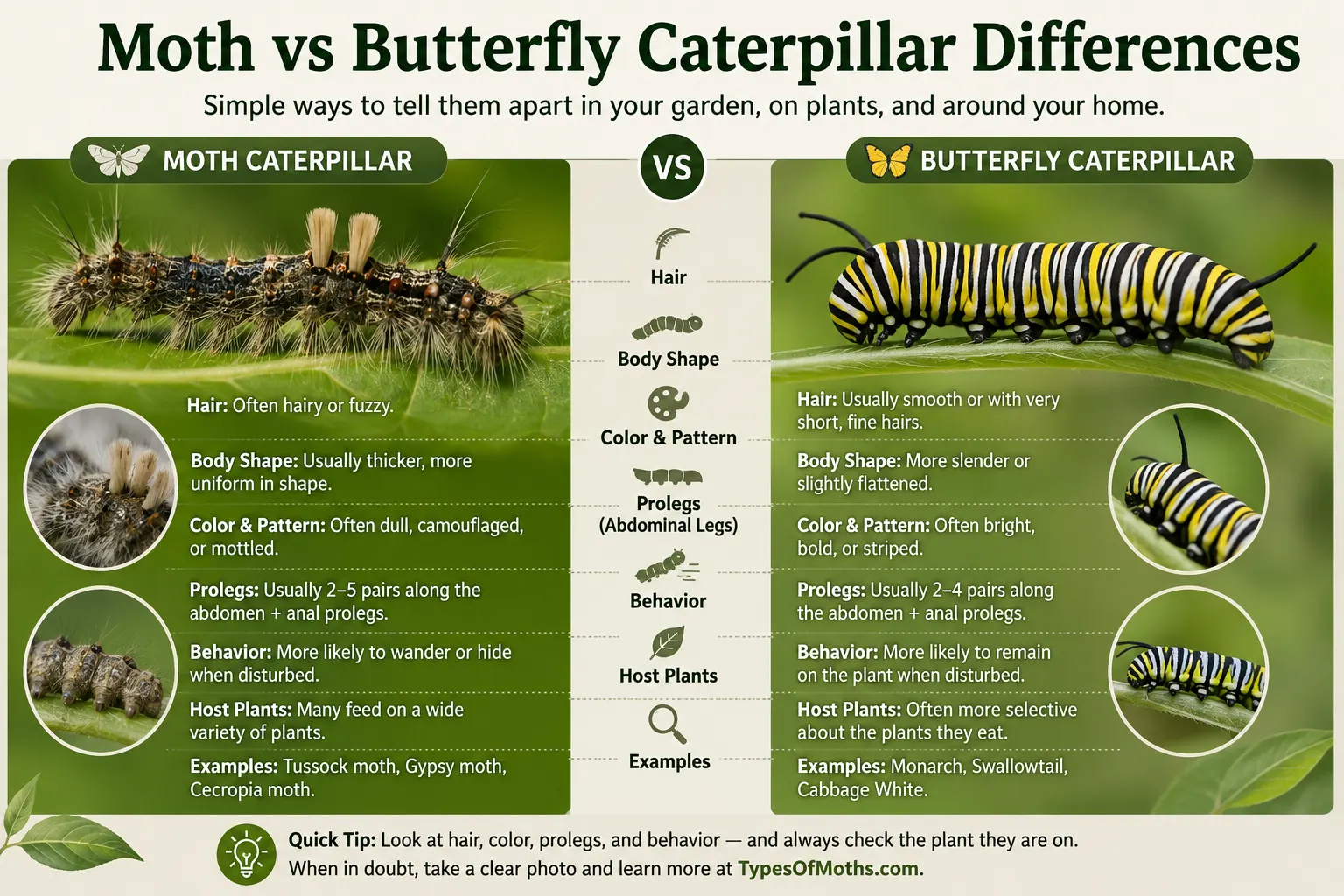
Moth vs Butterfly Caterpillar Differences: What Actually Helps with Identification
A caterpillar’s appearance alone often cannot tell you whether it will become a moth or a butterfly. The most important moth vs butterfly caterpillar differences are usually not simple rules such as “hairy means moth” or “smooth means butterfly.” Both groups belong to Lepidoptera, and their larvae overlap greatly in color, shape, hairs, spines, and behavior. For a useful identification, look at the host plant, body structure, markings, feeding style, location, season, geographic range, and clear photographs together.
Some caterpillars do have features that strongly point toward a particular moth or butterfly family. A large caterpillar with a rear “horn,” for example, may be a sphinx or hawk moth larva. A caterpillar that produces a forked, orange-red organ from behind its head when disturbed points toward the swallowtail butterflies. These are family-level clues, however—not universal rules for every moth or butterfly caterpillar.
Table of Contents
- Moths and butterflies are closer than they look
- Why caterpillars are difficult to divide into two groups
- First confirm that it really is a caterpillar
- Which moth vs butterfly caterpillar differences are useful?
- Hairy and fuzzy caterpillars
- Smooth green caterpillars
- Horns, spines, eyespots, and unusual shapes
- Movement and feeding behavior
- Why the host plant is one of your best clues
- Caterpillars found around homes
- What the pupa can tell you
- Practical caterpillar identification tips
- Moth vs butterfly caterpillar comparison table
- Common mistakes and misconceptions
- When to seek expert help
- Frequently asked questions
Moths and Butterflies Are Closer Than They Look
Moths and butterflies are both members of the insect order Lepidoptera. Their life cycle includes egg, larva, pupa, and adult stages. The larva is the caterpillar—the stage primarily responsible for feeding and growth.
Adults often provide familiar clues. Most butterflies have slender antennae ending in a club, while moth antennae are more variable and commonly lack that clubbed tip. Even this familiar adult distinction has exceptions, but it is usually more useful than anything available on a random caterpillar.
The situation becomes much harder during the larval stage. Caterpillars are built for feeding, growing, avoiding predators, and surviving long enough to pupate. Different lineages have independently developed camouflage, bright warning colors, hairs, spines, false eyes, horns, silk shelters, leaf-mining habits, and many other adaptations.
That diversity is why an unfamiliar green caterpillar on a tomato plant and a green caterpillar on a tree may look superficially similar while belonging to very different families.
It also explains why the question “Is this a moth caterpillar or a butterfly caterpillar?” is often less useful than:
“Which caterpillar family or species fits this appearance, host plant, place, and season?”
Why Caterpillars Are Difficult to Divide Into Moths and Butterflies
There is no dependable field rule saying that one body type belongs to moths and another belongs to butterflies.
University of Minnesota Extension specifically notes that butterfly and moth caterpillars may be smooth, hairy, or spiny. Missouri Extension’s caterpillar guide likewise shows enormous variation within Lepidoptera, from smooth swallowtails to hairy moth larvae, horned moth caterpillars, spiny species, and larvae that resemble leaves or other objects.
This overlap immediately eliminates several popular shortcuts.
A hairy caterpillar is not automatically a moth because butterflies can also have textured or spiny larvae.
A smooth caterpillar is not automatically a butterfly because many moth caterpillars are smooth.
Green does not indicate either group.
Large caterpillars occur among both moths and butterflies.
Bright colors do not prove that the adult will be a butterfly.
Daytime activity does not make a caterpillar a butterfly larva.
Instead, identification works best by collecting several independent clues.
First, Confirm That It Really Is a Caterpillar
Not every worm-shaped larva eating leaves is a butterfly or moth caterpillar.
One of the most common sources of confusion is the sawfly larva. Sawflies are relatives of bees and wasps, but their larvae may look remarkably like caterpillars.
A useful feature is the number of prolegs. Prolegs are the fleshy, unjointed structures along the abdomen that help a caterpillar grip leaves and stems.
University of Minnesota Extension gives a practical distinction:
- Sawfly larvae generally have six or more pairs of abdominal prolegs.
- Butterfly and moth caterpillars generally have two to five pairs.
- Butterfly and moth larvae may be smooth, hairy, or spiny, so texture is not a dependable way to separate them from one another.
The small jointed legs close to the head are the caterpillar’s true thoracic legs. When counting for sawfly identification, look farther back along the abdomen at the fleshy prolegs.
Do not worry if counting them from a photograph is difficult. A side-view close-up often makes them much easier to see.
Which Moth vs Butterfly Caterpillar Differences Are Actually Useful?
The most useful clues usually point toward families or smaller groups, rather than “moths” or “butterflies” as two neat categories.
A rear horn often points toward a sphinx moth
The familiar tomato hornworm is a good example.
Tomato hornworms have a conspicuous projection near the rear of the abdomen. They are larvae of sphinx moths, also called hawk moths. University of Minnesota Extension describes the tomato hornworm as a large green caterpillar with white V-shaped side markings and a black rear horn.
Other sphinx moth caterpillars may differ dramatically in colors and markings, so the presence of a horn should be treated as a clue toward the family rather than an exact species identification.
If you find a large horned caterpillar on tomato, pepper, eggplant, or a related plant, record the plant before removing or relocating the insect. Host information can be crucial for telling similar hornworm species apart.
Looping “inchworm” movement usually points toward moths
Many geometrid moth larvae have fewer functional abdominal prolegs than typical caterpillars. Their reduced middle support causes the body to arch upward as they move, creating the familiar looping or “measuring” motion associated with inchworms.
Utah State University describes cankerworms as inchworms that move by arching the middle of the body and bringing their rear prolegs toward their front legs before stretching forward again.
A classic inchworm is therefore much more likely to lead you toward a moth family than toward a butterfly.
A forked organ behind the head points toward swallowtail butterflies
Swallowtail caterpillars have one of the more useful butterfly-family clues.
When disturbed, they can extend an osmeterium, a fleshy forked organ located behind the head. Depending on the species it may be yellow, orange, or reddish and can resemble a tiny forked tongue.
University of Wisconsin–Madison Extension notes that all swallowtail larvae possess this structure.
Do not deliberately disturb a caterpillar simply to make it display defensive behavior. If you happen to observe an osmeterium, however, record it as a strong identification clue.
False eyes do not automatically mean moth or butterfly
Some caterpillars have large markings that resemble vertebrate eyes. They may even enlarge the front of their body when threatened.
This strategy occurs in different Lepidoptera groups. Some swallowtail butterfly caterpillars resemble snakes, while various moth caterpillars also have dramatic eyespots or unusual body projections. The Natural History Museum documents comparable defensive mimicry among moths and butterflies.
“Looks like a snake” is therefore an interesting observation, not a moth-versus-butterfly test.
Are Hairy or Fuzzy Caterpillars Usually Moths?
Many of the best-known fuzzy caterpillars are moth larvae. Woolly bears, tussock moth caterpillars, and various tiger moth larvae are familiar examples.
That has helped create the popular rule:
fuzzy caterpillar = moth
It is not a dependable general identification rule.
Moth larvae themselves range from heavily hairy to almost completely smooth. Missouri Extension describes individual moth families in which caterpillar body texture varies considerably, and University of Minnesota Extension explicitly notes that both butterfly and moth caterpillars can be smooth, hairy, or spiny.
Hair can still be useful when identifying a particular family or species. Record:
- whether hairs are long or short
- whether they form dense tufts
- whether they appear in evenly spaced clusters
- whether there are contrasting “pencils” of long hairs
- body color underneath the hairs
- colors of individual hair tufts
- presence of knobs, bumps, or spines beneath them
Avoid handling an unknown hairy or spiny caterpillar with bare skin. Some species have defensive hairs or spines capable of causing irritation. Penn State Extension, for example, notes that hairs of the hickory tussock moth caterpillar may irritate sensitive individuals.
A photograph is safer—and usually more useful for identification—than picking the caterpillar up.
What About Smooth Green Caterpillars?
“Green caterpillar” may be one of the least specific descriptions possible.
Both moth and butterfly larvae frequently use green coloration as camouflage among leaves. Their appearance can also change substantially as they grow through successive larval stages, known as instars.
A black swallowtail caterpillar illustrates this problem well. Young larvae are dark and spiny with a pale patch, while older larvae become predominantly green with black bands and yellow-orange spots. The same species can therefore look like two very different caterpillars depending on age.
When identifying a green caterpillar, look beyond color:
- Does it have longitudinal or crosswise stripes?
- Is there a tail horn?
- Are there false eyes?
- Is the head distinctly larger than the body?
- Are there dots or raised bumps on each segment?
- How many prolegs are visible?
- What plant is it actually eating?
The plant may narrow the possibilities much faster than the color.
Host Plants May Be Your Best Identification Clue
For many caterpillars, what they are eating is one of the most valuable pieces of evidence you can record.
Caterpillars are often associated with particular host plants or groups of plants. Butterfly Conservation notes that while some moth caterpillars can feed on a wide variety of plants, many are restricted to only a few kinds of plants, and some have even narrower requirements.
Butterflies show the same principle. Smithsonian educational material uses monarchs and milkweeds as a familiar example of caterpillars depending on specific host plants.
The key word is feeding.
A caterpillar crawling across a maple trunk is not necessarily a maple feeder. Mature caterpillars frequently wander away from their feeding sites when looking for places to pupate.
Whenever possible, record whether you actually saw the caterpillar eating the plant.
A garden example
Imagine finding a striped green caterpillar.
If it is actively eating parsley or dill and has black crossbands with yellow spots, a swallowtail butterfly becomes a reasonable possibility. Black swallowtail larvae commonly use plants in the carrot family, including parsley, dill, fennel, celery, and carrot.
Now imagine finding another large green caterpillar chewing tomato leaves with a prominent horn near the rear. That evidence points instead toward a hornworm and therefore a sphinx moth.
Both caterpillars are green. Their host plants and structural details tell a much more useful story.
Look at Feeding Style and Shelter
A caterpillar’s “home” on a plant can provide another clue.
Some caterpillars feed openly on leaf surfaces. Others hide inside rolled leaves, tie leaves together with silk, live inside stems, feed beneath bark, mine between the layers of leaves, or construct portable cases.
These behaviors can be associated with particular moth or butterfly families, but they should not be used alone.
A tiny larva tunneling inside a leaf, for example, may belong to one of several insect groups. You need the host plant and the shape of the mine before making a useful identification.
Similarly, silk does not automatically mean moth. Caterpillars in both groups can use silk during the larval stage.
Treat feeding architecture as another piece of evidence rather than a verdict.
Does Day or Night Activity Tell You Anything?
Adult butterflies are commonly active during the day, while many moths are associated with nighttime activity. Adult behavior is one reason people expect the same rule to work for caterpillars.
It does not.
Caterpillar behavior is driven by feeding, temperature, predator avoidance, development, and the biology of the individual species. A moth larva may feed openly in daylight, while a butterfly caterpillar may spend long periods motionless or concealed.
Even among adult Lepidoptera, the day-versus-night distinction has exceptions. Smithsonian material describes moths as primarily nocturnal but also emphasizes the close evolutionary relationship between the groups.
A caterpillar photographed at noon is therefore not automatically destined to become a butterfly.
Caterpillars Found Around Porch Lights, Windows, and Walls
Location is useful, but it needs interpretation.
An adult moth circling a porch light may have been attracted to the light. A caterpillar crawling on the wall beneath that light is a different situation. It may simply have left nearby vegetation while searching for a protected place to pupate.
Record nearby plants before assuming the caterpillar came from the light fixture or house itself.
Likewise, a caterpillar on an exterior wall may be a completely harmless outdoor species. Finding one individual outside does not mean a building has a moth infestation.
Indoor caterpillars require a different approach.
Caterpillars in Pantries and Kitchens
A small pale caterpillar crawling across a kitchen wall or ceiling can be connected to stored food.
University of Minnesota Extension notes that Indianmeal moth larvae feed in dried stored foods and, when mature, often leave the food and travel before spinning a cocoon. Caterpillars and cocoons may consequently appear on walls and ceilings some distance from the infested package.
Look for:
- silk webbing in flour, cereal, grains, nuts, birdseed, pet food, or dried foods
- larvae inside food packages
- small moths flying around the kitchen
- larvae wandering on nearby walls or ceilings
In this context, finding the food source matters much more than comparing the larva with an outdoor butterfly caterpillar.
Read Moths Around the Home and the detailed Moths Around the Home identification guide if the insect appears connected with stored food or another indoor material.
Caterpillars in Closets, Carpets, or Natural Fabrics
Larvae associated with wool, animal-derived fibers, upholstery, or carpets deserve a different identification pathway.
The Natural History Museum describes common clothes moth and case-bearing clothes moth larvae as small pale larvae associated with natural fibers. Case-bearing clothes moth larvae construct a portable case from silk and surrounding material.
Do not assume every tiny larva in a closet is a clothes moth. Carpet beetle larvae and other household insects may occur in similar locations.
Instead, record:
- exact material where larvae were found
- whether there is webbing
- whether a portable case is present
- type of fabric affected
- damaged area
- adult insects nearby
This is a household-insect identification problem rather than a general outdoor moth-versus-butterfly question.
Can the Pupa Tell You Whether It Is a Moth or Butterfly?
Sometimes—but not always.
A common beginner rule says butterflies make chrysalises while moths make cocoons. There is some practical value in that distinction, but it should not be treated as absolute.
A pupa is the developmental stage between caterpillar and adult.
A cocoon is a protective silk structure surrounding the pupa.
A butterfly pupa is commonly called a chrysalis.
Many moth caterpillars pupate inside silk cocoons, while many butterflies produce exposed chrysalises. However, pupation behavior varies among Lepidoptera. Some moths pupate in soil or in situations where no obvious heavy cocoon is visible. Illinois Extension therefore describes the cocoon/chrysalis distinction as a general pattern rather than an exception-free rule.
If you find the same caterpillar immediately before pupation, the eventual pupal structure can provide additional evidence. It is usually more informative than caterpillar fuzziness or color alone.
For the full developmental sequence, see Moth Life Cycle and Moth Life Cycle Stages.
Practical Identification Tips for an Unknown Caterpillar
A good caterpillar identification begins with observation, not guessing whether the adult will be a moth or butterfly.
Photograph the whole caterpillar
Take a clear side view showing:
- head
- entire body
- legs and prolegs
- stripes and spots
- hairs, spines, or horns
- rear end
Then photograph it from above if possible.
Include something for scale
Size can eliminate many possibilities.
A ruler beside the caterpillar is ideal. If that is not practical, photograph it next to a familiar object without touching or disturbing it.
Do not estimate size from memory if you can avoid it.
Photograph the plant
Take one photograph of the caterpillar on the plant and another showing enough leaves, stems, flowers, fruit, or bark to help identify the plant.
If you know the plant species, record it.
Most importantly, note whether you actually saw the caterpillar feeding.
Record the location
Country and state, province, county, prefecture, or region can dramatically narrow the possibilities.
A caterpillar species common in Florida may be impossible in northern Europe. Even within the same country, ranges can be regional.
Record the date
Caterpillars are seasonal.
Knowing whether an observation was made in April, July, or October may help separate species with otherwise similar larvae.
Record habitat
Useful habitat notes include:
- vegetable garden
- meadow
- woodland
- wetland
- suburban yard
- forest edge
- orchard
- lawn
- indoor pantry
- closet
- exterior wall
Describe behavior
Did it:
- loop like an inchworm?
- build a silk shelter?
- feed in a group?
- remain exposed on top of a leaf?
- hide underneath leaves?
- curl when disturbed?
- extend a forked organ?
- wander away from vegetation?
Behavior alone rarely confirms a species, but combined observations are powerful.
Compare multiple photographs
Do not identify a caterpillar from one similar-looking image found through a search engine.
Compare:
- body markings
- host plant
- geographic range
- season
- size
- family-level features
The How to Identify a Moth approach is also useful once the adult is known, while Moth Species with Pictures can help readers compare likely moth groups.
Moth vs Butterfly Caterpillar Comparison Table
| Feature | Moth Caterpillars | Butterfly Caterpillars | How Useful Is It? |
|---|---|---|---|
| Hair or fuzz | Many are hairy, many are smooth | Can also be smooth, spiny, or textured | Poor general clue |
| Green coloration | Very common | Very common | Poor clue |
| Bright colors | Occur in many groups | Occur in many groups | Poor clue |
| Large body size | Some are very large | Some are large | Poor clue |
| Rear horn | Characteristic of many sphinx/hawk moth larvae | Not a general butterfly feature | Strong family clue |
| Inchworm-style looping | Common in geometrid moth larvae | Not typical of butterflies | Useful family clue |
| Forked osmeterium behind head | Not a general moth feature | Characteristic of swallowtail larvae | Strong family clue |
| Hairy body | Common in some moth families | Does not rule out butterflies | Weak alone |
| Host plant | Often highly informative | Often highly informative | Very useful |
| Geographic range | Essential for species identification | Essential for species identification | Very useful |
| Season | Often narrows possibilities | Often narrows possibilities | Useful |
| Cocoon | Common among many moth groups | Less typical | Helpful but not absolute |
| Chrysalis/exposed butterfly-type pupa | Some moth exceptions exist | Common among butterflies | Helpful but not absolute |
| Found in stored food | Some moth larvae are pantry pests | Not normal butterfly habitat | Strong contextual clue |
| Found feeding on natural fabric | Clothes moths are possible | Not typical butterfly biology | Strong contextual clue |
The strongest lesson from the table is that broad appearance traits are weaker than specific structures plus ecological context.
Common Mistakes and Misconceptions
“All fuzzy caterpillars become moths”
Many familiar fuzzy caterpillars do become moths, but fuzziness is not a safe universal rule.
Use the arrangement of hairs together with host plant, markings, range, and season instead.
“Butterfly caterpillars are always smooth”
Swallowtails and some other familiar butterflies may have relatively smooth mature larvae, but butterfly caterpillars as a whole show much more variation than this rule suggests.
Even a single butterfly species can change dramatically between early and late instars. Black swallowtails, for example, change from dark, spiny early larvae into very different-looking older caterpillars.
“Bright caterpillars become colorful butterflies”
Larval color does not predict whether the adult is a moth or butterfly.
Moths can be brightly colored. Butterfly larvae can be cryptic. Adult appearance and caterpillar appearance may differ dramatically because the two life stages have different ecological roles.
“Brown caterpillar means moth”
Brown is common among many caterpillars because it can provide camouflage against bark, soil, stems, or dead vegetation.
Color alone is one of the weakest identification features.
“If it comes out at night, it must be a moth caterpillar”
Night activity is more useful when discussing many adult moths than when identifying larvae.
Caterpillars may feed at different times for many reasons, so record activity without treating it as proof.
“Every silk structure is a moth cocoon”
Caterpillars use silk for many purposes before pupation. Silk may secure a leaf, form a shelter, produce a feeding web, make a retreat, or assist with attachment.
Seeing silk does not automatically mean you are looking at a moth cocoon.
“The plant it is sitting on must be its host”
A caterpillar may wander away from its host before pupating.
“Found on oak” is useful.
“Observed eating oak leaves” is much stronger evidence.
“A caterpillar on the house means an infestation”
Outdoor caterpillars may crawl across walls, foundations, patios, fences, or windows while wandering.
A household infestation becomes more plausible when larvae are repeatedly found in association with food, fabric, webbing, cases, damaged materials, or adult household moths.
When Identification Remains Uncertain
Sometimes a photograph simply does not contain enough information for a species-level identification.
That is normal.
Many caterpillars change appearance between instars, and closely related species can look remarkably similar. A photograph showing only the back of a small green larva may not reveal the structures needed to separate several possibilities.
A responsible identification may therefore be:
Lepidoptera caterpillar
or:
likely moth caterpillar
or:
probable sphinx moth larva
rather than a confident species name.
Species identification becomes more reliable when appearance matches:
- body structure
- markings
- host plant
- geographic range
- season
- size
- behavior
For additional comparison, browse Types of Moths, Moth Identification, and Moth Species.
When to Seek Expert Help
Expert help is useful when the identification matters beyond simple curiosity.
Consider contacting a local university extension service, natural history museum, regional moth or butterfly organization, or experienced insect recorder when:
- a caterpillar appears to be an unusual or potentially invasive species
- many larvae are heavily defoliating a valuable tree or crop
- an identification remains uncertain despite good photographs
- you need a species-level record for a school, conservation, or monitoring project
- an unknown hairy or spiny caterpillar has caused a skin reaction
- larvae repeatedly appear in stored food, fabrics, or other household materials
- you need pest-management advice specific to your region
For household situations, identify the insect and the source before deciding whether any control is necessary. Outdoor caterpillars should not automatically be treated as pests simply because they are unfamiliar.
TypesOfMoths.com provides general educational information rather than medical or professional pest-control advice. Our research approach is explained in How We Research and our Editorial Policy.
Conclusion
The most important thing to know about moth vs butterfly caterpillar differences is that there is no reliable shortcut based on fuzziness, color, size, or daytime activity alone. Moths and butterflies are closely related Lepidoptera, and their caterpillars show enormous overlap in appearance.
Instead, build an identification from several clues: body structure, host plant, feeding behavior, size, markings, location, season, habitat, and clear photographs. Features such as a hornworm’s rear horn or a swallowtail’s osmeterium can sometimes point strongly toward a particular family, while household context may immediately suggest a pantry or clothes moth rather than an outdoor butterfly.
If you are starting with an unknown caterpillar or adult moth, continue with Moth Identification and Moth Species with Pictures. To understand what happens after the caterpillar stage, see Moth Life Cycle Stages.
Frequently Asked Questions About Moth vs Butterfly Caterpillars
What is the main difference between a moth caterpillar and a butterfly caterpillar?
There is no single visible feature that reliably separates every moth caterpillar from every butterfly caterpillar. Both can be green, brown, brightly colored, smooth, hairy, or spiny. Identification is more reliable when appearance is combined with host plant, geographic range, season, behavior, and family-specific structures.
Are all fuzzy caterpillars moths?
No. Many famous fuzzy caterpillars are moth larvae, but hairiness is not a universal moth characteristic. Butterfly and moth caterpillars can both show different body textures, so a fuzzy body should be treated as one clue rather than proof.
How can I tell what a caterpillar will turn into?
Start by identifying the caterpillar itself. Photograph its entire body, markings, head, legs, and any horns or spines. Record its size, date, geographic location, and especially the plant it is eating. Once you narrow the caterpillar to a family or species, you can determine the corresponding adult moth or butterfly.
Does a green caterpillar become a butterfly?
It might become either a moth or a butterfly. Green coloration is widespread because it provides camouflage among foliage. Host plant and structural features are much more useful than green color alone.
Do moth caterpillars always have hair?
No. Some moth larvae are densely hairy, while others are almost completely smooth. Tomato hornworms, for example, are large, relatively smooth sphinx moth caterpillars.
Do moth caterpillars always make cocoons?
Many moth caterpillars spin cocoons, but there are exceptions in how and where moths pupate. Likewise, butterflies commonly form exposed chrysalises. Pupation style can therefore be helpful, but it should be treated as a general pattern rather than an absolute rule.
Why is a caterpillar crawling on my kitchen wall?
If the caterpillar is near a pantry, inspect dried foods. Mature Indianmeal moth larvae often leave infested food and wander to walls or ceilings before pupating. Silk webbing inside dry foods is another useful clue. Not every indoor caterpillar is a pantry pest, however, so look for a direct association with food before reaching a conclusion.
What information is most useful when asking someone to identify a caterpillar?
Provide several clear photographs, approximate size, geographic location, date, habitat, and the name or photograph of the plant on which it was feeding. Mention unusual behavior such as looping, building silk shelters, feeding in groups, or displaying a horn or forked defensive organ. Those details are usually far more useful than saying only that the caterpillar was “green,” “brown,” or “fuzzy.”
References and Further Reading
Butterflies and Beyond — Smithsonian National Museum of Natural History
https://naturalhistory.si.edu/education/teaching-resources/life-science/butterflies-and-beyond
Useful background on Lepidoptera, butterfly and moth life cycles, host plants, and general adult differences.
Life Cycle of Butterflies and Moths — Butterfly Conservation
https://butterfly-conservation.org/discover-and-learn/activities-and-resources/life-cycle-of-butterflies-and-moths
Overview of the egg, caterpillar, pupa, and adult stages of butterflies and moths.
Caterpillar Foodplants — Butterfly Conservation
https://butterfly-conservation.org/moths/why-moths-matter/about-moths/caterpillar-foodplants
Useful reference for understanding the importance of host plants in moth caterpillar ecology and identification.
Caterpillars in Your Yard and Garden — University of Missouri Extension
https://extension.missouri.edu/publications/ipm1019
Extensive guide to caterpillar morphology, host plants, moth and butterfly families, and commonly encountered larvae.
Sawflies — University of Minnesota Extension
https://extension.umn.edu/yard-and-garden-insects/sawflies
Useful comparison of sawfly larvae with butterfly and moth caterpillars, including proleg differences.
Black Swallowtail, Papilio polyxenes — University of Wisconsin–Madison Division of Extension
https://hort.extension.wisc.edu/articles/black-swallowtail-papilio-polyxenes/
Detailed information on black swallowtail larval stages, host plants, osmeterium, and pupation.
Pantry Pests: Insects Found in Stored Food — University of Minnesota Extension
https://extension.umn.edu/product-and-houseplant-pests/pantry-pests-insects-found-stored-food
Identification and household context for Indianmeal moth larvae and other stored-food insects.
Clothes Moths Identification Guide — Natural History Museum, London
https://www.nhm.ac.uk/take-part/identify-nature/common-insect-pest-species-in-homes/clothes-moths-identification-guide.html
Identification information for common and case-bearing clothes moth larvae and adults.