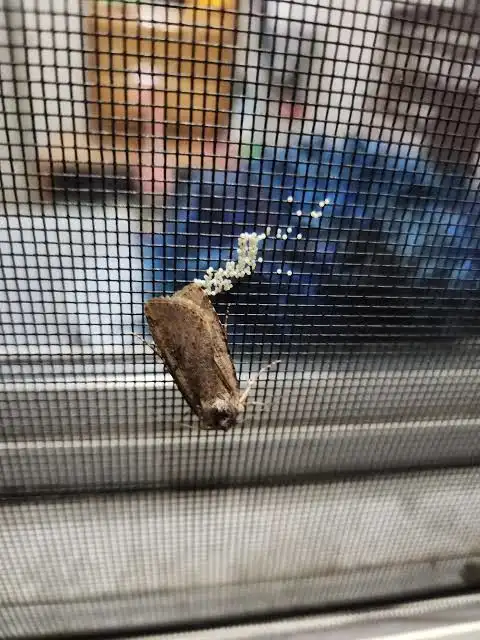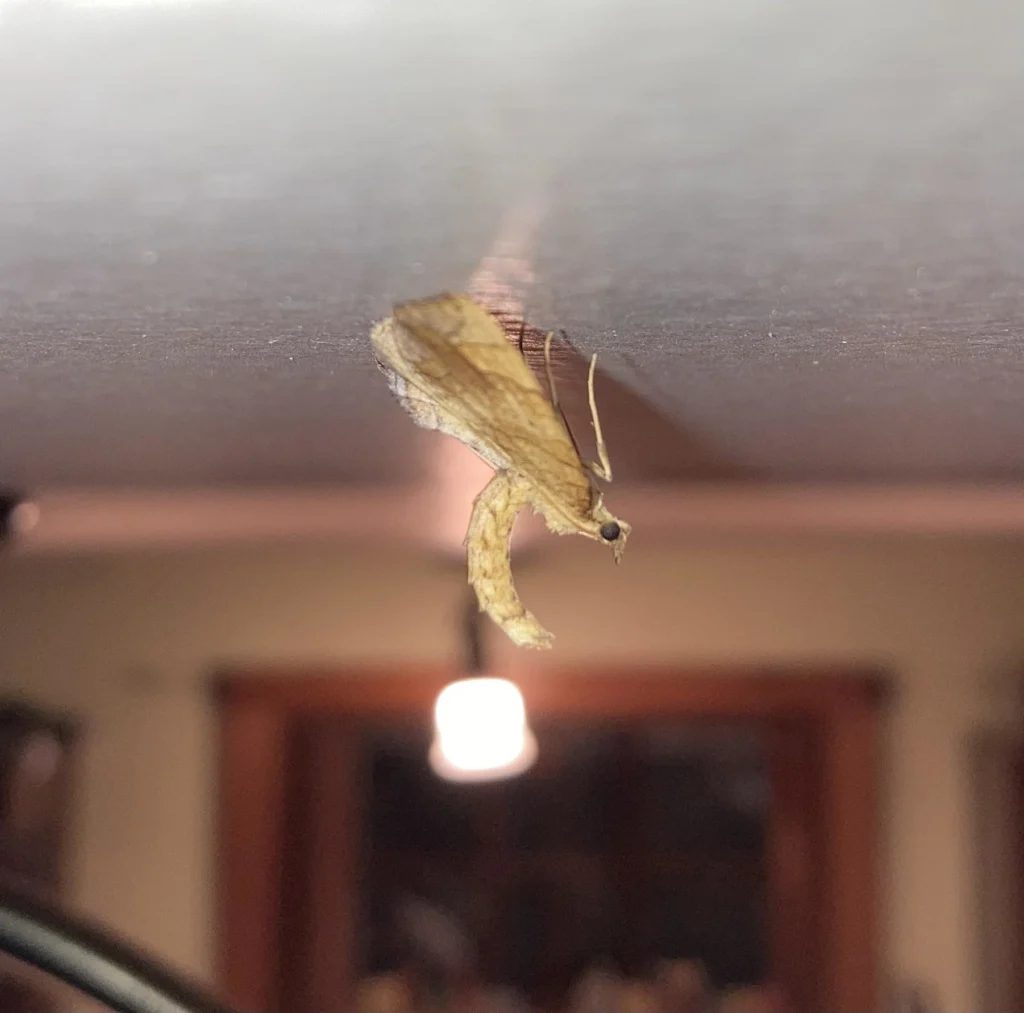
If you keep finding a tiny, fuzzy, moth-like insect on the bathroom wall near the sink, tub, or shower, it is most likely a drain fly, not a moth. Drain flies, also called moth flies, are true flies that breed in the slimy film inside drains, which is why they turn up in the same bathroom again and again. Real moths do land in bathrooms too, but usually one at a time, after flying in toward a light. Size, wings, antennae, the way it flies, and where it rests will usually tell you which one you have.
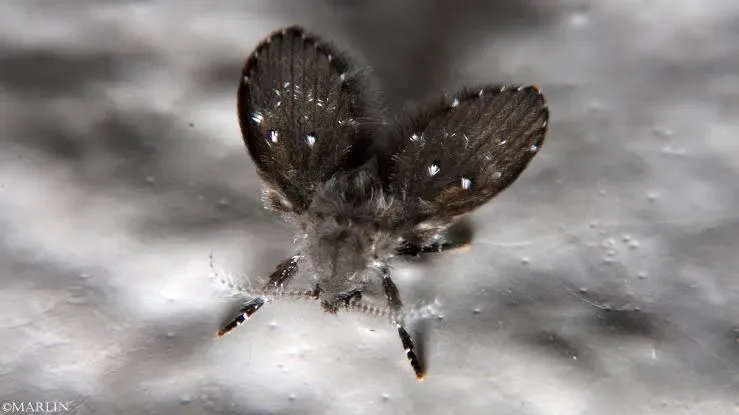
Drain fly or moth: the quick comparison
Use the table for a first guess, then check two or three features together. No single clue settles it on its own.
| Feature | Drain fly (moth fly) | Moth |
|---|---|---|
| What it is | A true fly (order Diptera, family Psychodidae) | A moth (order Lepidoptera) |
| Size | About 1/16 to 1/5 inch (2–5 mm) long | Varies widely; the clothes moths and pantry moths found indoors are about 1/4 to 1/2 inch long |
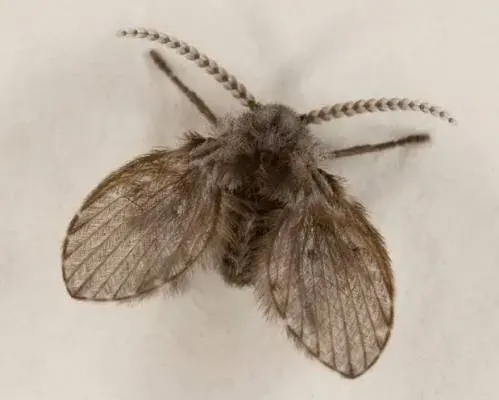
| Body covering | Body and wings densely covered in hairs, so the whole insect looks fuzzy | Body and wings covered in tiny overlapping scales |
| Wings | One pair, broad and fuzzy, looking too big for the body; veins run in parallel lines | Two pairs, front and hind, often with lines, bands, spots, or two-toned color |
| Antennae | Long, made of bead-like segments, each ringed with hairs | Thread-like, spindle-shaped, or feathery |
| Movement | Weak, jerky hops of a few feet, then lands again nearby | Stronger, more sustained flight |
| Where you see it | Walls near drains, sides of tubs and showers, around sinks | Near lights, windows, and ceilings |
| How many | Several at once, day after day | Often a single visitor |
What drain flies are
Drain flies go by several names: moth flies, filter flies, sewer flies, and sewage flies. They belong to the family Psychodidae, part of the true flies. Like other true flies, they have one pair of working wings; the hind pair is reduced to tiny knobs called halteres that help them balance in flight. The moth-like look comes from the dense hairs on the body and wings.
Two kinds that often turn up indoors are worth knowing. Psychoda species are tiny, about 2 mm long, and range from light tan to dark grayish brown. The bathroom moth fly, Clogmia albipunctata, is larger at around 4 mm. It is brown or blackish, with small white spots at the tips of the wing veins along the wing edges and whitish antennae. It once had a mostly tropical and Mediterranean range, but it is now widespread in North America and found in many other parts of the world.
Adults rest by day on shaded walls near plumbing and on the sides of tubs and showers. They become more active in the evening, when they hover around sinks and drains, and they are attracted to lights. They are weak fliers and cover only a few feet at a time.
Where they breed, and how fast
Females lay eggs in masses of dozens on the gelatinous film that builds up inside drains, traps, and overflow pipes. The larvae are legless, gray, and wormlike, up to about 3/8 inch long. They feed on the bacteria and decaying matter in that slime and breathe through a tube at the tail end, which lets them survive in very wet conditions.
Eggs hatch in about two days, larvae mature in roughly 9 to 15 days, and the pupal stage lasts less than two days. The whole cycle takes one to three weeks, and adults then live for about two weeks. Development slows in the cold, but indoors it can continue all year.
How to tell a drain fly from a moth, step by step
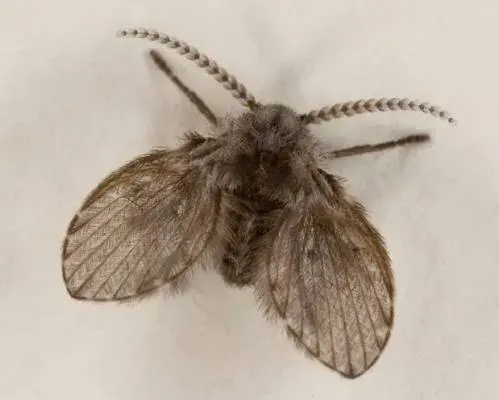
- Note where it sits. A fuzzy insect on the wall right beside the sink, tub, shower, or toilet, especially one that stays frozen in the same spot, points to a drain fly. One on the ceiling near the light or on the window could be either.
- Check the size. Drain flies are less than 1/4 inch long, often much less. Most moths that wander indoors are bigger, but some small moths overlap, so treat size as a hint rather than proof.
- Look at the wings from above. Take a close photo and zoom in. Drain fly wings look broad, furry, and oversized, with veins running in parallel lines. Moth wings are covered with scales that often form lines, bands, spots, or two-toned patterns, although some moths are plain.
- Check the antennae. Drain fly antennae look like a string of tiny beads, each ringed with hairs. Moth antennae are thread-like or feathery. Our moth vs butterfly antennae comparison covers moth antennae in more detail.
- Watch it move. Nudge it gently with a piece of paper. A drain fly makes a short, jerky hop of a few feet and lands again nearby. A moth usually flutters off and keeps flying.
- Count over a few days. Drain flies keep appearing, several at a time, because they are breeding in a drain. A single moth that shows up once and does not return is usually an outdoor visitor.
If you still can’t decide, a sharp, close photo of the wings and antennae is worth more than a description of color. From a distance, both can look like a plain gray or brown speck.
Confirm the source with a cup test
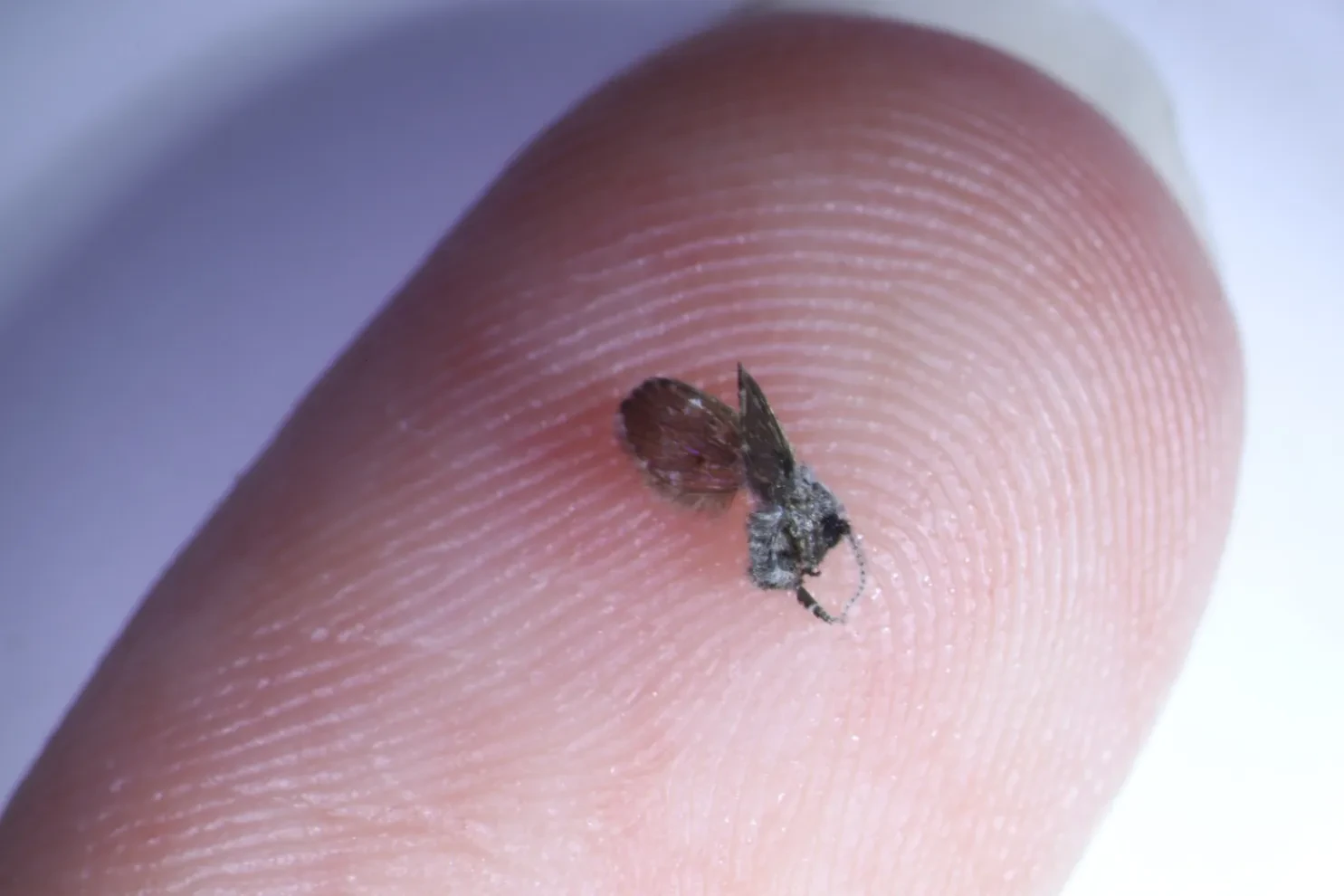
Seeing the flies near a drain is a strong clue, but it doesn’t prove which drain they come from. A simple trap tells you:
- Coat the inside of a clear plastic cup with a thin layer of petroleum jelly or vegetable oil, or tape a small sticky card inside it.
- Turn the cup upside down over the drain opening. For the overflow hole on a sink or tub, tape a small plastic bag over it instead.
- Leave it overnight or for a few days, then look for flies stuck inside.
- Test each drain separately, including floor drains and any sink or tub that rarely gets used.
Flies in the cup mean that drain is the breeding site. If every drain comes up empty, check other wet spots: the slime layer in a toilet bowl or tank that is seldom used, the drain pan under a refrigerator, standing water under cracked tile, or damp areas around a leaking pipe.
How to get rid of drain flies
Killing the adults won’t solve the problem. New flies keep emerging until the slime the larvae live in is gone, so the real work happens inside the drain.
- Remove the stopper or strainer and pull out any hair and debris.
- Scrub the inside of the drain and the overflow pipe with a stiff, long-handled pipe brush to break up the gelatinous film. For heavy buildup, a plumber’s snake with a brush tip, or removing the trap, reaches farther.
- Use an enzyme or bacterial drain cleaner made to break down organic scum, following the label directions.
- Flush with very hot water after cleaning.
- Repeat for a week or two. Adults that had already emerged can live for about two weeks, so a few may keep showing up for a while even after the drain is clean.
A few common fixes don’t work well. Bleach does not remove the slime film, and the larvae are surprisingly resistant to it. Never mix bleach with drain cleaners or other cleaning products, because some combinations release toxic gas. Pouring insecticide down a drain usually fails to kill the larvae and can damage the sewer system. Sprays, fly paper, and light traps catch adults only.
If the flies keep coming after every drain is clean and the cup tests stay empty, the source may be hidden. A broken pipe or a leak under the floor can create a breeding site you can’t reach, and at that point a plumber or a pest management professional is the right call.
When it really is a moth
Moths don’t breed in drains. A moth in the bathroom has usually flown in from outside, drawn by a light through an open window or a gap around a screen or door. One moth on its own is not a sign of an infestation; our section on moths around the home covers the usual reasons moths end up indoors. You can catch it under a cup, slide a card underneath, and let it go outside.
If small moths keep turning up, two household moths are worth ruling out:
- Webbing clothes moth. About 3/16 to 1/4 inch long, with plain tan wings that have no markings and a tuft of reddish hairs on top of the head. Its larvae feed on wool, fur, feathers, and other animal-based materials.
- Indian meal moth. About 3/8 to 1/2 inch long, with two-toned wings: pale gray near the body and reddish brown or copper on the outer part. Its larvae live in stored foods such as grains, flour, nuts, dried fruit, and pet food, so an adult in the bathroom has most likely come from a kitchen, pantry, or other place where food is stored.
Even then, an adult moth is only a clue. What confirms a clothes moth or pantry moth problem is evidence: webbing, larvae, or cocoons in stored food, or cases, larvae, and damage in wool and other animal fibers. Our guide to moths around the home and when to worry explains what to inspect. For a moth that matches neither, start with our moth identification guides.
FAQ
Why do I keep seeing tiny moths in my bathroom?
Tiny, fuzzy “moths” that show up near the sink, tub, or shower day after day are usually drain flies breeding in a drain or another wet spot. Real moths tend to appear one at a time and come in from outside.
Do drain flies bite?
No. Drain flies don’t bite people. They are mainly a nuisance, though very large numbers have occasionally been linked to allergy and asthma, and because they breed in sludge they can carry bacteria from drains onto surfaces.
Can drain flies come from the toilet?
Yes. A slime layer can build up in a toilet bowl or tank that is rarely used, and drain flies can breed there. Flushing and cleaning a guest-bathroom toilet now and then helps.
Why didn’t bleach get rid of them?
Bleach doesn’t remove the slime film where the larvae live, and the larvae tolerate it surprisingly well. Scrubbing the drain and using an enzyme drain cleaner work better.
How long do drain flies live?
Adults live about two weeks. Egg to adult takes one to three weeks depending on temperature, so a drain that isn’t cleaned can keep producing new flies.
References
- Ohio State University Extension, Drain Flies (Moth Flies), ENT-41
- Penn State Extension, Moth Flies in the Home
- University of Kentucky Entomology, Drain Flies or Moth Flies
- Clemson Home & Garden Information Center, Moth & Drain Flies
- Missouri Department of Conservation, Moth Flies
- Colorado State University, Moth Flies (Arthropods of Colorado)
- Oklahoma State University Extension, Moth Fly, Psychoda sp.
- Texas A&M AgriLife Extension, Indoor Flies and Their Control
- Washington State University, Moth Flies (Drain Flies)
- BugGuide, Clogmia albipunctata
- Akhoundi, M., et al. (2022). Clogmia albipunctata (Nematocera; Psychodidae) as the Etiologic Agent of Myiasis: True or False? Diagnostics, 12(9), 2129.
- NC State University, Order Diptera and Order Lepidoptera
- University of Minnesota Extension, Webbing Clothes Moth
- Maine Department of Agriculture, Conservation and Forestry, Indian Meal Moth