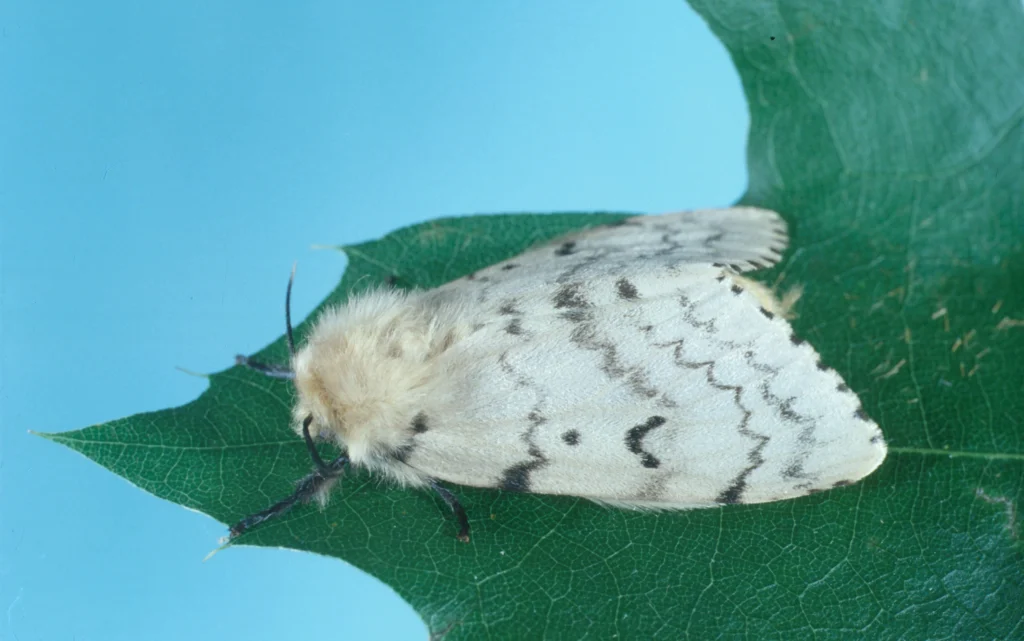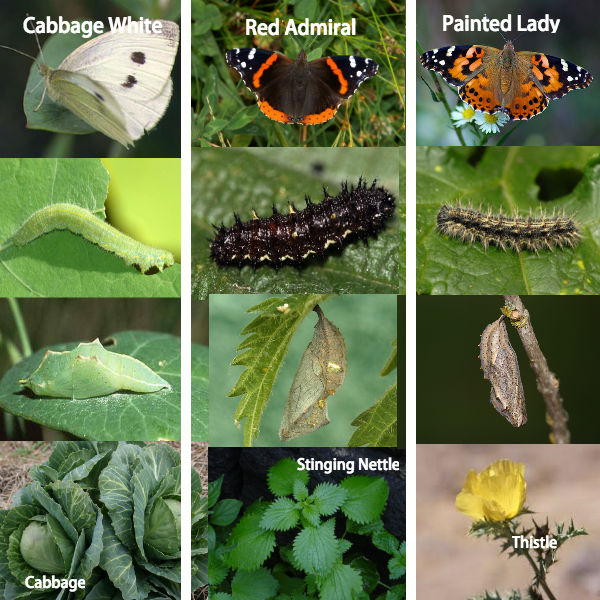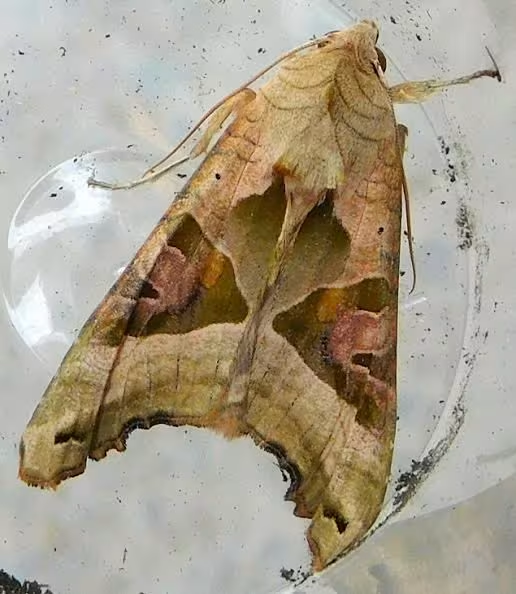
Moths are easy to overlook. One may be resting quietly on a wall, hiding against tree bark, or fluttering around a porch light after dark. At first glance, it might look like just another small brown insect. But once you know what to look for, moth identification becomes much easier — and surprisingly enjoyable.
If you are wondering how to identify a moth, start with a few simple clues: antennae, wing position, body shape, color, activity time, and where you found it. You do not need to be an expert entomologist to make a good first identification. You just need to slow down, observe carefully, and compare a few visible traits.
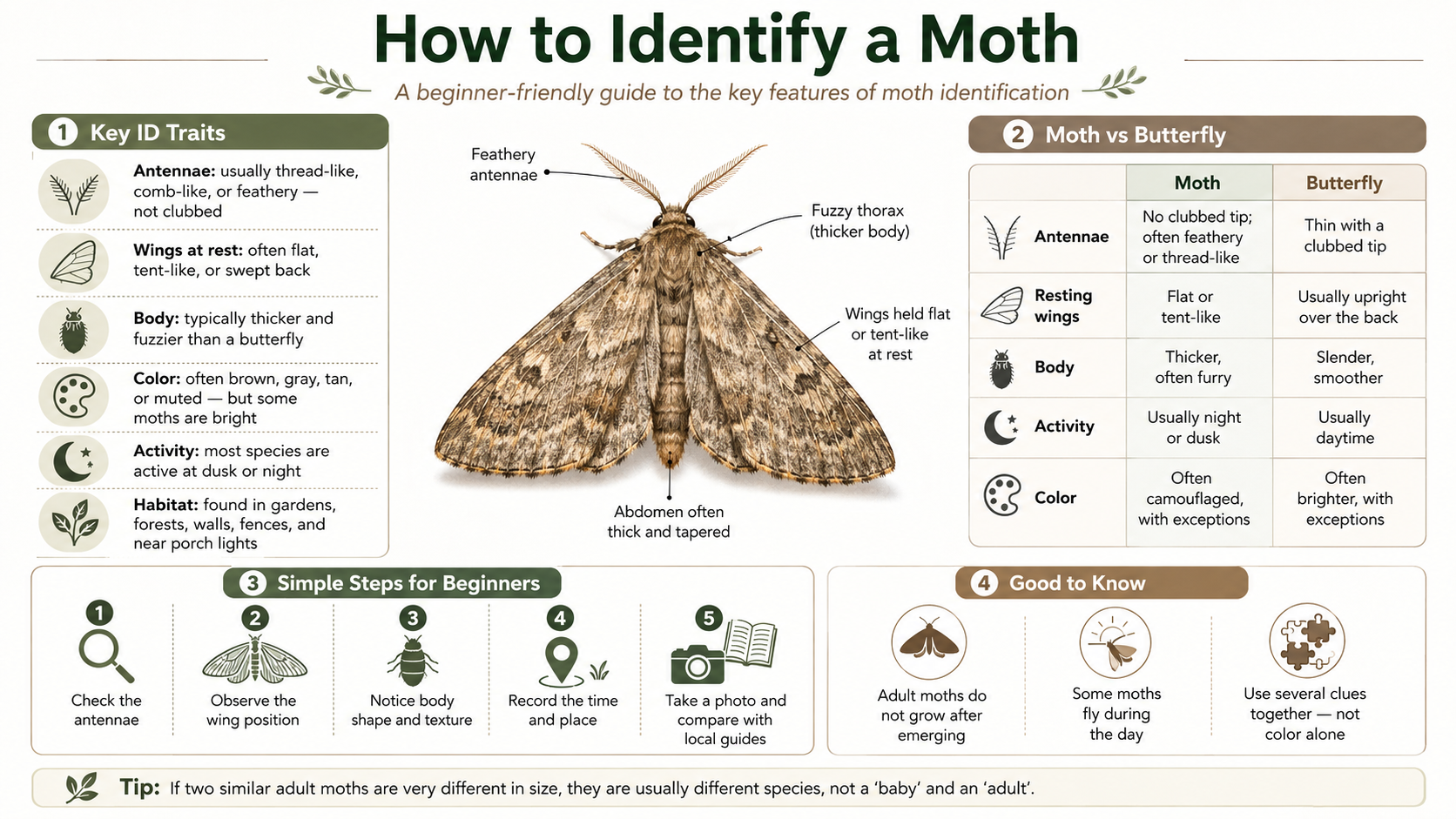
Moths belong to the insect order Lepidoptera, the same order as butterflies, and they share the familiar scale-covered wings that give this group its name. In North America north of Mexico alone, there are more than 12,000 moth species, so identifying every moth to species level can be difficult even for experienced observers.
How to Identify a Moth at a Glance
The fastest way to identify a moth is to look for a combination of features, not just one trait.
A moth will often have:
- Thread-like, comb-like, or feathery antennae without a rounded club at the tip
- Wings held flat, tent-like, or swept back while resting
- A thicker or fuzzier body than a butterfly
- Camouflaged brown, gray, tan, black, or earthy-colored wings
- Nighttime or dusk activity
- A habit of resting on walls, bark, fences, leaves, or near artificial lights
These clues are not perfect because nature is full of exceptions. Some moths fly during the day. Some are brightly colored. Some hold their wings in ways that look butterfly-like. Still, when several of these traits appear together, you are probably looking at a moth. The Australian Museum notes that antennae, resting posture, activity time, and wing structure are all useful clues, while also emphasizing that exceptions are common.
1. Check the Antennae First
Antennae are one of the best places to start.
Butterflies usually have thin antennae with a small club or knob at the end. Moths usually do not. Instead, moth antennae may look thread-like, saw-edged, comb-like, or beautifully feathery. Male moths often have especially large or feathery antennae, which help them detect pheromones from females.
If the insect has feathery antennae, it is very likely a moth. If the antennae are thin but do not have a clear clubbed tip, it may also be a moth. The Missouri Department of Conservation describes moth antennae as filaments without clubbed tips, sometimes shaped like feathers.
2. Look at How the Wings Rest
Wing position is another helpful clue.
Many butterflies rest with their wings held upright over their backs, almost like two pages of a book pressed together. Moths more often rest with their wings flat, spread out, tent-like, or swept back over the body. This posture helps many moths blend into tree bark, leaves, walls, and other surfaces during the day.
The Library of Congress explains this common difference clearly: butterflies tend to fold their wings vertically over their backs, while moths often hold their wings in a tent-like position that hides the abdomen.
When you see a moth resting on a wall, it may look triangular from above. On bark, dry leaves, or stone, its wing pattern can make it almost disappear.
3. Notice the Body Shape
Moths often look more solidly built than butterflies.
A butterfly usually has a slender, smoother body. Many moths have thicker, fuzzier bodies, which can help them retain heat during cooler evening or nighttime activity. This furry look is one reason moths can appear softer or more “powdery” than butterflies.
This is not just a visual detail. Body texture and size can tell you something about how the insect lives. A thick-bodied moth active at dusk or night needs to stay warm enough to fly, while many butterflies rely more heavily on sunshine and daytime warmth.
The University of Arkansas Extension notes that moths often have short, plump bodies and legs, while butterflies are commonly longer and thinner.
4. Study the Color and Wing Pattern
Many people think moths are always dull brown. That is not true.
Yes, many moths are brown, gray, tan, black, or muted green. These colors help them hide during the day. A moth resting on bark may have lines and patches that look almost like wood grain. Another may resemble a dead leaf. These subtle patterns are not boring — they are survival tools.
But some moths are strikingly colorful. Luna moths, tiger moths, burnet moths, rosy maple moths, and hawk-moths can be vivid, patterned, or surprisingly bright. The Natural History Museum points out that moths are often unfairly seen as drab, even though many species are colorful and dramatically patterned.
When identifying a moth, pay attention to:
- Main wing color
- Lines, bands, dots, or eye spots
- Wing shape and edges
- Symmetry of markings
- Whether the pattern looks camouflaged or warning-colored
If possible, take a clear photo from above and from the side. A good photo makes later identification much easier.
5. Consider the Time of Day
Behavior matters.
Most butterflies are active during the day. Most moths are active at night, dusk, or dawn. If you find an insect fluttering around a porch light, window, streetlamp, or outdoor bulb after dark, there is a good chance it is a moth.
That said, not all moths are nocturnal. Some fly in bright sunlight, especially day-flying moths such as certain burnet moths, clearwing moths, and some hawk-moths. The Library of Congress notes that moths are generally nocturnal, but there are day-flying moth exceptions.
So use time of day as a clue, not a final answer.
6. Look at Where You Found It
Habitat can narrow things down.
Moths live in forests, grasslands, wetlands, gardens, farms, deserts, and urban neighborhoods. Some rest on tree trunks. Others hide in low vegetation. Some appear near porch lights or windows. A few may turn up indoors, especially if they are pantry moths or clothes moths.
If you want to identify a moth more accurately, write down where you found it:
- On a house wall
- Near a porch light
- On tree bark
- In grass or flowers
- Inside a closet or pantry
- Near a pond, garden, or wooded area
Food plants can also help. Many moth caterpillars feed on specific plants, so knowing the local vegetation may help narrow the identification. The Missouri Department of Conservation notes that identifying caterpillar food plants can make moth identification easier.
7. Sort Moths by Size Before Trying to Name the Species
If you are a beginner, do not start by trying to name every moth species. That can become frustrating very quickly.
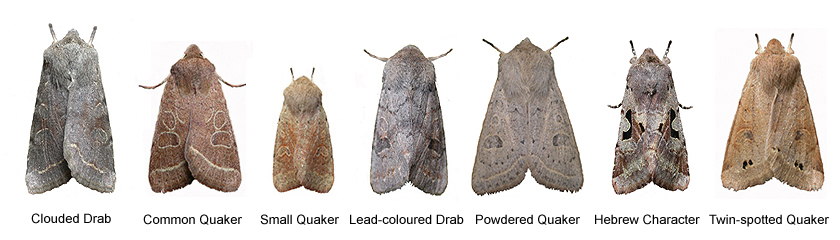
A better approach is to sort moths into broad groups first. One simple method is to separate them by size:
Micromoths are very small moths, often under about 1 to 1.5 cm in wing length.
Macromoths are larger and usually easier for beginners to photograph and compare.
After that, group moths by visible features:
- Small gray moth with narrow wings
- Large brown moth with eye spots
- White moth with black dots
- Green moth with long tails
- Orange-and-black moth with bold markings
- Thin moth resting in a T shape
This kind of “morphospecies” sorting is useful when you cannot identify the exact species. It also mirrors real field observation: sometimes the first step is simply recognizing that two moths look different.
8. Remember: Adult Moths Do Not Grow Bigger
This is a common beginner mistake.
If you find two similar-looking moths but one is much smaller, it is tempting to call one the “baby” and the other the “adult.” But adult moths do not grow after emerging from the pupa or cocoon. Growth happens during the caterpillar stage.
So two adult moths of noticeably different sizes are probably not baby and adult versions of the same moth. They may be different species, different sexes, or related species with similar markings.
9. Use Photos and Local Guides for Species Identification
Once you have observed the main traits, use a field guide or a reputable online identification resource.
For the best results, compare your moth with species found in your region. Local range matters because many moths look similar. A species common in one country, state, or habitat may not occur in another.
Good identification photos should show:
- Wing shape
- Full wing pattern
- Antennae
- Body shape
- Resting posture
- Approximate size
- Location and date
For difficult moths, especially small or plain-colored species, exact identification may require expert help. Some moths can only be confirmed by examining fine anatomical details.
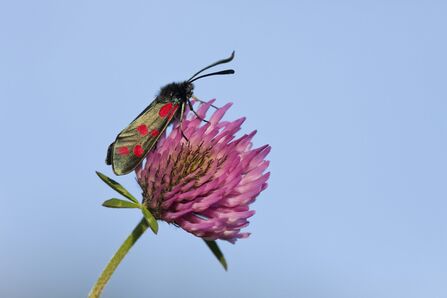
Six-spot burnet
Description: Black with slender wings. Each forewing has six red spots (the two closest to the head often look like one red smudge). Flies in the day, visiting flowers like a butterfly.
When & where: June-August. Flowery grassland throughout the UK. Caterpillars feed on bird’s-foot trefoil.
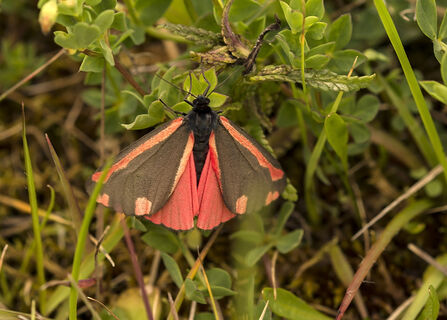
Cinnabar
Description: Each black forewing has a red line and two red dots, and the hindwings are bright red. Flies in sunshine and is attracted to light at night.
When & where: May-August. A variety of habitats, including sand dunes, heathlands and gardens. Caterpillars feed on ragwort.
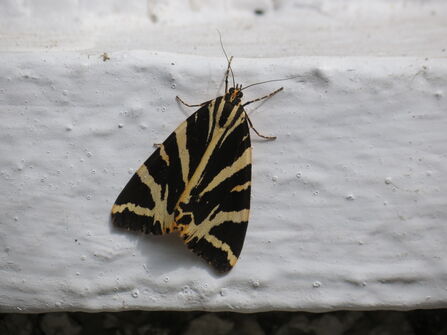
Jersey tiger
Description: The black forewings have striking creamy-white stripes and the hindwings are bright red, yellow or orange. Flies on warm days.
When & where: July-September. A range of habitats including rough ground, coastal cliffs and gardens. On the south coast of England, but rapidly spreading north, with a strong London population.
Moth vs Butterfly: Quick Comparison
| Feature | Moth | Butterfly |
|---|---|---|
| Antennae | Thread-like, comb-like, or feathery; usually no clubbed tip | Usually thin with a clubbed tip |
| Resting wings | Often flat, tent-like, or swept back | Often upright over the back |
| Body | Often thicker and fuzzier | Often slimmer and smoother |
| Color | Often camouflaged, but many exceptions | Often bright, but not always |
| Activity | Usually night, dusk, or dawn | Usually daytime |
| Habitat | Very wide range, including urban lights and shaded resting spots | Often sunny gardens, meadows, and flower-rich areas |
This comparison is helpful, but it should not be treated as a strict rule. Moths and butterflies are closely related, and some species blur the lines. The best identification comes from combining several clues.
Common Moth Identification Mistakes
Mistake 1: Thinking all moths are brown
Many moths are camouflaged, but plenty are colorful. Tiger moths, burnet moths, luna moths, and hawk-moths can be beautiful and bold.
Mistake 2: Assuming every night insect is a moth
Many insects come to lights at night, including beetles, flies, lacewings, and caddisflies. Look for scale-covered wings, antennae, and moth-like resting posture.
Mistake 3: Calling small adults “baby moths”
Adult moths do not grow larger. A tiny adult moth is not a baby; it is simply a small species or a small adult.
Mistake 4: Relying on color alone
Color can help, but it is not enough. Wing shape, antennae, posture, size, and location are often more reliable.
Mistake 5: Expecting every moth to be identifiable right away
Some moths are difficult. Even experts may need magnification, regional records, or specialist references.
Final Tips for Identifying a Moth
If you find a moth, take a calm, careful look before it flies away. Notice the antennae. Check how the wings are held. Look at the body shape. Study the pattern. Think about the time of day and where you found it.
A good beginner method is:
- Confirm it looks like a moth rather than another insect.
- Compare it with butterflies using antennae, wings, and body shape.
- Sort it by size and visible pattern.
- Check local guides or identification websites.
- Accept that some moths may remain unidentified.
That last point is important. Moth identification is not just about naming things. It is about noticing details you might otherwise miss — the fine lines on a gray wing, the leaf-like camouflage, the feathery antennae, the quiet life happening around your porch light after dark.
Once you learn how to identify a moth, even the plainest little visitor starts to look more interesting.
FAQ
How do I identify a moth?
Start by checking the antennae, resting wing position, body shape, color pattern, activity time, and location. Moths often have non-clubbed antennae, thicker bodies, and wings held flat or tent-like when resting.
What is the easiest way to tell a moth from a butterfly?
The easiest clue is usually the antennae. Butterflies often have clubbed antennae, while moths usually have thread-like, comb-like, or feathery antennae without a rounded club.
Are all moths active at night?
No. Most moths are nocturnal or active around dusk, but some moths fly during the day. Day-flying moths can be colorful and are sometimes mistaken for butterflies.
Are moths always brown or gray?
No. Many moths are brown or gray because camouflage helps them survive, but some species are brightly colored or boldly patterned.
Why do moths come to lights?
Many moths are attracted to artificial lights at night. The exact reasons are complex, but it is often linked to how they navigate in darkness.
Can I identify every moth I find?
Not always. Some moths are very small, worn, or similar to related species. Beginners can often identify the family or general type first, then work toward species-level identification with photos and local guides.
Do baby moths look like small adult moths?
No. A baby moth is a caterpillar. Adult moths do not keep growing once they emerge from the pupa or cocoon.
What should I photograph for moth identification?
Photograph the moth from above and from the side if possible. Try to capture the wings, antennae, body shape, and any markings clearly. Also note the location, date, size, and habitat.