The moth life cycle stages are one of the most fascinating examples of transformation in the insect world. A moth does not simply grow from a small moth into a larger moth. Instead, it passes through a complete change of body form: egg, larva, pupa, and adult.
For beginners, this can be surprising. The soft caterpillar feeding on a leaf, the hidden pupa inside a cocoon, and the winged moth resting near a porch light may all be the same animal at different points in life.
Understanding the moth life cycle helps with more than natural curiosity. It can help gardeners recognize caterpillars on host plants, homeowners identify whether small larvae indoors may be linked to clothes moths or pantry moths, and students understand how complete metamorphosis works. It also makes moth identification more realistic, because many moths are easiest to understand when you consider their season, habitat, food source, and life stage.
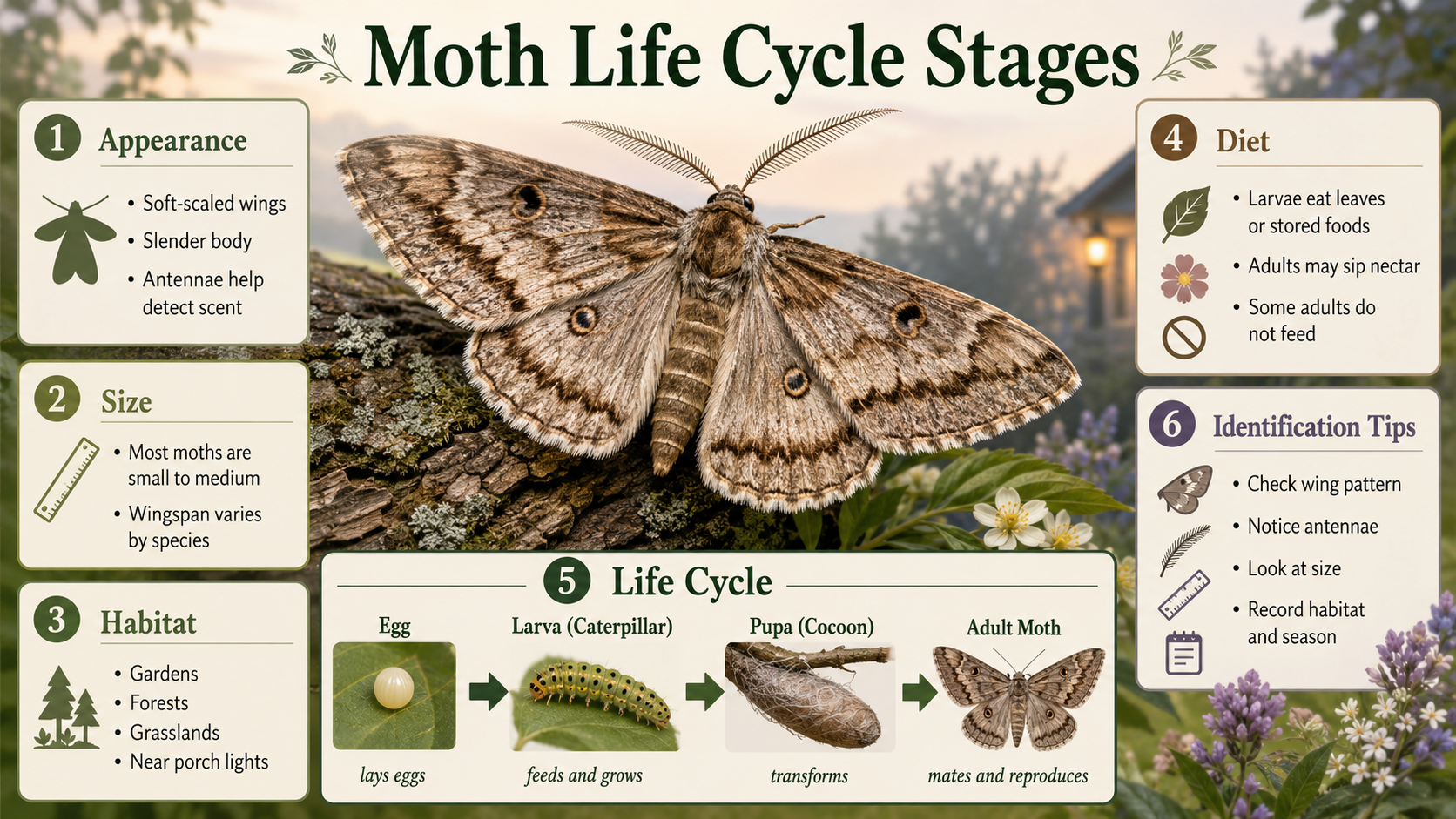
This guide explains each stage in clear, practical language. It also covers how moth development differs between species, what to look for when identifying eggs or larvae, common mistakes, and when household moth concerns may need closer attention.
What Are the Main Moth Life Cycle Stages?
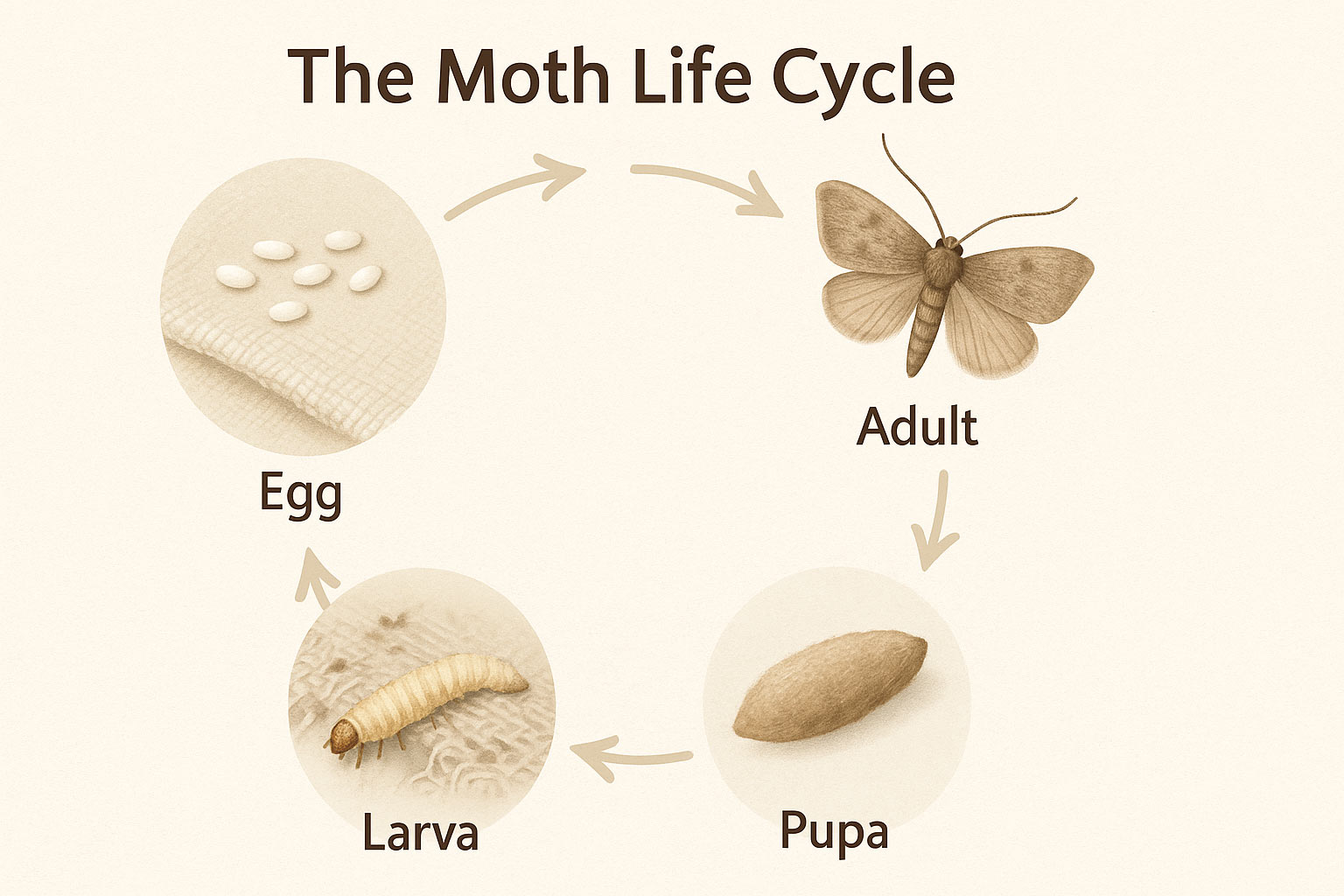
Moths belong to the insect order Lepidoptera, the same broad group as butterflies. Like butterflies, moths go through complete metamorphosis. This means the insect has four distinct life stages:
- Egg
- Larva, commonly called a caterpillar
- Pupa, often protected inside a cocoon or hidden shelter
- Adult moth
Each stage has a different appearance and purpose. The egg protects early development. The caterpillar feeds and grows. The pupa is the transformation stage. The adult moth is mainly responsible for dispersal, mating, and laying eggs for the next generation.
This is different from insects that hatch as small versions of the adult. A young moth does not look like a tiny wingless moth. It begins as a caterpillar, then reorganizes into a completely different adult form.
Why Moth Metamorphosis Matters
The moth life cycle is not just a beautiful natural process. It also explains many things people notice in gardens, forests, closets, pantries, and outdoor lights.
A caterpillar on a garden plant may later become a night-flying moth. A small larva in stored grain may be the damaging stage of a pantry moth. A quiet adult moth resting on a wall may no longer be feeding at all. If you only look at one stage, it is easy to misunderstand the insect.
For identification, life stage matters as much as color or size. A moth egg, larva, pupa, and adult can look so different that they may seem unrelated.
Stage 1: Moth Eggs
The moth life cycle begins when a female moth lays eggs. These eggs are usually small, delicate, and easy to overlook. Depending on the species, eggs may be laid singly, in small clusters, or in larger masses.
Many moths lay eggs directly on or near the food source that the caterpillars will need after hatching. For plant-feeding species, this often means leaves, stems, bark, grass blades, flower buds, seed heads, or the underside of host plant foliage. For some household moths, eggs may be placed near stored foods or animal-based fibers, depending on the species.
What Do Moth Eggs Look Like?
Moth eggs vary widely. They may be:
- Round, oval, flattened, or dome-shaped
- Smooth, ridged, or patterned under magnification
- White, cream, yellowish, greenish, brown, or translucent
- Laid in rows, clusters, patches, or hidden crevices
To the naked eye, many moth eggs look like tiny specks. On leaves, they may resemble pollen grains, plant bumps, or dust. Some eggs are easier to spot because they are laid in neat clusters or covered with scales or hairs from the adult moth’s body.
Where Are Moth Eggs Found?
Outdoor moth eggs are often found near host plants. A host plant is the plant or plant group that a caterpillar can eat. Many caterpillars are selective and cannot simply feed on any plant nearby.
Common outdoor egg-laying sites include:
- Undersides of leaves
- Leaf edges
- Grass stems
- Tree bark
- Twigs
- Flower buds
- Seed pods
- Lichens or mossy surfaces
- Hidden cracks in bark or plant debris
Indoor moth eggs are more likely to be found close to a larval food source. For example, pantry moth eggs may be associated with stored grains, cereals, dried fruit, nuts, pet food, or similar dry goods. Clothes moth eggs may be placed near wool, fur, feathers, silk, or other animal-based materials, especially in dark and undisturbed storage areas.
How Long Do Moth Eggs Take to Hatch?
The egg stage can be brief or prolonged, depending on temperature, humidity, season, and species. Some eggs hatch within days in warm conditions. Others may remain dormant through colder or unfavorable periods.
For many beginner observations, it is safest to avoid giving a single exact number for all moths. Moth development is highly species-dependent. Warmth usually speeds development, while cold or dry conditions may slow it.
Stage 2: Moth Larvae or Caterpillars
The larval stage is the feeding and growth stage of the moth life cycle. This is the stage most people call a caterpillar. In household contexts, people often call them moth larvae, especially when they are found in food packages, closets, carpets, or storage bins.
Scientifically, both terms can be correct. A moth larva is a caterpillar.
What Is the Main Job of a Moth Caterpillar?
A moth caterpillar’s main job is to eat, grow, and store enough energy for transformation. Many adult moths live briefly, and some do not feed at all as adults. Because of this, the larval stage is often the most important feeding period in the moth’s life.
Caterpillars grow quickly, but their outer skin does not stretch indefinitely. As they increase in size, they shed their skin in a process called molting. The growth periods between molts are called instars. A caterpillar may look different from one instar to the next, sometimes changing color, texture, pattern, or hairiness.
This is one reason caterpillar identification can be difficult. The same species may look different when young, half-grown, and fully mature.
What Do Moth Caterpillars Eat?
Moth caterpillar diets vary greatly. Many feed on plants, but not all feed in the same way. Some eat leaves openly. Others bore into stems, fruit, seeds, roots, or wood. Some feed on lichens, algae, fungi, decaying plant matter, stored foods, or animal-based fibers.
Common moth larval foods include:
- Leaves of trees, shrubs, grasses, and wildflowers
- Flower buds or petals
- Seeds and seed pods
- Fruits or stored grains
- Tree bark or wood in some species
- Lichens and algae
- Fungi or decaying organic matter
- Wool, fur, feathers, silk, and similar materials in clothes moth species
- Dry stored foods in pantry moth species
This wide range is why moths are so ecologically diverse. Some caterpillars are important food for birds, bats, reptiles, amphibians, and other insects. Others are pollinator-linked species or part of nutrient cycling. A smaller number become household or agricultural pests when their larvae feed on stored goods, textiles, or crops.
What Do Moth Larvae Look Like?
Most moth larvae have soft, elongated bodies. They usually have a distinct head capsule, three pairs of true legs near the front, and several pairs of fleshy prolegs along the abdomen. Some are smooth, while others are hairy, spiny, camouflaged, striped, spotted, or twig-like.
Moth larvae can be:
- Green and leaf-like
- Brown and bark-like
- Hairy or woolly
- Smooth and pale
- Brightly patterned
- Hidden inside cases, silk shelters, or rolled leaves
- Found in webbing, tunnels, or frass-covered feeding areas
The word frass means insect droppings. In caterpillar identification, frass can be a useful clue because larvae often leave small dark pellets, powdery debris, silk, or chewed plant material near feeding sites.
Are Moth Caterpillars Harmful?
Most moth caterpillars are not dangerous to observe, but it is wise not to handle unknown caterpillars with bare hands. Some hairy or spiny caterpillars can irritate skin. A few species in certain regions can cause stronger reactions.
For children, classrooms, and garden observations, the safest approach is simple: look closely, take photos, but avoid touching unknown caterpillars. If handling is necessary for educational purposes, use a soft brush, leaf, or container rather than fingers.
For household moths, the concern is usually not personal safety. Clothes moth larvae can damage animal-based textiles, and pantry moth larvae can contaminate stored dry foods with webbing, frass, and cast skins. The adult moths are often more visible, but the larvae are usually the stage causing the practical problem.
Stage 3: Moth Pupae and Cocoons
After the caterpillar has grown enough, it enters the pupal stage. This is the transformation stage between the feeding larva and the winged adult.
The word pupa refers to the insect’s life stage. The word cocoon refers to a protective covering that many moth caterpillars spin around the pupa. These two words are related, but they do not mean exactly the same thing.
A moth pupa is the developing insect. A cocoon is the shelter around it.
What Happens Inside the Pupa?
Inside the pupa, the moth undergoes dramatic reorganization. The caterpillar body changes into an adult form with wings, antennae, adult legs, reproductive organs, and adult mouthparts if that species has functional adult mouthparts.
From the outside, the pupa may look quiet or inactive. Inside, it is one of the most important phases of the moth life cycle.
Where Do Moths Pupate?
Moths pupate in many different places. Some spin silk cocoons on plants. Some pupate underground. Others hide in leaf litter, bark crevices, rolled leaves, fabric folds, food packaging corners, or sheltered cracks.
Common pupation sites include:
- Soil
- Leaf litter
- Rolled leaves
- Bark cracks
- Plant stems
- Silk shelters
- Cocoons attached to twigs
- Crevices near stored food
- Folds or seams of infested fabric
- Corners of shelves, closets, or storage containers
This hidden stage is why moths can seem to “appear suddenly.” The adult may emerge after the pupa has been concealed for days, weeks, or longer.
Cocoon vs Chrysalis: What Is the Difference?
People often use “cocoon” and “chrysalis” interchangeably, but they are not the same.
A chrysalis is the exposed pupal form commonly associated with butterflies. A cocoon is a silk protective structure spun by many moth caterpillars around the pupa.
Many moths make cocoons, but not all moth pupae are obvious silk cocoons. Some pupate underground or in simple shelters. Some cocoons are soft and papery. Others are tough, camouflaged, or mixed with plant fibers, bark particles, or debris.
How Long Does the Pupal Stage Last?
The pupal stage may last a short time in warm growing seasons or much longer if the species overwinters as a pupa. Some moths remain in the pupal stage through winter and emerge as adults when conditions are favorable.
As with eggs and larvae, there is no single timeline that applies to every moth species. Temperature, humidity, food quality during the larval stage, season, and species all affect development.
Stage 4: Adult Moths
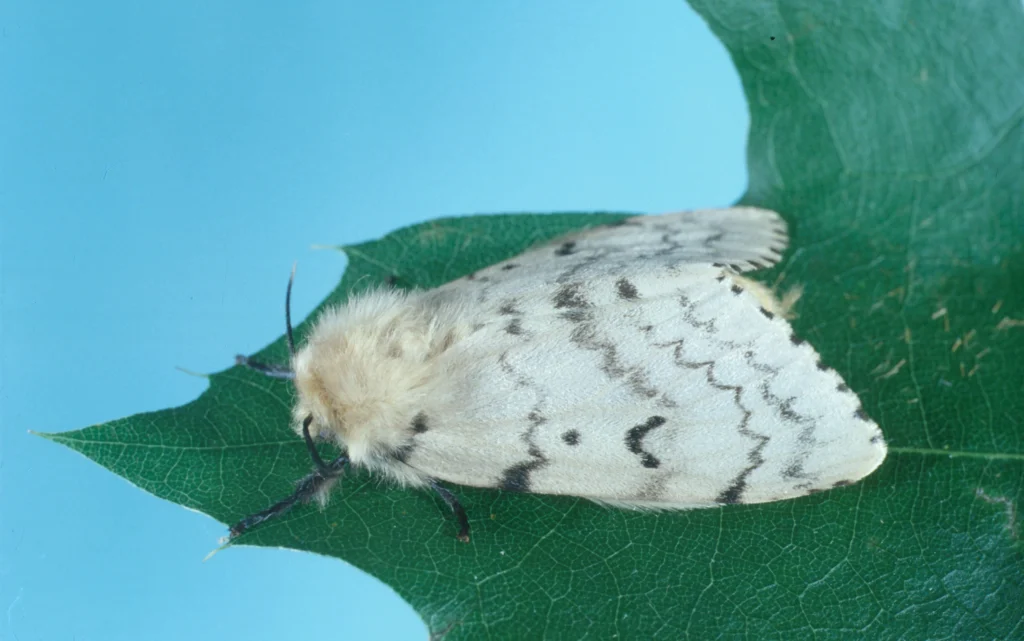
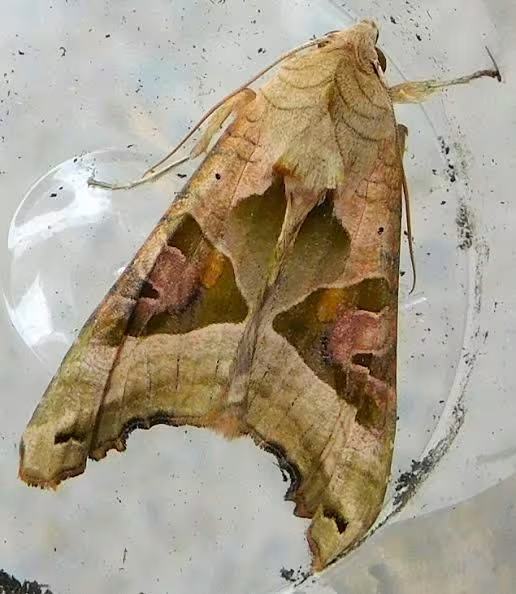
The adult moth is the winged stage most people recognize. It emerges from the pupal case, expands its wings, and waits until they harden enough for flight.
Newly emerged moths can look soft, pale, or crumpled at first. Their wings may be folded, damp, or wrinkled. After emergence, the moth pumps fluid into the wing veins, expands the wings, and rests while the wings dry and harden.
What Is the Main Job of an Adult Moth?
The adult stage is mainly about reproduction and dispersal. Adult moths find mates, move to new areas, and females lay eggs to begin the next generation.
Some adult moths feed on nectar, tree sap, rotting fruit, or other liquid foods. Others have reduced mouthparts and do not feed as adults. These species rely on energy stored during the caterpillar stage.
How Long Do Adult Moths Live?
Adult moth lifespan varies widely. Some live only a few days. Others may live several weeks or longer, especially if they can feed as adults or enter periods of reduced activity.
For many moths, the adult stage is shorter than the larval stage. This is why the caterpillar is often the growth stage, while the adult is the reproductive stage.
Why Are Moths Attracted to Lights?
Many moths are active at night and may be drawn to artificial lights. The exact reasons can vary and are still studied, but light attraction is common enough that porch lights, windows, and outdoor fixtures are frequent places to notice adult moths.
However, a moth at a light does not automatically mean there is an indoor infestation. Many outdoor moths simply fly toward light and rest nearby. If you see moths repeatedly in a pantry, closet, or storage area, that is a different situation and deserves closer inspection.
How Long Does the Full Moth Life Cycle Take?
The full moth life cycle can take a few weeks, several months, or even longer, depending on the species and environment.
Important factors include:
- Species
- Temperature
- Humidity
- Food quality
- Season
- Day length
- Whether the species overwinters
- Whether it has one or multiple generations per year
Some small household pantry moths can complete their life cycle relatively quickly in warm indoor conditions. Some outdoor moths have one generation per year and spend winter as eggs, larvae, pupae, or adults depending on the species.
Because of this variation, any general answer to “how long do moths live?” needs context. The better question is: which moth species, in which location, at what season, and at what life stage?
Moth Life Cycle Stages Compared
| Life Stage | Common Name | Main Purpose | What It Looks Like | Where You May Find It | Identification Notes |
|---|---|---|---|---|---|
| Egg | Moth egg | Early development | Tiny dots, discs, domes, or clusters | Leaves, bark, stems, food sources, fabric areas, crevices | Often hard to identify without host plant, location, and magnification |
| Larva | Caterpillar or moth larva | Feeding and growth | Soft-bodied, worm-like or caterpillar-like | Host plants, stored foods, fabric, leaf litter, wood, stems | Often the most damaging stage for household moths |
| Pupa | Moth pupa | Transformation | Brown, tan, reddish, or enclosed in cocoon | Soil, leaf litter, cocoons, cracks, rolled leaves, storage areas | Usually inactive and hidden |
| Adult | Adult moth | Mating, dispersal, egg-laying | Winged insect with scales on wings | Lights, plants, walls, closets, pantries, outdoor habitats | Wing pattern, size, antennae, season, and location help with ID |
Outdoor Moths vs Household Moths
Not all moths around a home are pests. Many are harmless outdoor species that enter accidentally or rest near lights. Others may be associated with stored foods or textiles.
Understanding the life cycle helps separate casual sightings from true household problems.
Outdoor Moths
Outdoor moths may be found:
- Resting on walls, fences, tree trunks, or leaves
- Visiting flowers at dusk or night
- Flying near porch lights
- Hiding in vegetation during the day
- Emerging seasonally after pupation
Many outdoor moths have caterpillars that feed on specific host plants. Their presence can be part of a healthy garden or local ecosystem.
Clothes Moths
Clothes moths are small household moths whose larvae feed on animal-based materials. The larvae, not the adults, cause damage.
Materials that may be affected include:
- Wool
- Fur
- Feathers
- Silk
- Leather
- Hair
- Taxidermy
- Felt
- Wool rugs
- Animal-fiber blends
Clean cotton, linen, and synthetic materials are usually less attractive unless blended with animal fibers or soiled with food, sweat, body oils, or other residues.
Adult clothes moths are often small, buff-colored, and weak fliers. They tend to avoid bright lights and prefer dark, undisturbed places. Seeing small moths flying strongly around kitchen lights may point to another kind of moth, not necessarily clothes moths.
Pantry Moths
Pantry moths, such as Indianmeal moths, are associated with stored dry foods. Their larvae may feed in grains, cereals, flour, cornmeal, nuts, dried fruit, seeds, pet food, birdseed, chocolate, spices, and similar products.
Signs may include:
- Small larvae in food packages
- Silk webbing in stored food
- Clumped grains or flour
- Frass or debris
- Adult moths flying near cabinets
- Larvae wandering away from food to pupate
Again, the adult moth is usually the stage people notice first, but the larvae are the stage feeding inside the food source.
Practical Identification Tips for Moth Life Cycle Stages
Moth identification can be challenging, especially from a single blurry photo or a single life stage. Responsible identification usually requires several clues.
Key Clues to Record
When trying to identify a moth, caterpillar, egg, or pupa, record:
- Location: country, state, region, or habitat
- Season and date
- Size, preferably with a ruler or object for scale
- Host plant or food source
- Habitat: forest, garden, pantry, closet, grassland, wetland, porch, etc.
- Wing pattern or body pattern
- Antennae shape
- Whether the insect was active by day or night
- Whether larvae were feeding, wandering, webbing, or hiding
- Clear photos from several angles
For caterpillars, photograph the side, top, head, and host plant. For adult moths, photograph the wings at rest, body shape, antennae, and any visible markings.
Why Host Plant Matters
Many moth caterpillars are linked to specific host plants. If you find a caterpillar on oak, willow, milkweed, grass, cabbage, tomato, or another plant, that plant can narrow the possibilities.
However, a caterpillar found crawling across a path may not be on its host plant. It may be wandering to pupate. In that case, the nearby plant may not be the food source.
Why Adult Moth Photos Can Still Be Uncertain
Some adult moths are easy to recognize. Others belong to groups with many similar species. A photo may not show the fine details needed for species-level identification.
Identification may remain uncertain when:
- The photo is blurry
- The moth is worn or missing scales
- Only the underside is visible
- The location is too broad
- Similar species overlap in the region
- The moth belongs to a difficult species complex
- Genitalia examination or expert review would be needed
A careful answer is better than a confident wrong one. For many moths, identification to family or genus may be more realistic than exact species.
Life Cycle Clues in Homes and Gardens
In the Garden
If you find eggs or caterpillars on plants, ask:
- Are leaves being chewed?
- Are caterpillars feeding openly or hiding in rolled leaves?
- Are there droppings below the plant?
- Are multiple caterpillars present?
- Is the plant a known host for local moths or butterflies?
- Are birds, wasps, or other predators active nearby?
Many caterpillars are part of the garden food web. Light feeding is often normal. Heavy feeding on vegetables or ornamental plants may require closer identification before action.
In the Pantry
If you see small moths in the kitchen, inspect dry goods carefully. Look for webbing, larvae, clumped food, or movement inside packaging.
Common source areas include:
- Cereal boxes
- Flour and grain bags
- Rice, pasta, and cornmeal
- Nuts and dried fruit
- Birdseed
- Pet food
- Seeds
- Chocolate or dry mixes
The practical goal is to find the larval food source, not simply chase flying adults.
In the Closet
If you suspect clothes moths, look in dark, undisturbed places. Check wool sweaters, rugs, stored blankets, felt, fur, feathers, taxidermy, and items left untouched for long periods.
Look for:
- Irregular surface grazing
- Small holes
- Silky webbing
- Larval cases
- Cream-colored larvae
- Damage in folds, seams, cuffs, or hidden areas
- Infestation near stored animal-fiber items
Carpet beetles can cause similar fabric damage, so do not assume every hole is from moths.
Common Mistakes and Misconceptions
Mistake 1: Thinking Adult Moths Eat Clothes
Adult clothes moths do not chew holes in sweaters. Their larvae are the damaging stage. Adult moths are often the visible warning sign, but the real feeding occurs before adulthood.
Mistake 2: Calling Every Indoor Moth a Clothes Moth
Small moths indoors may be pantry moths, clothes moths, or outdoor moths that accidentally entered. Location matters. Moths near dry food storage suggest a pantry source. Moths in dark textile storage suggest a fabric source. Moths at windows or lights may be outdoor visitors.
Mistake 3: Assuming Every Caterpillar Is a Pest
Most caterpillars are simply part of the local ecosystem. Some become beautiful or ecologically important moths. A few may damage crops, stored goods, or textiles, but identification should come before control.
Mistake 4: Handling Hairy Caterpillars
Hairy caterpillars are interesting, but some can irritate skin or eyes. Avoid touching unknown caterpillars, especially children’s “fuzzy” caterpillar finds. Observation and photography are safer than handling.
Mistake 5: Expecting Every Moth to Have the Same Timeline
There is no single moth life cycle calendar. Some species develop quickly. Others spend months in one stage or overwinter before continuing development. Species, climate, and season all matter.
Mistake 6: Confusing Cocoon and Pupa
The pupa is the insect stage. The cocoon is the protective covering made by many moth caterpillars. A moth can have a pupa without an obvious cocoon, and a cocoon may hide the pupa inside.
Mistake 7: Identifying Species from One Clue
Wing color alone is rarely enough. Good moth identification often needs location, season, size, wing pattern, resting posture, antennae, habitat, host plant, and clear photos.
When to Seek Expert Help
Most moth observations do not require expert help. Still, there are situations where it is sensible to ask for assistance.
Seek Identification Help When:
- You need species-level identification for a school, survey, or conservation project
- A caterpillar may be a regionally important pest species
- You find repeated larvae in stored food or textiles
- A moth or caterpillar resembles a medically significant species in your region
- You have clear photos but cannot narrow the identification
- The moth may be invasive or subject to local reporting rules
Useful sources of help may include local extension services, university entomology departments, natural history groups, moth recording groups, museum experts, or reputable citizen science platforms.
Seek Household Pest Help When:
- Pantry moths keep returning after cleaning
- You cannot find the source of larvae
- Textile damage continues despite washing, vacuuming, and storage changes
- Valuable rugs, garments, museum items, taxidermy, or heirlooms are at risk
- You are unsure whether the culprit is clothes moths, carpet beetles, or another insect
Seek Medical Advice When:
- A caterpillar contact reaction is severe
- A rash spreads, blisters, or lasts longer than expected
- Hairs or particles get into the eyes
- Breathing symptoms occur
- A child, pet, or sensitive person has a strong reaction
- You suspect exposure to a locally known hazardous caterpillar species
For most people, the safest rule is simple: avoid handling unknown caterpillars and wash skin if accidental contact occurs.
Conclusion
The moth life cycle stages show how much change can happen within one small insect’s life. A moth begins as an egg, grows as a caterpillar, transforms as a pupa, and emerges as a winged adult. Each stage has a different role, appearance, and behavior.
For beginners, the most important point is that moths cannot be understood only by looking at the adult. Eggs, larvae, pupae, cocoons, host plants, food sources, season, and habitat all provide valuable clues. This is especially true when identifying caterpillars in gardens or small moths inside homes.
Most moths are harmless parts of the natural world, and many are important in ecosystems as pollinators, prey, decomposers, or plant-feeding insects. A smaller number matter to homeowners because their larvae feed on stored foods or animal-based textiles. In those cases, careful identification and finding the larval source are more useful than reacting to every adult moth you see.
Whether you are a student, gardener, homeowner, teacher, or nature enthusiast, learning the moth life cycle gives you a clearer and calmer way to understand these often-overlooked insects.
FAQ
What are the four stages of the moth life cycle?
The four main moth life cycle stages are egg, larva, pupa, and adult. The larva is commonly called a caterpillar. The pupa is the transformation stage, and the adult is the winged moth.
Do moths come from caterpillars?
Yes. Moths begin as eggs, hatch into caterpillars, become pupae, and then emerge as adult moths. The caterpillar and adult moth can look so different that they may seem like unrelated insects.
What is a moth larva?
A moth larva is the caterpillar stage of a moth. This is the main feeding and growth stage. In gardens, larvae often feed on plants. In homes, some species may feed on stored dry foods or animal-based fibers.
Is a moth larva the same as a caterpillar?
Yes. A moth larva is a caterpillar. People often use “caterpillar” for outdoor plant-feeding larvae and “moth larva” for larvae found indoors, but both refer to the larval stage.
How long does it take for a moth egg to hatch?
It depends on the species and conditions. Some moth eggs hatch in a few days during warm weather, while others take longer or remain dormant during unfavorable seasons.
What do moth caterpillars eat?
Many moth caterpillars eat leaves, flowers, seeds, stems, or other plant parts. Some feed on lichens, fungi, wood, stored grains, dried foods, wool, fur, feathers, or other specialized materials. Diet depends strongly on the species.
Do adult moths eat clothes?
No. Adult clothes moths do not chew holes in clothing. The larvae are the stage that feeds on wool, fur, feathers, silk, and other animal-based materials.
Do pantry moths damage food as adults or larvae?
The larvae are the feeding stage. Adult pantry moths are often noticed flying near cabinets, but the larvae are usually responsible for webbing, debris, and contamination in stored dry foods.
What is the difference between a pupa and a cocoon?
The pupa is the moth’s transformation stage. A cocoon is a protective silk covering that many moth caterpillars make around the pupa. Not every moth pupa is inside an obvious cocoon.
Do all moths make cocoons?
No. Many moths spin cocoons, but some pupate underground, in leaf litter, inside rolled leaves, in bark crevices, or in other hidden shelters.
How long does a moth stay in its cocoon?
The time varies by species, season, and temperature. Some moths emerge after a short pupal period, while others remain as pupae through winter or another unfavorable season.
How long do adult moths live?
Adult moth lifespan varies widely. Some adults live only a few days, while others may live for weeks or longer. Some adult moths feed, while others do not have functional mouthparts and rely on energy stored from the caterpillar stage.
Why did I find a caterpillar crawling away from plants?
A caterpillar wandering away from plants may be searching for a safe place to pupate. In that case, the plant nearest to where you found it may not be its host plant.
Are moth caterpillars dangerous to touch?
Most are not dangerous, but some hairy or spiny caterpillars can irritate skin or eyes. It is best not to handle unknown caterpillars with bare hands.
How can I identify a moth species?
Use several clues: location, season, size, wing pattern, antennae, resting posture, habitat, host plant, and clear photos. Some moths can be identified from photos, but others require expert review.
Why are moths near my porch light?
Many night-flying moths are attracted to artificial lights or become disoriented around them. A moth near a porch light is often an outdoor species and does not necessarily mean there is an indoor infestation.
What does it mean if I see small moths in my kitchen?
Small moths in the kitchen may indicate pantry moths, especially if you also find larvae, webbing, or clumped dry foods. Inspect grains, cereals, flour, nuts, dried fruit, pet food, and birdseed.
What does it mean if I see small moths in my closet?
Small moths in dark closets or storage areas may be clothes moths, especially if there is damage to wool, fur, feathers, silk, or similar materials. Check hidden folds, seams, rugs, blankets, and stored garments.
Can moth identification be uncertain?
Yes. Many moth species look similar, and some cannot be confidently identified from a single photo. Location, season, size, habitat, and clear images are often needed. Sometimes identification to family or genus is more realistic than exact species.
Are moths useful?
Yes. Many moths are important parts of ecosystems. They serve as food for birds, bats, spiders, and other animals. Some visit flowers, and their caterpillars contribute to food webs and nutrient cycling. Only a minority become serious household or garden concerns.