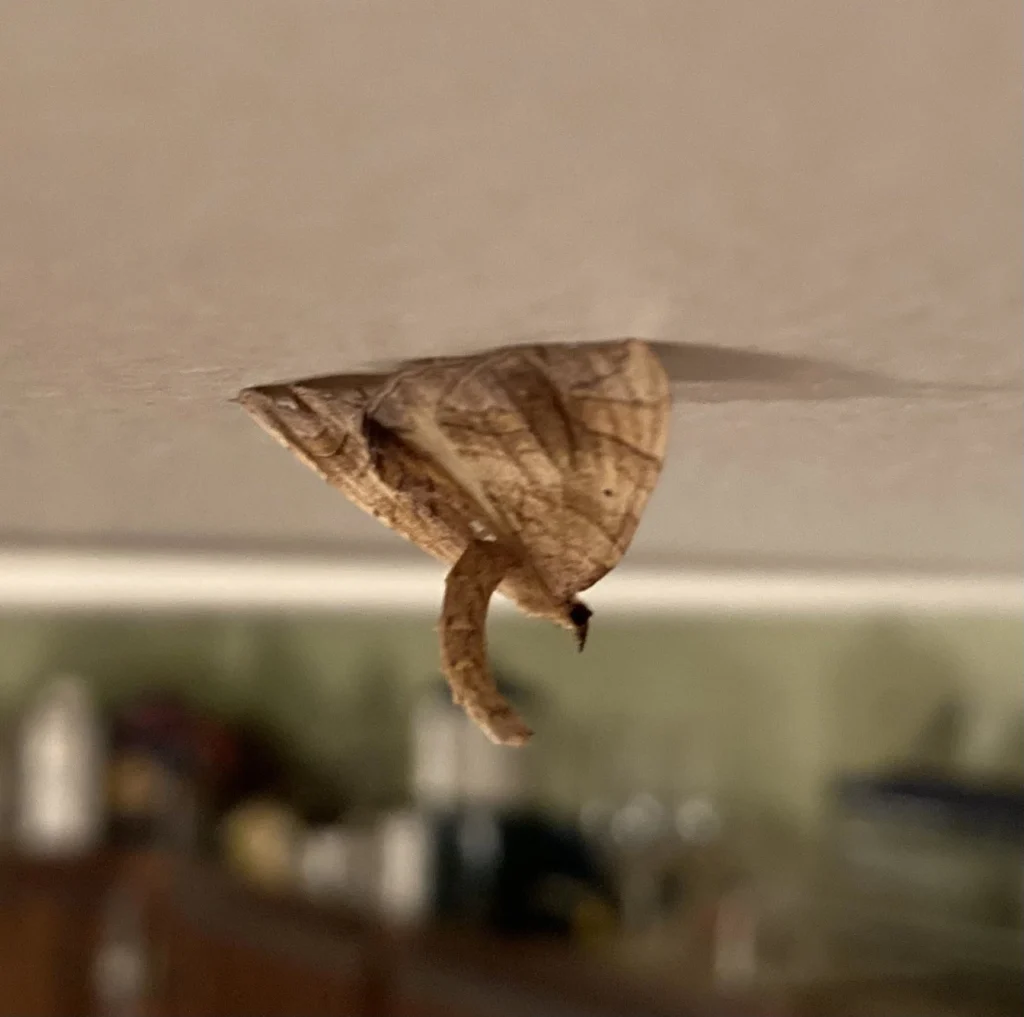
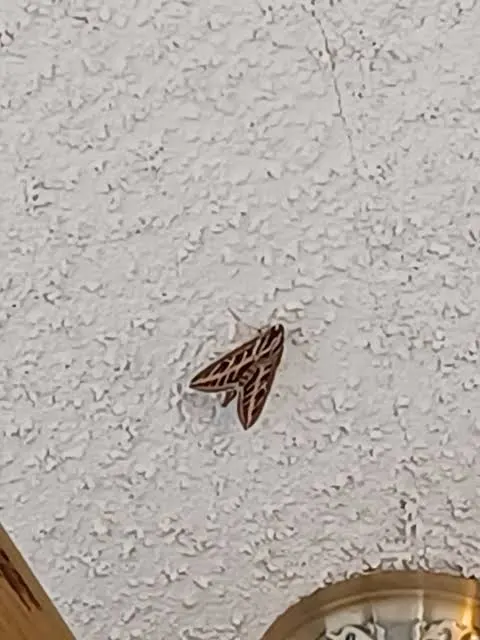
A moth sitting on a wall or ceiling is usually one of three things: an outdoor moth that came in at night and is resting until dark, a small moth that lives and breeds indoors, or an insect that only looks like a moth. The wall or ceiling itself tells you little. What helps is the room you found it in, its size, how it holds its wings, and what is nearby, such as stored food, wool clothing, or a bathroom drain.
What the wall or ceiling can and cannot tell you
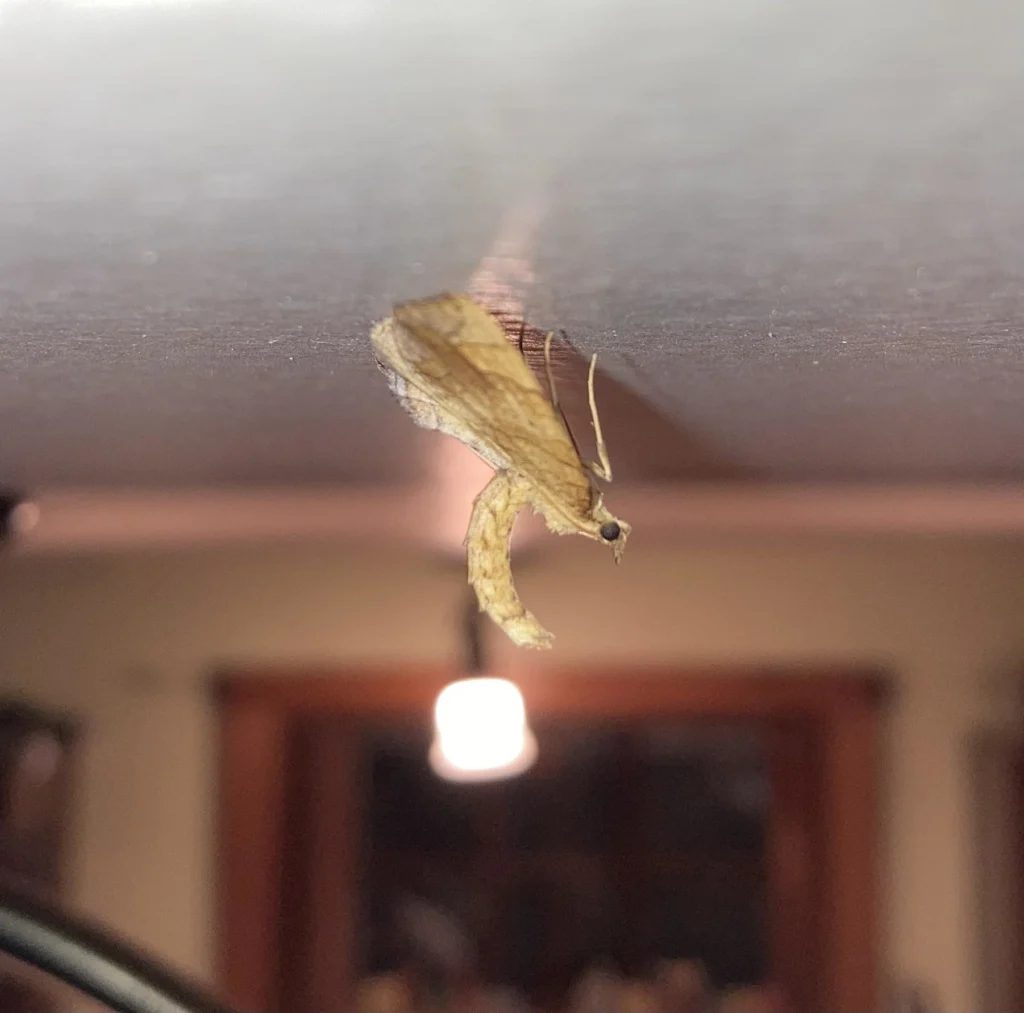
Almost any moth that ends up indoors will land on a wall or ceiling sooner or later. Those are simply the biggest surfaces in a room, and moths that fly at night spend the day sitting still. So finding a moth up there does not point to a particular species, and it does not mean your home has a moth problem.
The location inside your home is more useful. A small two-toned moth on a kitchen wall, a tiny fuzzy insect on the bathroom tiles near the shower, and a large patterned moth on the ceiling by the front door are very different situations. Start with where you are standing, then look at the insect.
Quick guide: where you found it and what it may be
| Where and what you see | Possible match | What to check next |
|---|---|---|
| Small moth, about ¾ inch across, on a kitchen wall, cupboard door, or ceiling; pale front third of the wings, coppery-brown outer part | Indianmeal moth (a stored-food moth) | Dry foods, birdseed, and pet food for webbing or larvae |
| Small pale caterpillars crawling on the kitchen ceiling or upper walls | Stored-food moth larvae looking for a place to pupate | The same food check; look along cupboard seams and cracks for cocoons |
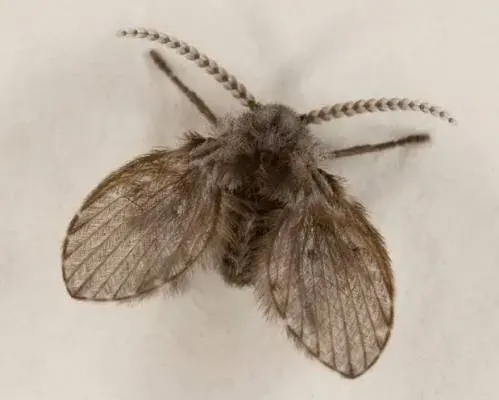
| Tiny insect, about ⅛ inch, on bathroom walls near a drain, with hairy wings held like a roof | Moth fly (drain fly), not a moth | Sinks, showers, and floor drains for slimy buildup |
| Medium or large patterned moth on a ceiling or wall near a light, a door, or a window | Outdoor moth that came in at night | Whether a door or unscreened window was open after dark |
| Small buff moth in a dark closet, rarely on bright walls | Clothes moth | Wool, fur, feathers, and other animal fibers for holes or larvae |
| Brownish moth with dark spots, or a moth with a white “collar,” on an indoor wall in Britain or Europe | Brown house moth or white-shouldered house moth | Dust and debris behind skirting boards and in stored goods |
| Flat, seed-shaped gray case on a wall, in a humid area such as Florida or Louisiana | Household casebearer caterpillar | Old spider webs, corners, and wool rugs nearby |
Treat the table as a starting point. Several of these insects can turn up in more than one room, and a single sighting is rarely enough for a firm answer.
Small moths that live indoors
Indianmeal moth
The Indianmeal moth is the small moth most often seen on kitchen walls and cupboard doors. It has a wingspread of about ¾ inch. The front third of each forewing is whitish-gray, and the rest is reddish-brown to coppery, so a resting moth looks clearly two-toned. When it lands, it folds its wings flat along the length of its body. In flight it tends to flutter weakly in a zigzag.
The adult moth is only the visible sign. The damage is done by the larvae, which feed in dry stored foods such as cereals, flour, nuts, dried fruit, birdseed, and pet food, and they leave webbing behind. When the larvae are fully grown, they often leave the food and wander to find a place to pupate. That is why people sometimes find small caterpillars on the ceiling, on upper walls, or on the counter, well away from the pantry.
Clothes moths
Webbing and casemaking clothes moths are small, about ½ inch, and beige or buff, with narrow, fringed wings. The webbing clothes moth is evenly buff with a small tuft of reddish hairs on its head. The casemaking clothes moth looks similar but has dark specks on its wings.
Clothes moths avoid light, so they are seldom seen resting on a bright wall or ceiling. They stay in dark, undisturbed places such as closets, basements, and attics. A small moth in a well-lit kitchen is more likely to be a stored-food moth than a clothes moth. Adult clothes moths do not feed and cause no harm to fabric; the larvae feed on wool, fur, feathers, and other animal fibers.
Brown house moth and white-shouldered house moth
In Britain and Ireland, two other small moths are common indoors. The brown house moth (Hofmannophila pseudospretella) has a wingspan of about 15–26 mm (⅝–1 inch) and varies a lot in size. Adults are often found on indoor walls and can appear at any time of year, though they are most common in summer. Its caterpillars live behind skirting boards and in similar spots, feeding on organic debris that can include wool, fur, dead insects, and dried plant material.
The white-shouldered house moth (Endrosis sarcitrella) is slightly smaller, about 15–21 mm across, and is named for the white “shoulders” at the front of its body. It breeds continuously indoors, so it can also be seen year-round. Its caterpillars feed on dried plant and animal debris. Both were carried around the world by people, and both are common in British homes.
Household casebearer
In humid parts of the southeastern United States, especially Florida and Louisiana, people often find what looks like a flat, gray seed stuck to the wall. This is the case of the household casebearer (Phereoeca uterella), a small caterpillar that builds a spindle-shaped case of silk, sand, soil, and debris, about 8–14 mm long. The caterpillar pokes its front end out to crawl and drags the case with it.
Cases turn up under old spider webs, in bathrooms, bedrooms, and garages, and hanging from curtains. The larvae feed mostly on old spider webs and will also eat wool. The adult is a small, gray moth with a wingspan of about 7–13 mm. Vacuuming the cases and clearing old webs is usually enough to keep them in check.
Insects on the wall that are not moths
Moth flies (drain flies)
If the “moth” is tiny, about ⅛ inch long, fuzzy, and sitting on a bathroom wall near the shower or sink, it is likely a moth fly. Moth flies are true flies, not moths. Fine hairs cover their wings, and they hold them like a roof over the back, which gives them a moth-like look. They fly weakly, in short hops, and often sit on walls near the drain they came from.
Their larvae live in the slimy film inside drains. Moth flies do not bite and do not damage the house. To find which drain they are coming from, coat the inside of a cup with petroleum jelly or cooking oil, turn it upside down over the drain, and check it after a day. Cleaning out the buildup in that drain removes their breeding site.
Caddisflies
Caddisflies look a lot like moths and are drawn to lights at night, so they often end up on walls and ceilings in homes near streams, lakes, or ponds. They hold their wings like a roof over the body, but their forewings are covered in fine hairs rather than scales, and their antennae are long and thread-like, usually about as long as the body. A dull, roof-winged insect with very long, thin antennae on a ceiling near water is worth checking against caddisflies before calling it a moth.
Outdoor moths that came in at night
Many moths on walls and ceilings are simply outdoor moths that flew in through an open door or window after dark. Research published in 2024 found that flying insects keep their back turned toward the brightest light they see, because they normally use the sky to tell which way is up. Near a lamp or ceiling light, that response keeps them circling the light instead of flying away, and when they finally settle, the ceiling or a wall beside the light is an easy place to land.
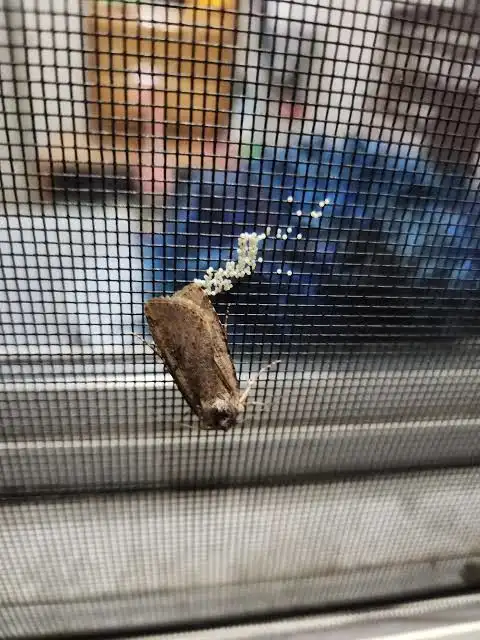
Once a night-flying moth has landed, it may stay in the same spot all day. That stillness is normal resting behavior, not a sign that the moth is sick or that it is laying eggs on your wall.
Resting posture helps sort these visitors into broad groups. Geometrid moths usually rest with their wings spread out flat against the surface, and they tend to have slender bodies and broad wings, often with thin wavy lines. Many owlet moths fold their wings back over the body instead. Neither posture names a species, but it narrows your search. For wing markings, our guide to moth identification by wing pattern is a good next step, and if the moth is large and on the outside of the house, see what to do about a large moth on an outside wall at night.
How to identify a moth on your wall or ceiling
- Note the room. Kitchen, bathroom, closet, or near an outside door each point toward a different group.
- Photograph it without touching it. A moth on a high ceiling can usually be photographed with your phone’s zoom from below. Take one photo from as straight-on as you can, and one from the side if possible.
- Judge the size. Compare it with something nearby, such as a light switch or a ceiling fixture. “Tiny,” “about the size of a fingernail,” and “as wide as a palm” are already useful categories.
- Look at the wings. Are they spread flat, folded back along the body, or held like a roof? Are they scaly or hairy? Is there a clear two-toned pattern?
- Check the antennae. Thread-like antennae about as long as the body, together with hairy wings, point toward a caddisfly rather than a moth.
- Add the date and your location. Many moths fly only in certain months or regions, and some indoor species, like the household casebearer, are limited to certain climates.
- Look for evidence nearby. Webbing in food, holes in wool, cases on the wall, or slime in a drain tell you far more than the moth itself.
For a fuller method that works for any moth, see our beginner’s guide to identifying a moth, or browse the moth identification guides by feature.
Should you worry about a moth on the wall?
Usually not. One moth on a wall or ceiling is not proof of an infestation. Adult moths do not bite, and most moths found indoors are outdoor visitors that will leave if given the chance.
It is worth a closer look if you keep finding the same small moth in the same room over days or weeks, if you see small caterpillars on the kitchen ceiling, or if you find webbing in food, holes in wool, or cases on the walls. In that case, look for the source rather than chasing the adults. Our guide to moths around the home covers how to check pantries, closets, and storage areas calmly.
To move a single outdoor moth, wait until it rests low enough to reach, place a glass over it, slide a piece of card underneath, and release it outside. Turning off indoor lights near open doors in the evening helps keep the next one out.
FAQ
Why is there a moth on my ceiling that won’t move?
Most moths fly at night and rest during the day. A moth that has not moved since morning is usually just waiting for dark.
Are small moths on my kitchen ceiling pantry moths?
They may be. A small two-toned moth on a kitchen wall or ceiling fits the Indianmeal moth, and caterpillars on the kitchen ceiling often point to stored-food moths. Confirm it by checking dry foods, birdseed, and pet food for webbing or larvae before throwing anything away.
What is the tiny fuzzy moth on my bathroom wall?
A very small, fuzzy insect with roof-like wings on a bathroom wall is most often a moth fly, which breeds in drains. It is a fly, not a moth, and cleaning the drain is the fix.
Can a moth on the wall be identified from one photo?
Sometimes to a group, occasionally to a species. Many small brown moths look alike in photos, so add your location, the date, an estimate of size, and notes on the room and any evidence nearby.