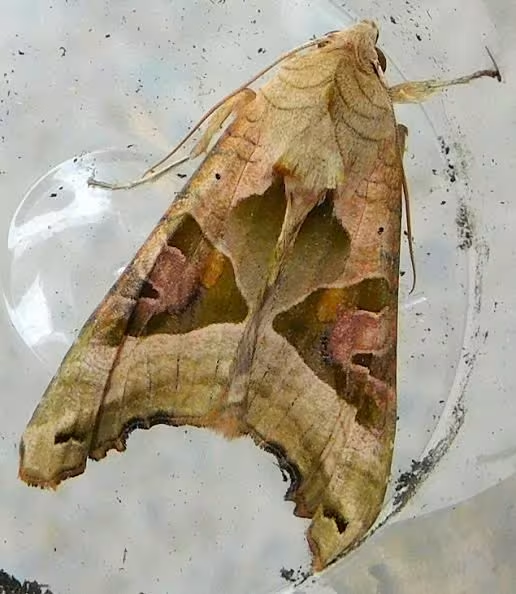
A moth with wavy wing pattern identification usually cannot be confirmed from the wavy lines alone. However, those markings are a useful starting clue. Geometer moths are especially well known for transverse, sometimes wavy lines that may continue from the forewings onto the hindwings, but other moth families can show similar zigzags, bands, scallops, and irregular crosslines.
For a beginner, the best approach is to look at the whole moth rather than trying to match one stripe. Check how it holds its wings, whether its body is slender or heavy, how large it is, where and when you found it, and whether the lines continue across all four wings.
A clear photograph and an accurate location can often turn a vague “brown moth with wavy lines” into a much shorter list of possibilities.
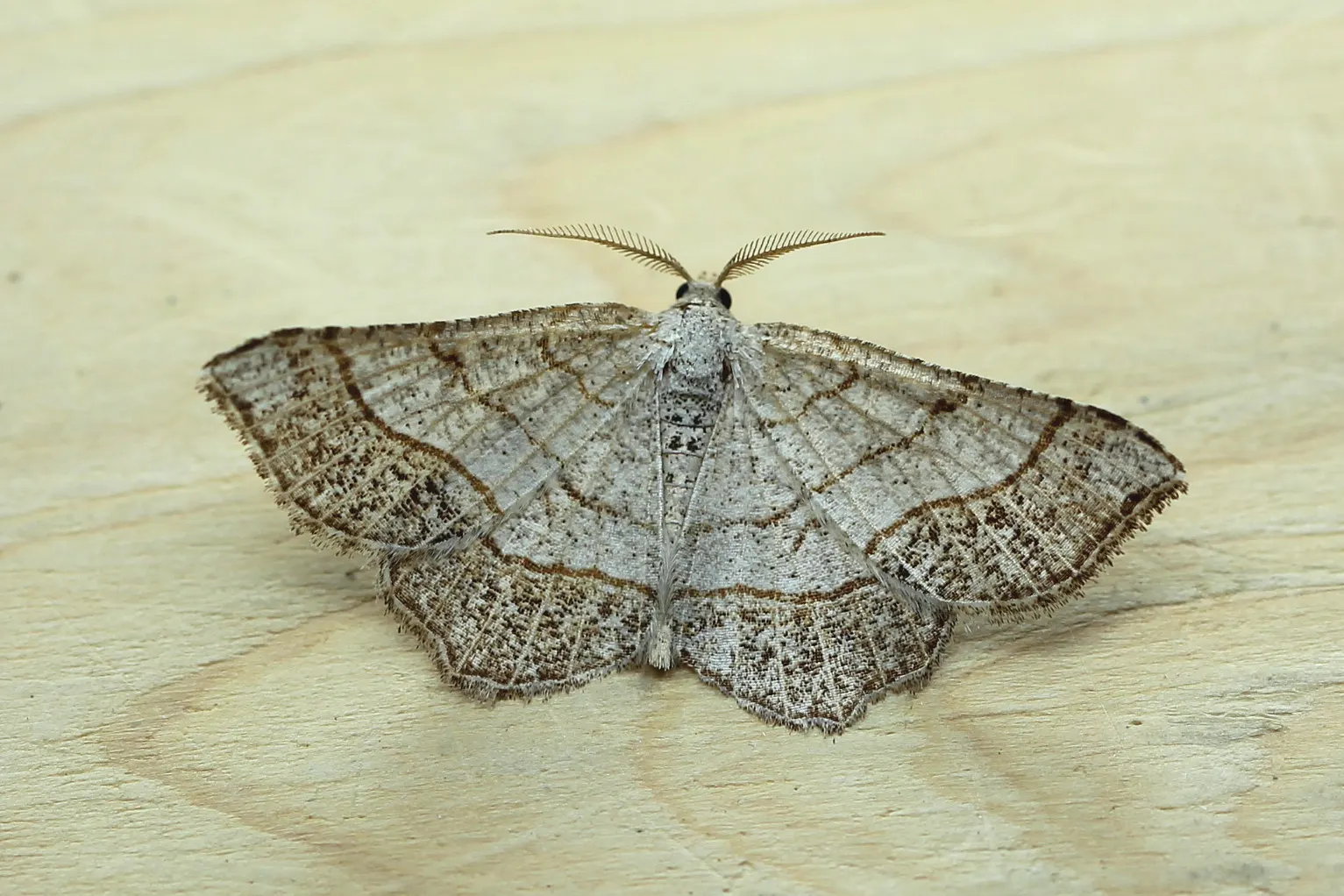
Why Wavy Wing Lines Are Useful but Not Enough
When people describe an unknown moth as having “wavy wings,” they usually mean the markings on the wings, not that the wings themselves are physically bent.
These markings may look like:
- thin rippling lines
- dark zigzags
- pale scalloped bands
- several parallel crosslines
- a single curved stripe
- saw-toothed markings
- broken waves or dashes
- bands edged by irregular lines
Entomologists use more precise names for different markings. A line before the middle of the forewing may be called an antemedial line, while one beyond the middle is a postmedial line. A line closer to the outer wing margin may be called a subterminal line. Species descriptions frequently use these features because their exact position and shape can help separate similar moths. For example, descriptions of some noctuid moths distinguish zigzagged antemedial and postmedial lines rather than simply describing the insect as “wavy.”
You do not need to memorize this terminology to identify a moth. For a beginner, it is more useful to ask:
How many lines are there? Where are they? Do they cross the entire wing? Are they straight, scalloped, jagged, or broken?
Those observations are much more informative than color alone.
Geometer Moths Are an Important Possibility
If the moth has broad wings, a relatively slender body, and several fine wavy lines running across the wings, Geometridae — the geometer moth family — should be one of the first groups you compare.
North Carolina State University describes adult geometrids as generally small to medium-sized moths with slender bodies and broad wings. Their wing patterns often include intricate wavy lines that appear continuous from the forewing onto the hindwing. The antennae may be threadlike or feathered.
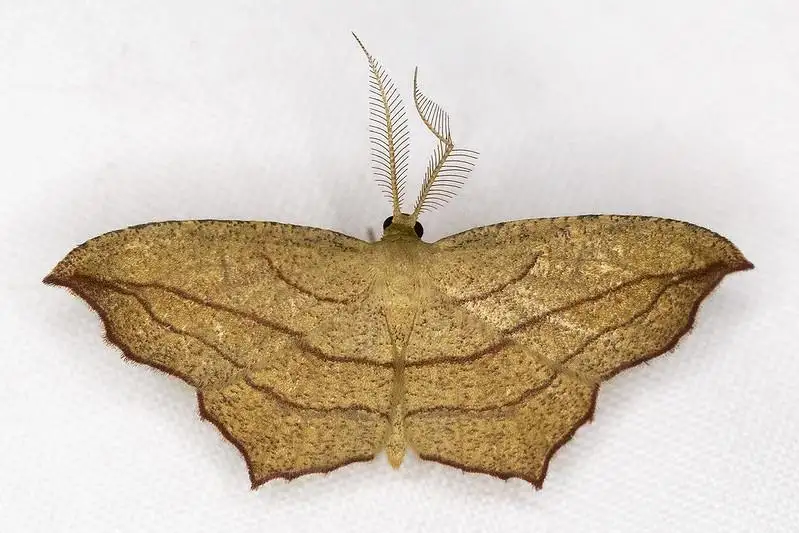
The Missouri Department of Conservation also notes that many adult geometrids hold their broad wings spread flat to the sides, although there are exceptions. In some species, forewing and hindwing markings align when the moth rests, creating continuous bands across the entire visible wing surface.
This combination is particularly useful:
slender body + broad spread wings + crosslines continuing across forewings and hindwings
It does not prove that you have found a geometer moth, but it makes Geometridae a strong family-level possibility.
The family includes an enormous variety of appearances. Some geometrids are gray or bark-colored, others pale cream, brown, yellow, or green. Pattern intensity can range from barely visible lines to bold contrasting bands. If you want to see how varied moth families can be, browse the Types of Moths and Moth Species with Pictures guides.
Why are they called geometer moths?
Their name is connected primarily with their caterpillars rather than their adult wing patterns.
Geometer caterpillars are commonly called inchworms, loopers, or spanworms because of their distinctive looping movement. They have fewer abdominal prolegs than many other moth caterpillars, producing the familiar “inching” motion.
Finding an inchworm on a plant can therefore provide another clue about which moth family may be present in an area, although you normally cannot assume that a nearby adult and caterpillar belong to the same species.
Other Moths Can Have Wavy or Zigzag Markings
One of the most important lessons in moth identification is that wavy lines are not exclusive to geometer moths.
Several unrelated moths can produce a similar first impression.
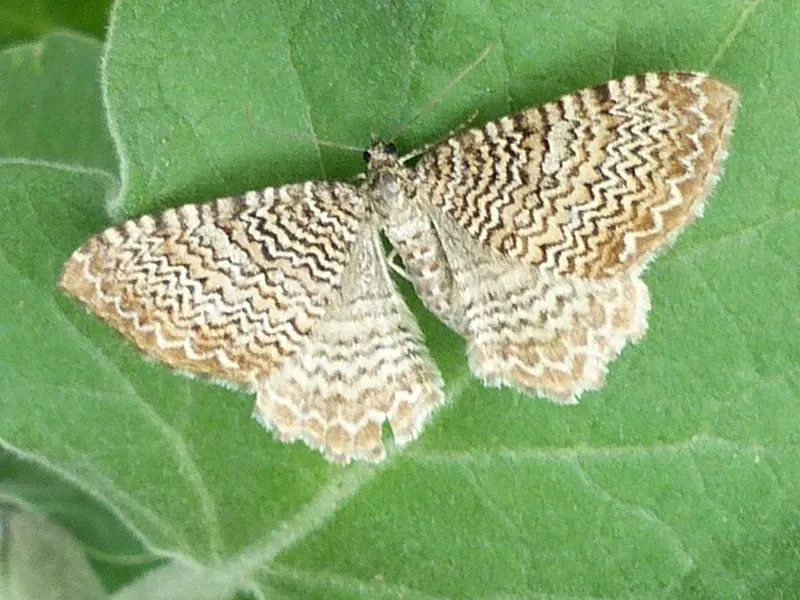
Noctuid and related moths
Many moths traditionally recognized among noctuid-type groups have complex forewing patterns consisting of crosslines, spots, patches, and scalloped bands.
For example, the scribbled sallow moth has distinctly zigzagged antemedial and postmedial lines across its forewings.
A beginner looking only at those lines might assume it is a typical geometer. Body shape and the complete pattern help separate it.
This is why a useful moth identification process should always combine multiple traits.
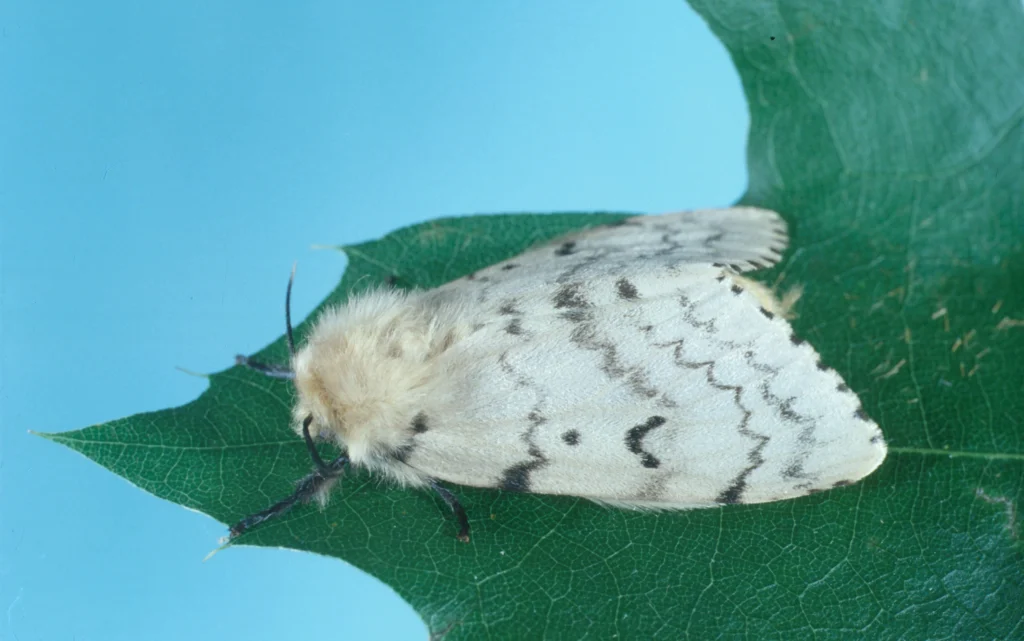
Spongy moth
The spongy moth (Lymantria dispar) provides another good example of why “wavy pattern” is too broad for a species identification.
Females can have creamy-white wings crossed by darker saw-tooth or zigzag-like markings, while males are smaller and generally darker. Male antennae are conspicuously feathered.
A photograph of a pale moth with dark waves therefore needs much more context before it can be called a spongy moth. Size, sex, geographic range, body structure, antennae, and other markings all matter.
Meal moth
Indoor moths provide yet another example.
The meal moth, Pyralis farinalis, has patterned wings containing brown areas bordered by pale or whitish wavy lines. University of Minnesota Extension notes that the adult also has a characteristic resting posture in which the abdomen may be curved upward. The species is associated with stored products such as grains.
That is very different from finding a geometrid sitting on an exterior wall beside a garden.
Context changes the identification.
How to Read the Wing Pattern
Instead of asking only whether the pattern is wavy, break it into smaller observations.
Count the main crosslines
Look for one, two, three, or several clearly visible lines.
Are they:
- close together?
- widely separated?
- equally dark?
- doubled?
- edged with pale scales?
- interrupted in the middle?
A moth with one strong diagonal band belongs to a different visual category from one covered in six thin parallel ripples.
See whether the markings continue onto the hindwings
This is especially useful when the moth is resting with all four wings visible.
Many geometrids have patterns arranged so that lines on the forewings visually continue onto the hindwings.
If the forewing contains several wavy lines but the hindwing is plain, you should broaden your search beyond the most obvious geometrid candidates.
Check the direction of the waves
Some lines run almost straight across the wing.
Others:
- bow outward
- bend sharply near the leading edge
- form a series of teeth
- create a broad W shape
- curve toward the body
- become scalloped near the lower wing edge
Small differences in line shape can be diagnostic once you have narrowed the moth to a genus or small group.
Look for spots between the lines
Do not let the waves distract you from smaller marks.
Check for:
- a central black dot
- kidney-shaped marks
- round or oval spots
- pale patches
- dark dashes
- contrasting wing tips
- reddish or coppery areas
These can sometimes be more useful than the wavy lines themselves.
Examine the wing margins
Are the outer edges smooth, rounded, scalloped, angular, or pointed?
Geometer moths include many species with distinctive outer wing shapes. Some have sharply angled forewings; others have gently scalloped hindwings.
Wing outline should therefore be treated as part of the pattern rather than as a separate afterthought.
Check Wing Shape and Resting Posture
A moth can look dramatically different depending on how it holds its wings.
Wings spread broadly and flat
A moth resting flat against a wall, tree trunk, leaf, or sheet with broad wings extending sideways is worth comparing with geometrids.
This is a common resting posture in the family, although not universal.
Wings folded like a roof
Many other moths hold their wings sloping backward over the abdomen.
When this happens, the hindwings may be completely hidden. A photograph taken only from above can therefore show less of the moth’s pattern than expected.
Wings wrapped tightly around the body
Some small moths rest in a narrow, elongated shape. These are unlikely to resemble the classic broad-winged geometrid silhouette even if their wings contain irregular lines.
Triangular resting shape
Numerous small pyralid and crambid moths can form a triangular outline when resting.
If a tiny indoor moth looks triangular rather than broad and flat, its location and food association may be more useful than trying to match individual lines.
For a fuller introduction to these structural clues, see How to Identify a Moth.
Look at Size and Body Shape
“Brown moth with wavy lines” could describe insects of very different sizes.
Always record an approximate measurement.
Useful comparisons include:
- smaller than a fingernail
- about the width of a coin
- roughly 2–3 cm across
- around 5 cm across
- larger than the palm of your hand
If possible, estimate wingspan rather than body length when the wings are open.
Avoid picking up the moth solely to measure it. A photograph beside a familiar object, without disturbing the insect, can give useful scale.
Slender versus heavy-bodied moths
Body proportions matter.
Many geometrids have a noticeably slender abdomen in relation to their broad wings.
By contrast, some noctuid moths look heavier through the thorax and abdomen. Hawk moths often have especially robust, streamlined bodies and narrower forewings.
These differences are easier to recognize after looking at several photographs rather than a single specimen.
Examine the Antennae
Antennae are worth photographing, but they should not be used as a stand-alone identification test.
Moths may have antennae that look:
- thin and threadlike
- finely combed
- strongly feathered
- slightly thickened
Within some species, males and females have noticeably different antennae. Spongy moth males, for example, have feather-like antennae, while female antennae are much less conspicuous.
Geometrid antennae can also be either threadlike or feathered.
Therefore, “feathery antennae” does not automatically identify a moth family or species.
Use antennae as one piece of evidence.
Use Location and Season
Location is one of the strongest identification filters available.
A species that occurs in Florida may not occur in northern Canada. A moth recorded in Britain may have close-looking relatives in North America, Australia, or East Asia.
That is why a photograph found through an image search can be misleading if the geographic origin is ignored.
Butterflies and Moths of North America specifically requests both the date and exact location when people submit photographs for identification. Those details allow an observation to be compared with known regional records and flight periods.
Record at least:
Country → state/province/region → nearest town or county
You do not need to publish your home address.
Season matters too
Many moth species are adults only during particular parts of the year.
If two species look nearly identical but one normally flies in spring and the other in late summer, the observation date can substantially narrow the possibilities.
Record the exact date whenever possible rather than relying on “I saw it sometime in summer.”
Consider Habitat and Behavior
The place where a moth is sitting is useful, but the surrounding habitat is even better.
Ask what is nearby.
Garden or woodland
A patterned moth found among trees, shrubs, herbaceous plants, or leaf litter may be associated with local vegetation.
Take note of whether the area is:
- deciduous woodland
- coniferous woodland
- grassland
- wetland
- suburban garden
- agricultural land
- coastal habitat
- dry scrub
You do not need to identify every plant. Even a broad habitat description helps.
Porch light or window
Moths found near outdoor lights are often difficult to identify from behavior alone because many different species may appear around illuminated buildings.
Treat the light as the place you encountered the moth, not as a species-level characteristic.
Photograph the moth before it flies away, especially if the wings are spread enough to show both forewings and hindwings.
Tree trunk or wall
Gray, brown, cream, and lichen-like patterns can make moths remarkably inconspicuous on bark and masonry.
What looks like a random wavy design may function as camouflage by disrupting the moth’s outline against a complex background. The Natural History Museum describes this kind of disruptive coloration in moths resting against bark.
Wavy-Patterned Moths Around the Home
Finding a patterned moth indoors does not automatically mean you have a household infestation.
The first question is not “What pest is this?”
It is:
Where exactly did I find it, and is there any evidence that larvae are feeding indoors?
A single moth on a wall or window
One isolated moth near a door, open window, hallway, or light may simply be an outdoor species that entered the building.
If it has broad wings, a detailed bark-like pattern, and no connection with stored food or textiles, compare it with outdoor moth groups first.
A moth repeatedly appearing near stored food
The situation changes if small moths repeatedly appear around:
- flour
- cereal
- grains
- nuts
- seeds
- dried fruit
- pet food
- stored dry products
Indianmeal moths are among the common stored-food moths in homes. Adults have distinctive two-toned forewings, while larvae may create silken webbing in infested food.
Meal moths can also occur around stored grain and have more obviously patterned wings with pale wavy boundaries.
The location and larval evidence matter more than the general phrase “wavy moth.”
For a focused household checklist, see Moths Around the Home and the more detailed Moths Around the Home Guide.
A moth near clothing or carpets
Do not assume a patterned outdoor moth is eating clothing.
The common webbing clothes moth is relatively plain and tannish rather than strongly covered with wavy crosslines. Case-bearing clothes moths can have small spots, although markings may become difficult to see on worn adults. More importantly, it is the larval stage that damages susceptible natural-fiber materials.
If you suspect fabric damage, look for evidence around wool, fur, feathers, carpets, or similar materials instead of identifying the problem from one adult moth alone.
Practical Identification Tips
When photographing or recording a moth with wavy wing markings, collect the following information.
Photograph the moth from directly above
A dorsal photograph — looking down at the back — is often the most useful view for wing-pattern identification.
Try to capture:
- both forewings
- both hindwings if visible
- outer wing margins
- the thorax
- abdomen
- antennae
Do not force the wings open.
Take a second photograph from the side
A side view can show whether the wings lie flat, form a roof, or wrap around the body.
It can also reveal the body’s thickness and resting posture.
Record approximate size
Use a ruler if convenient, or photograph the moth near a known object without touching it.
Even a rough estimate is better than none.
Note the exact pattern
Write down observations while the moth is still present:
- ground color
- number of wavy lines
- line color
- whether lines continue onto hindwings
- spots or dots
- patches near the wing tips
- scalloped edges
- unusual colors
Photos can distort color, so a written note can be surprisingly useful.
Record location
Include country and region.
For difficult species, a county, prefecture, province, or similar local area can make a major difference.
Record the date
Exact dates are preferable because flight periods often help narrow identifications.
Record habitat
“Found outdoors” is less useful than:
“Resting on a porch wall beside deciduous woodland.”
Or:
“Found on a window beside a suburban garden.”
Or:
“Repeatedly found inside a grain-storage room.”
Note behavior
Useful details include:
- active during daytime
- came to an outdoor light
- resting flat against bark
- wings held roof-like
- flying low through vegetation
- repeatedly appearing around stored food
Keep the original photographs
Image compression can erase tiny scales and lines.
Keep the highest-resolution version if you intend to request expert identification later.
BAMONA, for example, encourages clear photographs accompanied by the date and location for identification submissions.
Quick Comparison Table
| What you observe | Possible direction to investigate | What to check next |
|---|---|---|
| Broad wings, slender body, wings spread flat, several wavy lines | Geometer moths | Do the lines continue from forewing to hindwing? |
| Brown or gray moth with complex zigzags mostly on forewings | Noctuid or related moth groups | Look for central spots, heavier body, and precise line shape |
| Pale or cream moth with strong dark saw-tooth lines | Several possibilities, including spongy moth in appropriate regions | Check size, antennae, geography, and other markings |
| Small patterned moth around grain or stored dry food | Stored-product moth possibility | Inspect food for larvae, silk, or repeated moth activity |
| Plain golden or buff moth around natural-fiber materials | Clothes moth possibility | Look for larval evidence and fabric damage |
| Broad patterned moth appearing once near a window or porch light | Often an outdoor visitor | Photograph it and compare with regional species |
| Wavy lines continuing across all four visible wings | Strong clue toward some geometrids | Confirm wing shape, body build, range, and season |
| Pattern is faint or incomplete | Worn specimen or naturally weak markings | Use shape, size, location, season, and remaining marks |
The table is a narrowing tool, not a species key.
Common Identification Mistakes
Assuming all wavy-lined moths are geometrids
Geometrids are important candidates because wavy crosslines are common in the family, but other moth groups also possess zigzags and scalloped markings.
Use the family as a starting point, not a conclusion.
Searching by color alone
“Brown moth” or “gray moth” can produce hundreds of possibilities.
A better description would be:
“Small gray moth, approximately 25 mm wingspan, three dark wavy crosslines, broad wings held flat, found on an exterior wall in Ohio in August.”
Every added observation removes irrelevant possibilities.
Ignoring the hindwings
If the moth is resting flat, look at the hindwings.
A line continuing cleanly from front to back can be a valuable structural clue.
Assuming a moth indoors is a clothes moth
Many outdoor moths occasionally enter buildings.
The relevant question is whether there is evidence of a breeding population associated with food, textiles, or another indoor resource.
Judging size from a close-up photo
Macro photography can make a 15 mm moth look enormous.
Always record an actual or approximate scale.
Ignoring worn wing scales
Moth wing markings can become less distinct as scales are lost.
University of Minnesota Extension specifically notes that the characteristic markings of Indianmeal moths may become less clear when scales have rubbed from the wings.
An older specimen may therefore look surprisingly different from a fresh reference photograph.
Expecting one photo to prove a difficult identification
Some closely related species cannot be separated confidently from a poor photograph.
It is perfectly reasonable to identify an observation only as:
Geometridae
or:
possible geometer moth
rather than assigning an unsupported species name.
Good identification is not about forcing the most specific answer possible. It is about stopping at the level the evidence supports.
When to Seek Expert Help
Consider asking for experienced identification help when:
- several species look nearly identical
- your moth appears outside the expected range of the closest match
- the photograph shows an unusual or potentially significant species
- identification depends on features not visible in your photos
- you are documenting biodiversity records
- you repeatedly find moths associated with stored food or fabric damage and cannot identify the source
In North America, Butterflies and Moths of North America accepts photographs with date and location information for review by regional coordinators.
In the UK, the Natural History Museum offers identification resources, and regional moth groups and Butterfly Conservation resources can also help with local species.
Elsewhere, useful options include a local natural history museum, university entomology or extension service, regional moth organization, or established biodiversity recording group.
For a household infestation involving stored products or valuable textiles, a qualified local pest professional may be appropriate if the source cannot be located or the problem persists.
Conclusion
The safest approach to moth with wavy wing pattern identification is to treat the pattern as the beginning of the identification process rather than the answer.
Geometer moths deserve particular attention when the insect has a slender body, broad wings held flat, and wavy lines that continue across both forewings and hindwings. But noctuid-type moths, spongy moths, stored-product moths, and other groups can also show zigzag or wavy markings.
Record the moth’s size, complete wing pattern, antennae, resting posture, location, season, habitat, and behavior, and take clear photographs whenever possible. Those combined clues are far more reliable than color or a single stripe.
If you are still narrowing down an unknown moth, continue with the Moth Identification guide or browse Moth Species with Pictures to compare the overall structure as well as the markings.
Frequently Asked Questions
What moth has wavy lines on its wings?
Many moths have wavy or zigzag lines, so the description does not point to one species. Geometer moths are especially worth checking because wavy lines commonly occur across their broad wings, but several other moth families have similar markings.
Are moths with wavy wing patterns always geometer moths?
No. Wavy crosslines are useful clues for Geometridae, especially when they continue from forewing to hindwing, but similar lines also occur in unrelated moths. Body shape, wing posture, size, location, and season should also match.
How do I identify a small brown moth with wavy lines?
Start by measuring it and noting where it was found. Check whether the wings are broad or narrow, whether the hindwings are visible, how many lines there are, and whether the moth holds its wings flat or roof-like. If it was found around stored food, inspect that food for larvae or silk rather than relying only on the adult’s color.
What does it mean if the lines continue across the front and hind wings?
Continuous wavy crosslines across forewings and hindwings are characteristic of many geometer moths and can be an important family-level clue. They are not enough by themselves for a species identification.
Is a wavy-patterned moth in my house harmful?
Not necessarily. A single outdoor moth that enters through a door or window is different from moths repeatedly emerging from stored food or natural-fiber materials. Look for evidence of larvae and a consistent indoor food source before assuming you have an infestation.
Can wing patterns fade as a moth gets older?
They can become less distinct when wing scales are rubbed away. This is one reason an older moth may not match a fresh reference photograph exactly.
Can I identify a moth from one photograph?
Sometimes, especially if the species has distinctive features. In harder cases, identification may require several views plus size, date, location, and habitat. BAMONA specifically uses photographs together with date and location information when reviewing identification submissions.
Should I identify the moth from an image search?
Image search is useful for finding candidates, but visual similarity alone is not enough. Check whether the reference species occurs in your region and season, and compare structure, size, wing shape, and markings rather than selecting the first visually similar photograph.
References and Further Reading
Family Geometridae — General Entomology
North Carolina State University
https://genent.cals.ncsu.edu/insect-identification/order-lepidoptera/family-geometridae/
Useful overview of geometer moth body shape, antennae, wing posture, and continuous wavy wing lines.
Geometrid Moths
Missouri Department of Conservation
https://mdc.mo.gov/discover-nature/field-guide/geometrid-moths
Beginner-friendly information on adult geometrid structure and resting posture.
Identification Tools
Butterflies and Moths of North America
https://www.butterfliesandmoths.org/identification_tools
Explains identification resources and the value of photographs, dates, and accurate locations.
Identify a Butterfly, Moth, or Caterpillar
Butterflies and Moths of North America
https://www.butterfliesandmoths.org/identify
Regional identification and sighting-review resource for North America.
Identify a Moth
Butterfly Conservation
https://butterfly-conservation.org/moths/identify-a-moth
Photographic identification resource covering a wide range of British moth species.
Pantry Pests: Insects Found in Stored Food
University of Minnesota Extension
https://extension.umn.edu/product-and-houseplant-pests/pantry-pests-insects-found-stored-food
Useful for distinguishing outdoor moth observations from stored-food moth problems.
Clothes Moths Identification Guide
Natural History Museum, London
https://www.nhm.ac.uk/take-part/identify-nature/common-insect-pest-species-in-homes/clothes-moths-identification-guide.html
Identification information for common clothes moths and their larvae.