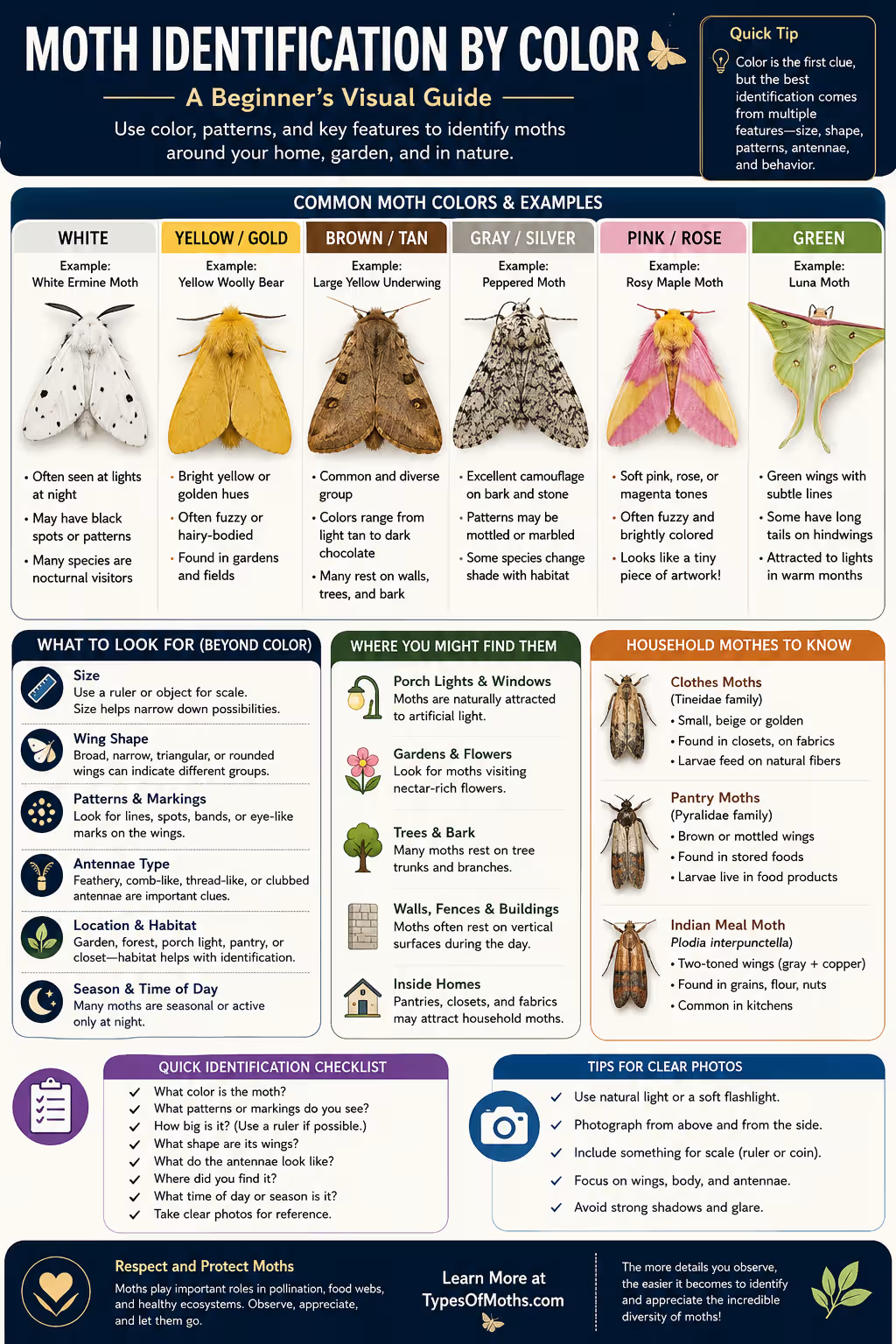
A moth’s color can help you begin an identification, but it rarely confirms a species by itself. Effective moth identification by color also considers wing pattern, size, shape, resting posture, antennae, location, season, habitat, and behavior.
Start by describing the moth’s dominant color under neutral light. Then look for bands, dots, wavy lines, eyespots, transparent areas, contrasting hindwings, and other repeatable markings. A clear photograph and the place and date of the sighting can reduce a long list of possibilities to a manageable group.
This guide explains how beginners can use color responsibly without forcing a species name when the evidence is incomplete.
Can a Moth Be Identified by Color Alone?
Color is useful for eliminating obviously different candidates. A pale green moth is unlikely to match a uniformly dark brown species, and a black moth with six red spots belongs in a different visual group from a plain cream moth.
However, color alone is not a reliable species test.
Butterfly Conservation’s identification material recommends considering wing pattern and shape along with flight period, distribution, habitat, and food plants. Its regional moth guidance specifically notes that wing shape and pattern may be more helpful than color.
Several factors create uncertainty:
- Different species may share nearly identical background colors.
- Males and females can look different.
- Individuals of one species may vary.
- Freshly emerged moths may look brighter than worn adults.
- Hindwing colors may be hidden while the moth is resting.
- Artificial lighting can shift green toward blue, cream toward white, or brown toward orange.
- Tiny wing scales may be rubbed away, weakening spots and bands.
- Regional species can resemble moths found on another continent.
Use color to create a shortlist. Confirm the shortlist with several independent features.
Readers who need a broader identification process can continue with How to Identify a Moth: A Beginner’s Guide.
Why Moth Colors Can Be Difficult to Judge
Moths and butterflies belong to the insect order Lepidoptera, a name associated with their scale-covered wings. Their colors and patterns are produced by thousands of tiny overlapping scales.
These scales make moths visually detailed, but they also complicate identification.
Wing wear changes the appearance
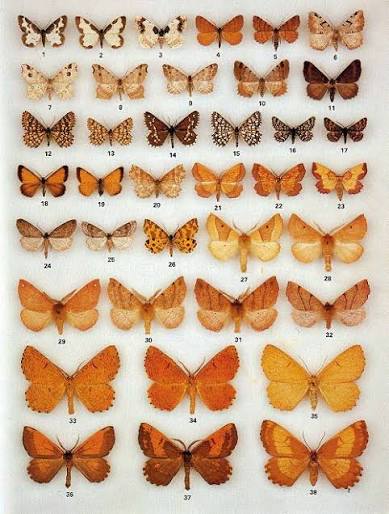
An older moth may have faded areas, missing fringe scales, or weak markings. A spot shown clearly in a field guide may be barely visible on a worn individual.
This is particularly important when identifying small indoor moths. University of Minnesota Extension notes that the distinctive markings of Indianmeal moths may become less clear when scales have rubbed away. The Natural History Museum similarly explains that spots on older case-bearing clothes moths can wear off.
Light changes perceived color
A moth photographed beside a warm household bulb may appear more yellow or orange than it does in daylight. A cool LED can make gray wings appear blue. Phone cameras may brighten dark areas or add saturation automatically.
Metallic and iridescent colors are especially dependent on the angle of light. Some Lepidoptera colors are created partly by microscopic physical structures rather than pigment alone, so the apparent hue can change as the insect or camera moves.
When possible, compare several photographs taken without a strong color filter.
Resting posture hides part of the pattern
Many moths rest with their forewings covering most or all of their hindwings. A moth that appears plain brown at rest might have orange, pink, red, yellow, or patterned hindwings underneath.
Do not force the moth to open its wings. Instead, wait for a natural movement or take additional photographs if it changes position.
Your color word may differ from someone else’s
One observer may call a moth tan, while another describes it as pale gray-brown. Olive may be recorded as green, brown, or yellow. Dark burgundy can look almost black in poor light.
Record two descriptions when necessary, such as:
- Olive green with pink lines
- Gray-brown with a copper patch
- Cream with pale yellow markings
- Black with a blue-green sheen
These combinations are more informative than a single color name.
A Simple Color-Based Identification Process
A consistent process prevents you from selecting the first similar image returned by a search engine.
Record the sighting before searching
Write down:
- Country, state, province, county, or nearest city
- Date and approximate time
- Indoor or outdoor location
- Habitat, such as woodland, garden, grassland, wetland, farmland, or urban wall
- Nearby plants
- Estimated body length or wingspan
- Whether the moth was active by day or night
- Whether it flew rapidly, hovered, remained still, or repeatedly returned to a light
Location and date are central to identification and wildlife recording. Butterflies and Moths of North America asks users to submit both with photographs, while its regional pages use local species lists to narrow possible identifications.
Choose the dominant visible color
Ignore tiny accents at first. Ask which color covers most of the visible forewings:
- Brown or gray
- White or cream
- Green
- Yellow, gold, or orange
- Pink or red
- Black or very dark brown
- Blue, purple, or metallic
- Strongly multicolored
Describe the pattern
After choosing a color group, look for:
- Straight or wavy crosslines
- Longitudinal stripes
- Rows of dots
- One large central spot
- Kidney-shaped marks
- Triangles or wedges
- A pale collar behind the head
- Contrasting wing borders
- Transparent windows
- Eyespots
- A different-colored hindwing
- Checkered fringe along the wing edge
Compare shape and posture
Notice whether the moth is:
- Broad and triangular
- Long and narrow
- Leaf-shaped
- Flat-winged
- Tent-shaped
- Resting with wings tightly wrapped around the body
- Holding the abdomen upward
- Showing long tails on the hindwings
Filter by region and season
Only compare your moth with species known from the same geographic area and active during the relevant part of the year.
A visually convincing match from another continent is not a strong identification.
Decide how precise the evidence allows you to be
A good conclusion might be:
- “Likely a geometrid moth.”
- “Possibly a sphinx moth in the genus X.”
- “Consistent with a luna moth, based on shape, tails, eyespots, and location.”
- “Small indoor moth, but the photo does not show enough detail to distinguish pantry and clothes moth candidates.”
- “Species cannot be confirmed from this photograph.”
An honest family- or genus-level identification is better than an unsupported species name.
Brown and Gray Moths
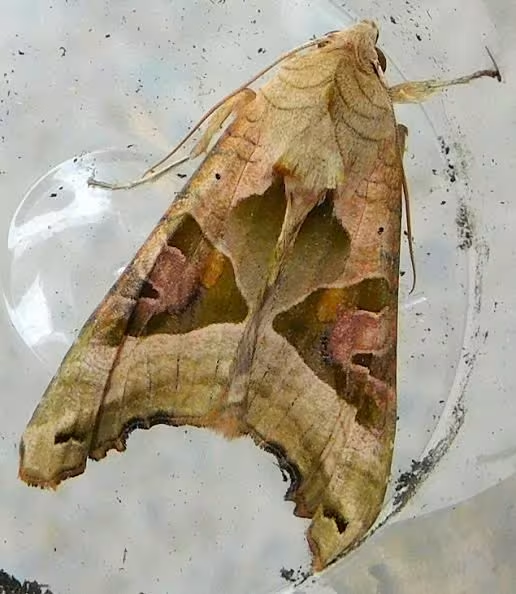
Brown and gray are among the most common colors noticed on resting moths. These colors can resemble bark, soil, dead leaves, stone, and weathered wood, making the moth difficult to see during the day.
Because many unrelated moths share these neutral colors, concentrate on structure rather than shade.
What to observe
Look for:
- Pale or dark crosslines
- Black dashes
- Kidney-shaped or oval marks
- Silver spots
- Rust-colored patches
- Scalloped wing edges
- A contrasting collar
- A pale stripe along the back
- Whether the forewing is narrow, broad, pointed, or rounded
A description such as “brown moth” may fit hundreds of possibilities. “Medium gray-brown moth with two wavy black lines, a white dot, and scalloped wing edges” is much more useful.
Brown moths found on walls
Outdoor moths commonly rest on walls, fences, doors, and window screens after visiting artificial lights. A brown moth on an exterior wall is not automatically associated with food, clothing, or structural damage.
Record whether it was:
- Outside or inside
- Alone or one of many
- Near a porch light
- Close to a pantry, closet, or stored materials
- Broad-winged or narrow-winged
- Larger or smaller than a fingernail
Context usually tells you more than the brown color.
Brown moths with hidden hindwings
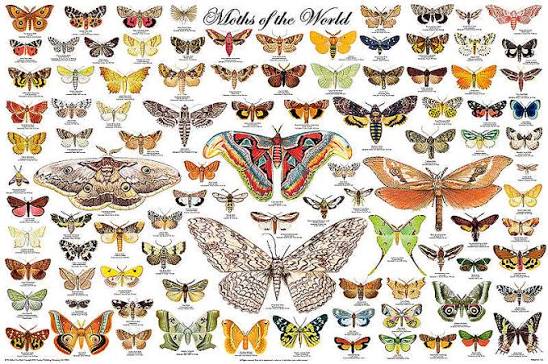
Some moths have subdued forewings and brightly colored hindwings. When resting, the forewings act like camouflage. During flight, the sudden flash of another color may become visible.
Record any orange, red, yellow, pink, or black color seen when the moth flies, but avoid chasing or handling it merely to expose the hindwings.
White and Cream Moths
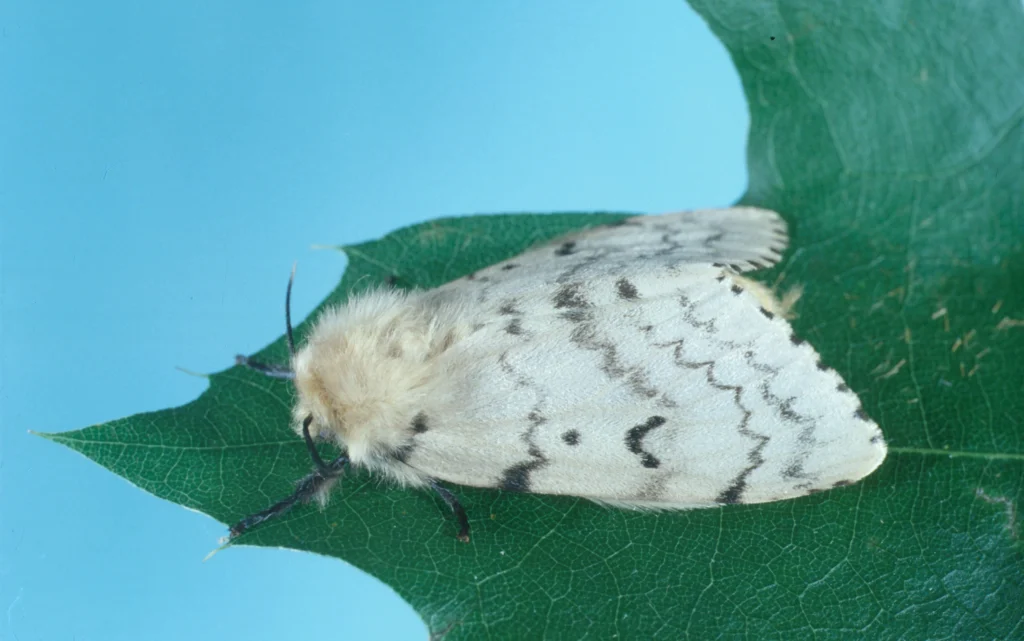
A white moth may be pure white, ivory, cream, pale yellow, or light gray. Under a bright outdoor lamp, a pale moth can appear whiter than it actually is.
Useful white-moth features
Check for:
- Black dots or flecks
- Dark outer borders
- Wavy gray lines
- Gold-edged wings
- A yellow or orange head
- Translucent areas
- Pearly or satin-like reflections
- A contrasting abdomen
- A row of spots along the wing margin
White is often only the background color. The placement of small markings may hold the most useful information.
Do not assume every small white moth is a household pest
Many small outdoor moths are white or cream and may enter through an open door or window. A single pale moth near a lamp does not demonstrate an infestation.
For an indoor identification, examine where the moth was found and look for independent evidence such as:
- Webbing in stored dry food
- Larvae in a cupboard
- Cases or silk on natural-fiber textiles
- Repeated adults appearing in the same room
- Irregular damage to wool, fur, feathers, or similar materials
Household moth identification should be based on the insect, its location, and signs produced by the larvae—not color alone.
Green Moths
Green moths attract attention because they resemble living leaves, moss, or fresh plant growth. The color may range from pale mint and yellow-green to emerald, olive, or blue-green.
How to narrow a green moth identification
Record:
- Overall size
- Tail length, if any
- Eyespots or clear windows
- White or pink crosslines
- Straight or scalloped wing edges
- Whether the moth holds its wings flat or roof-like
- Body color
- Antenna shape
- Geographic region
In North America, the luna moth is a familiar example of a large pale green moth. Its combination of long curving hindwing tails and transparent eyespots is far more diagnostic than green color alone.
Smaller green moths may belong to entirely different families. A tiny green moth with white diagonal lines should not be identified as a “baby luna moth.” Adult moths do not grow after emerging; small adults are separate species, not juvenile forms of large moths.
Green color may fade
Some green moths lose intensity as they age or after death. A guide image showing a fresh emerald individual may not immediately resemble a faded yellow-green or gray-green moth.
Use the lines, spots, wing shape, and location to support the comparison.
Yellow, Gold, and Orange Moths
Yellow moths range from pale straw and buttery cream to mustard, gold, or bright lemon. Orange may cover an entire wing or appear only on the hindwings, abdomen, collar, or outer border.
Features that help
Record whether the moth has:
- Pink, brown, or purple lines
- Black speckles
- A red or dark border
- Orange hindwings beneath brown forewings
- Large eyespots
- White patches
- A fuzzy golden body
- A pointed or rounded forewing
The difference between yellow and orange can be less useful than the arrangement of markings. A yellow moth with scattered pink spots is unlikely to match a yellow moth with two brown crosslines, even when their background color is similar.
Watch for warm indoor lighting
Warm LEDs and incandescent bulbs can turn a cream or pale brown moth into a vivid yellow subject in a phone photograph. Take another image in indirect daylight when practical.
Do not carry a delicate moth into direct sun solely for identification. A photograph near a neutral white or gray background may be sufficient.
Pink and Red Moths
Pink and red moths are memorable, but several unrelated species use these colors in different ways.
The pink may be:
- The main forewing color
- A narrow border
- A set of crosslines
- A patch on the body
- A hidden hindwing color
- Part of a pink-and-green pattern
The Natural History Museum describes the elephant hawkmoth of the UK and Ireland as having distinctive pink and olive-green coloration. In North America, the bella moth has pink and yellow forewings marked by rows of white-ringed black spots. These examples show why both geography and pattern must accompany a color description.
Red-and-black moths
For a moth with black wings and red spots, count the spots and note whether they are separate or fused. Also check:
- Whether the hindwings are red
- Whether the red is actually pink, orange, or crimson
- Whether the moth was flying during the day
- Whether the wings are narrow and rounded
- Whether the body has a metallic sheen
Butterfly Conservation notes that the six-spot burnet is identified partly by six red spots on each forewing, while also warning that spots may sometimes merge and that rare color variants occur. This is a useful example of why spot arrangement matters more than simply recording “black and red.”
Do bright colors mean danger?
Bright color does not provide a simple measure of danger to people. Color may be involved in camouflage, species recognition, or defense against predators, but it should not be used to decide whether an insect is safe to handle.
Observe adults without touching them. Avoid handling unidentified caterpillars, particularly those with dense hairs or spines, because some species have irritating or stinging structures. The caterpillar of the southern flannel moth is one documented example with stinging hairs hidden among its dense covering.
Black and Very Dark Moths
A moth may appear black even when its wings are dark brown, charcoal, deep purple, or metallic green. Phone cameras often lose detail in dark insects, turning subtle markings into a solid silhouette.
Photographing a dark moth
Try to capture:
- One image without flash
- One image with gentle side lighting
- The outer edge of each wing
- Any pale collar or shoulder marks
- Spots visible only at an angle
- The abdomen and antennae
- A side view showing the resting posture
Avoid strong direct flash at close range. It may produce a bright reflection while leaving the pattern difficult to interpret.
Important dark-moth patterns
Look for:
- White or cream spots
- Red, orange, or yellow hindwings
- Thin silver lines
- Metallic blue-green areas
- Pale wing tips
- Transparent patches
- Eyespots
- A colored band around the abdomen
A nearly black moth with narrow wings and transparent spots belongs in a different visual group from a broad black moth with cream patches.
Blue, Purple, and Metallic Moths
True blue or purple is less commonly reported as a dominant moth color than brown, gray, white, green, or yellow. However, some moths have blue, violet, turquoise, or metallic scales, particularly when viewed at a favorable angle.
Confirm that the color is not a photographic effect
Check whether:
- The blue appears in every photograph.
- The color changes when the camera moves.
- A nearby white object also looks blue.
- The moth was under a cool LED.
- The wings are actually glossy black with a blue reflection.
- The body, wings, or only a few patches are metallic.
Structural coloration can change with viewing angle, so several photographs may show different hues without representing different insects.
For identification, describe the base color and the reflective color separately:
Black forewings with a metallic blue-green sheen and two transparent spots.
That is more precise than simply calling it a blue moth.
Multicolored Moths and Eyespots
Some moths combine pink, green, yellow, red, black, white, and metallic colors. Others have large circular markings that look like vertebrate eyes.
How to describe a multicolored moth
Begin with the forewing:
- Record the background color.
- Describe the largest contrasting area.
- Count prominent spots.
- Note the direction of lines or bands.
- Record the hindwing color separately.
- Describe the body and collar.
- Mention whether colors are matte, glossy, or metallic.
For example:
Olive-green forewings with two broad pink diagonal bands; pink body; narrow cream lines; hindwings partly hidden.
This description can be searched more effectively than “beautiful colorful moth.”
What are eyespots?
Eyespots are circular wing markings composed of contrasting rings or patches. They occur in different sizes and colors and may help discourage predators or redirect an attack away from a more vulnerable part of the insect.
When identifying a moth with eyespots, record:
- Number of eyespots
- Forewing or hindwing placement
- Round, oval, crescent, or transparent center
- Ring colors
- Relative size
- Whether the spots are visible while the moth is resting
Do not assume all large moths with eyespots are the same species. Polyphemus moths, emperor moths, moon moths, eyed hawkmoths, and other groups have very different shapes, distributions, and spot arrangements.
Patterns That Matter More Than Color
Field guides often use technical terms for wing markings, but beginners can start with plain descriptive language.
Crosslines
Crosslines run from the leading edge of the wing toward the inner or trailing edge. They may be:
- Straight
- Wavy
- Jagged
- Double
- Dotted
- Pale
- Dark
Count the lines and note whether they continue across both forewings.
Spots and patches
Describe each major spot by:
- Shape
- Color
- Size
- Position
- Border
- Symmetry
Useful descriptions include:
- One white spot near each wing tip
- Two black dots in the center
- Copper patch at the outer edge
- Kidney-shaped dark mark
- Row of cream spots along the border
Wing borders
A contrasting outer border can separate similar species. Check whether the border is:
- Even or broken
- Broad or narrow
- Straight or scalloped
- Present on the forewing, hindwing, or both
- The same color along the entire edge
Transparent areas
Clear or partly transparent windows occur in several moth groups. Record their number, shape, and placement.
Transparent spots combined with a slender body and hovering flight may suggest a different group from transparent eyespots on a large, broad-winged silk moth.
Fringe
The fine scales or hairs along the wing edge may be plain, checkered, unusually long, or differently colored from the main wing.
Fringe is easy to miss in a blurry photograph, so take at least one close image from directly above.
Using Size, Shape, and Antennae
Once you have chosen a color group, shape may remove many incorrect candidates.
Estimate size carefully
Record both body length and wingspan when possible. They are not interchangeable.
A moth with a long narrow body may look large even when its wingspan is modest. A broad-winged moth may have a much wider span but a short body.
Useful size comparisons include:
- Smaller than a grain of rice
- About the length of a fingernail
- Similar in width to a coin
- Approximately 3 centimeters across
- Larger than an adult hand when the wings are spread
A measurement in millimeters or centimeters is better than “small” or “huge.”
Observe wing shape
Common visual categories include:
| Wing form | What it may look like |
|---|---|
| Long and narrow | A small aircraft or arrowhead |
| Broad and triangular | A wide triangle with a heavy body |
| Rounded | Soft outer edges with few sharp corners |
| Scalloped | Wavy or toothed wing margins |
| Leaf-like | Angular outline resembling dry foliage |
| Long-tailed | Hindwings ending in narrow extensions |
| Tent-like | Wings sloping over the body like a roof |
These forms do not identify a species by themselves, but they are powerful filters.
Look at the antennae
Moth antennae are often threadlike, comb-like, or feathery, while butterflies usually have antennae ending in a noticeable club. This is a useful general distinction, although nature does not follow every popular rule without exceptions.
Within moths, antennae can also provide clues:
- Strongly feathered antennae may indicate a male in some groups.
- Thin threadlike antennae occur in many families.
- Very short antennae may help separate a candidate from a similar species.
- Antennae hidden behind the wings should be marked as “not visible,” not guessed.
Use resting posture
A moth’s normal posture can be more reliable than a color affected by lighting.
Record whether it rests:
- Flat with wings spread
- With wings angled backward
- In a steep roof shape
- With forewings wrapped tightly around the abdomen
- With the abdomen raised
- With forelegs extended
- Like a dry leaf or broken twig
Take the photograph before approaching closely, because the posture may change when the moth becomes alert.
Location, Season, and Habitat
A moth identification must make biological sense in the place and time where it was observed.
Geographic location
At minimum, record a country and state, province, county, or region. A nearby city is usually more useful than “North America” or “Europe.”
Regional checklists can show:
- Species already documented in the area
- Commonly reported moths
- Seasonal records
- Similar regional species
- Whether the candidate would be far outside its known range
BAMONA provides regional pages and verified sighting records for North America, while Butterfly Conservation offers identification and seasonal resources for Britain and Ireland.
Time of year
Different moths fly at different times. Some are active in spring, others in summer or autumn, and a smaller number can appear during colder periods. Butterfly Conservation notes that moths occur throughout the year, although the species present change with the season.
Include the full date rather than writing “last summer.”
Habitat
Record the immediate setting:
- Deciduous woodland
- Conifer forest
- Wetland
- Meadow or grassland
- Coastal habitat
- Desert or scrub
- Agricultural field
- Vegetable garden
- Flower garden
- Urban wall
- Pantry
- Closet
- Attic
- Garage
A moth at a porch light beside mature woodland has a different context from a moth repeatedly emerging from a cereal cupboard.
Day or night
Many moths are active after dark, but day-flying moths are not unusual, and some are as brightly colored as butterflies. Time of activity should therefore support an identification rather than determine whether the insect is a moth.
Moths Found Inside a Home
Most outdoor moth sightings are harmless observations. Indoor moths require a different approach because a few species can be associated with stored food or natural-fiber materials.
Do not label an indoor moth a pest from color alone.
A moth near a window
A single moth resting near a window or ceiling may have entered accidentally. This is especially likely when:
- A window was open.
- Exterior lights were on.
- The moth is relatively large.
- It has bold outdoor camouflage or bright hindwings.
- No larvae, webbing, cases, or material damage are present.
- No additional adults appear over the following days.
Release an accidental visitor outdoors when practical.
Possible pantry moths
Indianmeal moth adults have a distinctive two-toned forewing: the inner portion is pale gray or tan, while the outer portion is reddish brown with a coppery appearance. Older individuals may have less obvious markings after losing scales.
Color is only part of the evidence. Also check dry stored products for:
- Silk webbing
- Larvae
- Clumped food particles
- Cast skins
- Cocoons around shelf corners or package seams
- Repeated adult moths near the pantry
Stored products may include grains, cereal, flour, nuts, dried fruit, seeds, spices, dry pet food, and similar materials.
Possible clothes moths
The common webbing clothes moth is small and golden, with relatively plain wings and a reddish-haired head. The case-bearing clothes moth is more gray-brown and may show dark forewing spots, although those spots can wear away. Their larvae—not the flying adults—are the stage associated with damage to suitable animal-derived materials.
Look for:
- Larval cases
- Silk tubes
- Webbing
- Larvae in dark, undisturbed areas
- Damage to wool, fur, feathers, hair, or other susceptible materials
- Repeated small moths in wardrobes or storage areas
A small tan moth in a bedroom is not enough evidence to diagnose clothes moth activity.
For a fuller household assessment, see Moths Around the Home: Identification, Causes, Prevention, and When to Worry.
How to Photograph a Moth for Identification
A good photograph does more than show color. It preserves pattern, shape, scale, and posture.
Take a direct overhead photograph
A dorsal view—the view from directly above—is often the most useful image for wing pattern comparison.
Try to include:
- Both forewings
- Wing tips
- Outer edges
- Thorax
- Abdomen
- Antennae
- Natural resting posture
Keep the camera parallel to the moth to reduce distortion.
Add a side view
A side photograph can reveal:
- Body shape
- Wing angle
- Leg position
- Raised abdomen
- Hidden colors
- Snout-like mouthparts or palps
- Thickness of the body
Record size separately
BugGuide’s photography guidance emphasizes that location, date, size, habitat, and multiple relevant views can all support identification.
Estimate the moth against a nearby known surface or make a separate measurement after it leaves. Do not place a coin or ruler on the insect, and do not touch or pin it merely to obtain a scale photograph.
Preserve natural color
For a more accurate image:
- Turn off decorative color filters.
- Avoid extreme digital zoom.
- Clean the phone lens.
- Use indirect daylight when available.
- Take one photograph with flash and one without.
- Keep a neutral-colored wall or card nearby without disturbing the moth.
- Do not alter saturation before requesting identification.
Photograph hidden information when it appears naturally
When the moth moves, you may be able to capture:
- Hindwing color
- Abdomen markings
- A second resting posture
- The underside
- Antennae spread
- Flight behavior
Do not pull the wings open. Moth wing scales and margins are easily damaged.
Practical Identification Checklist
Before comparing species photographs, record the following.
Appearance
- Dominant forewing color
- Secondary colors
- Number and placement of spots
- Crosslines or bands
- Wing border
- Fringe color
- Forewing shape
- Hindwing color, when visible
- Body color
- Antennae shape
- Estimated body length
- Estimated wingspan
Context
- Country and region
- Date
- Time
- Indoor or outdoor
- Habitat
- Nearby plants
- Weather conditions, when relevant
- Light source nearby
- Whether the moth was alone
- Day- or night-flying behavior
Photographs
- Direct overhead image
- Side image
- Image showing antennae
- Wider habitat photograph
- Unedited original
- Size estimate
Identification confidence
Choose one:
- Confirmed by a qualified identifier or authoritative regional source
- Probable species
- Possible species
- Genus only
- Family only
- Unidentified moth
This prevents a tentative image match from being repeated later as a confirmed record.
Moth Color Comparison Table
| Dominant visible color | Useful clues to record | Common mistake | Best next check |
|---|---|---|---|
| Brown or gray | Crosslines, dark dashes, silver spots, scalloped edges | Treating all brown moths as one group | Wing shape, exact pattern, size |
| White or cream | Black dots, borders, transparency, head color | Assuming it is a clothes moth | Location and signs of larvae or damage |
| Green | White or pink lines, tails, eyespots, wing edge | Calling every green moth a luna moth | Size, region, tails, eyespots |
| Yellow or gold | Pink lines, brown patches, speckling, hindwing color | Confusing warm lighting with true yellow | Daylight photograph and pattern |
| Orange | Whether orange is on forewings or hidden hindwings | Ignoring plain outer forewings | Flight view and hindwing pattern |
| Pink or red | Green areas, black spots, red bands, body color | Identifying from color without geography | Region, spot arrangement, wing shape |
| Black or charcoal | Metallic sheen, pale dots, colored hindwings | Losing pattern detail in exposure | Side lighting and unedited image |
| Blue or purple | Angle-dependent sheen, transparent spots | Treating LED color cast as real color | Multiple angles and neutral lighting |
| Multicolored | Exact order and placement of colors | Searching only for “rainbow moth” | Describe each wing area separately |
| Eyespotted | Number, size, ring colors, forewing or hindwing position | Assuming all eyespotted moths are related | Overall shape, size, tails, location |
Common Identification Mistakes
Identifying the first similar image
Search results favor striking, popular, and well-photographed species. The first image may come from another continent or show a moth that only shares the same color.
Check the source, range, size, season, and complete pattern.
Searching with only one color word
“Green moth” or “brown moth” is too broad. Add the most diagnostic feature:
- Large pale green moth with tails and eyespots
- Small green moth with two white diagonal lines
- Brown triangular moth with silver central spot
- Black moth with six red forewing spots
- Cream moth with three dark spots and fringed wings
Ignoring how the wings are positioned
A folded moth may look narrower and darker than an open-wing photograph of the same species. Compare specimens in similar resting positions.
Using size-free photographs
Close-up photography makes a five-millimeter moth look enormous. Without scale, readers may compare a tiny micro-moth with a large silk moth.
Always record an approximate measurement.
Assuming a colorful insect must be a butterfly
Moths can be bright, iridescent, and active in daylight. Antennae, body structure, wing posture, and other anatomical features are more useful than the stereotype that butterflies are colorful and moths are dull.
Assuming every indoor moth is destructive
Many outdoor moths enter buildings accidentally. A household pest identification requires the correct adult or larva plus relevant evidence from food, fabric, or storage areas.
Ignoring worn scales
Old moths may lose the markings used in field guides. When several features match but a spot is missing, inspect whether the wing looks worn rather than immediately rejecting the candidate.
Forcing a species-level answer
Some closely related moths cannot be separated confidently from an ordinary photograph. Genital examination, microscopic features, rearing history, or specialist knowledge may sometimes be needed.
“Uncertain” is a valid identification result.
Using a caterpillar’s color to predict the adult
A caterpillar and its adult moth may have completely different colors and patterns. Caterpillars also change appearance as they grow.
For caterpillar identification, record the host plant, body pattern, hairs or spines, head color, location, and date. BAMONA notes that larval identification can be especially difficult and that host-plant information is valuable.
When to Ask an Expert
Seek additional help when:
- Several regional species look nearly identical.
- The photograph may show a rare or unusual regional record.
- You suspect a newly introduced or regulated species.
- A caterpillar has hairs or spines and contact has caused a reaction.
- Stored food repeatedly contains larvae or webbing.
- Natural-fiber materials show continuing damage.
- Identification will be used for research, conservation, teaching, or a formal wildlife record.
- The available images do not show essential features.
Useful contacts include:
- A university extension entomology service
- A natural history museum
- A regional moth or butterfly conservation group
- A local biological-recording organization
- A verified citizen-science identification project
- A qualified pest-management professional for a persistent indoor problem
For North American observations, BAMONA allows users to submit photographs with date and location information for review by regional coordinators.
When requesting help, send the original photographs and all available context. Do not crop away the surrounding scale or edit the colors heavily.
Conclusion
Moth identification by color works best as the beginning of an investigation, not the final decision. First record the dominant color, then study the lines, spots, borders, eyespots, wing shape, size, antennae, posture, location, season, habitat, and behavior.
A confident identification should be supported by several matching features and a realistic regional range. When the evidence is incomplete, identifying the moth to a family or genus—or leaving it unidentified—is more responsible than choosing a species from one similar photograph.
The next useful step is How to Identify a Moth: A Beginner’s Guide. Readers ready to compare visual examples can also browse Moth Species with Pictures and the main Types of Moths collection.
Questions Readers Often Ask
Can you identify a moth from its color alone?
Usually not. Color can narrow the possibilities, but many unrelated moths share similar colors. Confirm an identification with wing pattern, size, shape, antennae, location, season, habitat, and photographs.
What colors can moths be?
Moths can be brown, gray, white, cream, green, yellow, orange, pink, red, black, blue, purple, metallic, or strongly multicolored. Some have transparent areas or contrasting hidden hindwings. Moths are not limited to dull brown species.
Why does a moth look greener or brighter in one photograph?
Lighting, camera processing, viewing angle, wing wear, and reflective or structural coloration can change the apparent color. Compare unedited photographs taken from more than one angle and, when possible, under neutral light.
What should I search for after identifying the main color?
Add the strongest visible feature, size, and location. For example, search for “large pale green moth with tails and eyespots in Ohio” rather than simply “green moth.”
Is a small brown moth inside my home a clothes moth?
Not necessarily. Small pantry moths, clothes moths, and harmless outdoor moths can all appear brown or tan. Check the wing markings, room where it was found, and evidence such as larvae, webbing, cases, contaminated food, or fabric damage.
How can I identify a green moth?
Record its size, wing shape, crosslines, tails, eyespots, resting posture, location, and season. Large pale green moths with long tails are different from small green moths with white lines or scalloped edges.
Are bright or colorful moths active during the day?
Some are. Although many moths are nocturnal, numerous species fly during daylight and can be as brightly colored as butterflies. Activity time is helpful evidence but is not a dependable moth-versus-butterfly rule.
Why can an expert identify only the family or genus?
The photograph may not show microscopic or hidden features needed to separate closely related species. The specimen may also be worn, photographed from the wrong angle, or outside a well-documented region. A broader identification is often the most accurate conclusion supported by the evidence.