A moth with long tails trailing from its back wings is usually a moon moth or a close relative in the giant silk moth family (Saturniidae). In the United States and Canada, a large pale-green moth with long curving tails is very likely a luna moth. Smaller white or pale-yellow moths with short pointed tips on the hindwings, and large tropical moths with swallowtail-like wings, belong to different families entirely.
Where you are matters more than almost any other clue. Tailed moths are spread across the world, but each kind has a fairly limited range, so your location rules most of them out straight away.
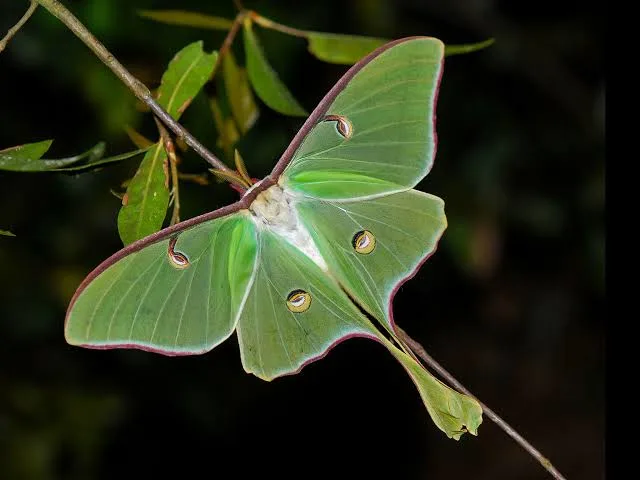
What the tails can and cannot tell you
The tails are extensions of the hindwings, the smaller back pair. They are a useful starting clue because relatively few moths have them, but they are not a species label on their own.
The same basic tail shape has evolved several separate times in silk moths around the world, and other families have their own versions. Long, ribbon-like tails, short pointed tips and broad swallowtail shapes can all show up in moths that are not closely related.
Tails also wear down. An older moth, or one that has survived a bat attack, may have chipped, shortened or missing tails. A luna moth with no tails left can look like a different moth altogether, so check the rest of the wing pattern before ruling anything out.
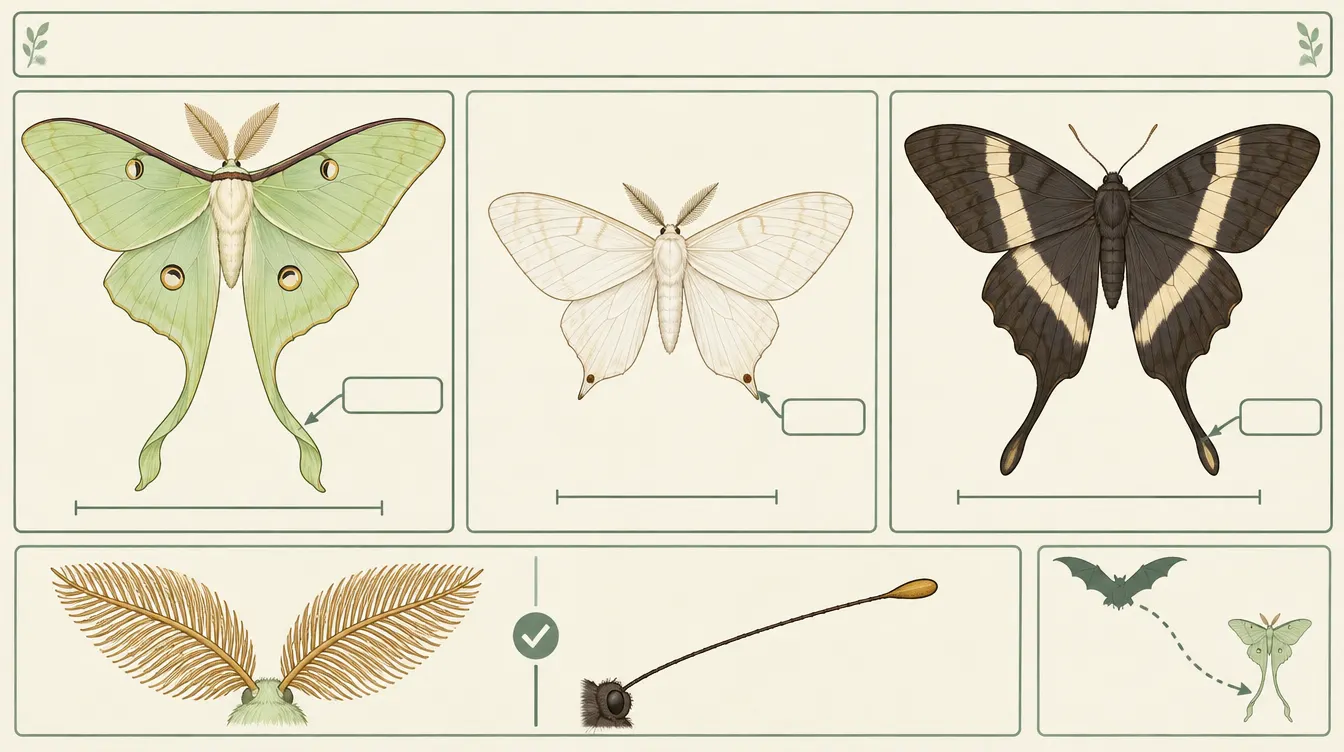
Moths with tails on their wings
| Moth | Where it lives | Size | Tails | Main colour clues | When you might see it |
|---|---|---|---|---|---|
| Luna moth (Actias luna) | Eastern North America, from Nova Scotia west to Saskatchewan and south to Florida and eastern Texas | 7.5–10.5 cm wingspan | Long, curving | Pale green; a clear eyespot on each wing; outer edges pink or yellow depending on region and season | At night, often at porch lights; one brood in the north (May–July), two or three in the south (March–September) |
| Asian moon moths (e.g. Actias selene) | Afghanistan and India east to China and Korea, south to Southeast Asia | Large | Long | Pale green with eyespots | At night |
| Spanish moon moth (Graellsia isabellae) | Pine forests in Spain and parts of the Alps | 65–100 mm | Long | Pale green with dark wing veins | Spring, at night |
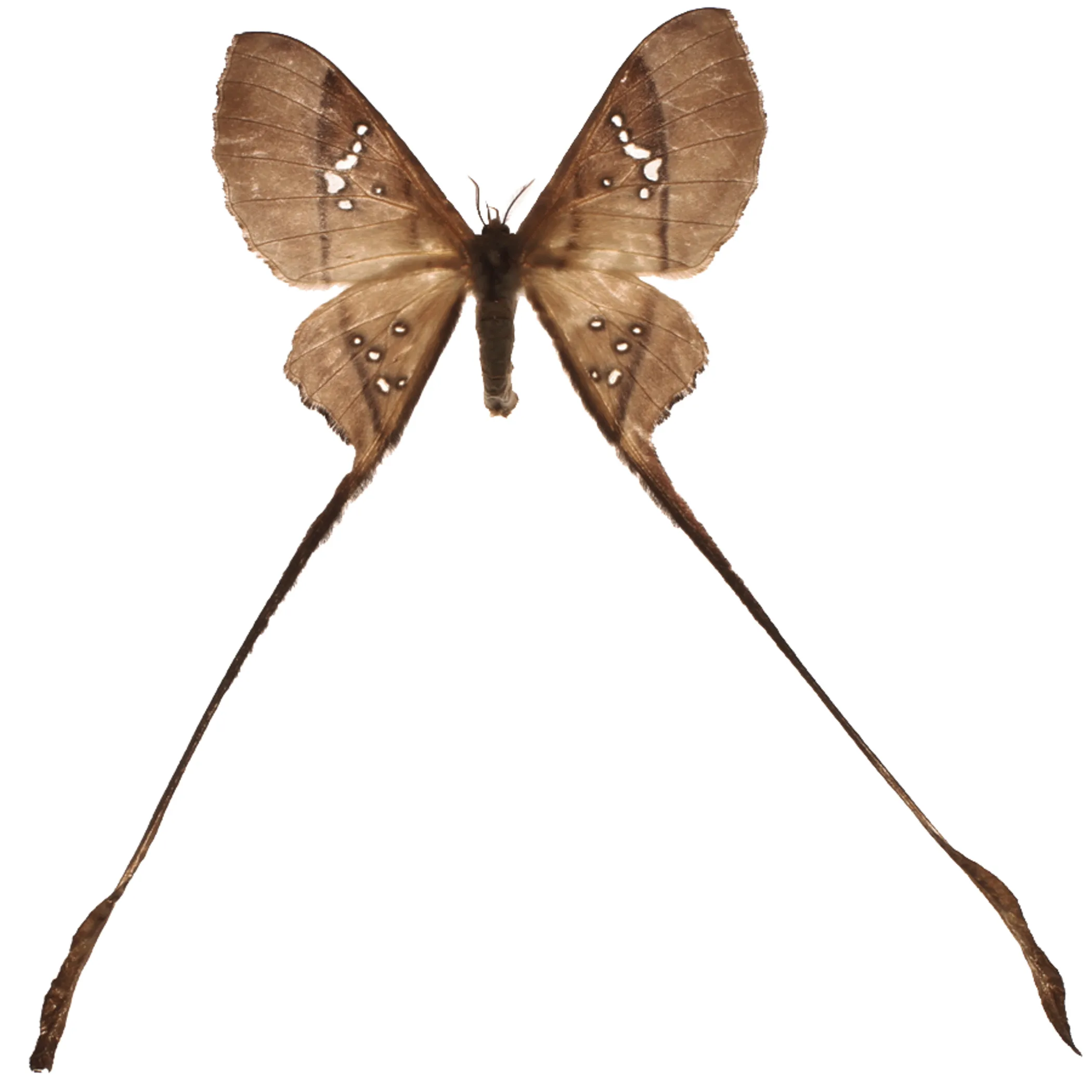
| Comet moth (Argema mittrei) | Rainforests of Madagascar | About 20 cm wingspan in males | Very long; about 15 cm in males | Bright yellow with red-brown tails | At night |
| Swallow-tailed moth (Ourapteryx sambucaria) | Europe and the Near East | 50–62 mm | Short, pointed tips on the hindwing edge, each with a small brownish spot at its base | White to pale yellow with faint lines | June–July, at night and often at lights |
| Tropical swallowtail moth (Lyssa zampa) | Tropical Southeast Asia, southern China and the Himalayas; occasional records farther north | Up to 160 mm wingspan | Broad, swallowtail-like | Large and broad-winged | Day and night; sometimes appears in large numbers around city lights, most often May–November |
| Green-banded urania (Urania fulgens) and relatives | Southern Mexico through Central America to northwest South America; rare stray to Texas | Medium-large | Swallowtail-like, with white on the tail | Dark with iridescent green bands | Daytime; often mistaken for a butterfly |
How to narrow it down
- Start with location. A tailed moth in Ohio, a tailed moth in England and a tailed moth in Malaysia are going to be completely different insects. Write down the country, region and rough habitat.
- Note the size. A moth roughly the size of your palm points toward the silk moths or the big tropical swallowtail moths. A moth closer to the size of a large coin is more likely a geometer such as the swallow-tailed moth.
- Look at the tail shape. Long, thin, curving tails suggest a moon moth. Short points on the edge of the hindwing suggest a geometer. Broad tails that make the whole wing look like a swallowtail butterfly suggest the Uraniidae family.
- Check the colour and markings. Pale green with eyespots is the classic moon-moth look. Plain white or cream with fine lines fits the swallow-tailed moth.
- Note the time of day. Most tailed moths fly at night and turn up at lights. A tailed insect flying in bright sunshine is either a day-flying moth such as a urania or, more often, a butterfly.
- Look at the antennae. This is the quickest way to rule out a butterfly (see below).
Is it a moth or a butterfly?
Plenty of tailed insects are butterflies. Swallowtail butterflies have broad tails on their hindwings, and many small hairstreak butterflies have thin, thread-like tails.
The antennae are the giveaway. Butterflies have thin antennae with a small club at the tip. Moon moths have broad, feathery antennae, and many other moths have thin antennae with no club. Butterflies also tend to rest with their wings folded upright over the back, while most tailed moths rest with their wings spread or held flat.
The day-flying urania moths are the tricky exception. They fly in daylight and look very much like swallowtail butterflies, so the antennae are worth a close look before you decide.
Why do some moths have tails?
In moon moths and their relatives, the tails help them escape bats. Bats hunt at night by echolocation, and the long, twisting tails seem to pull the bat’s attack away from the moth’s body.
In a 2015 study, big brown bats aimed more than half of their attacks at luna moth tails. Luna moths with intact tails survived far more often than moths whose tails had been removed.
A later study on African moon moths found the same pattern. Moths with full tails escaped bats most often, moths with shortened tails did less well, and moths with no tails were caught most often. Losing part of a hindwing is a fair trade, because a moth can still fly on its forewings.
Caterpillars and adults
The tails belong only to the adult moth. Moon moth caterpillars look nothing like the adults and are usually found on the leaves of their food plants.
Luna moth caterpillars feed on the leaves of trees such as birch, sweet gum, hickory, walnut, persimmon and sumac. The adults do not feed at all. Moon moths have no working mouthparts, so the adult stage is short and is spent mating and laying eggs.
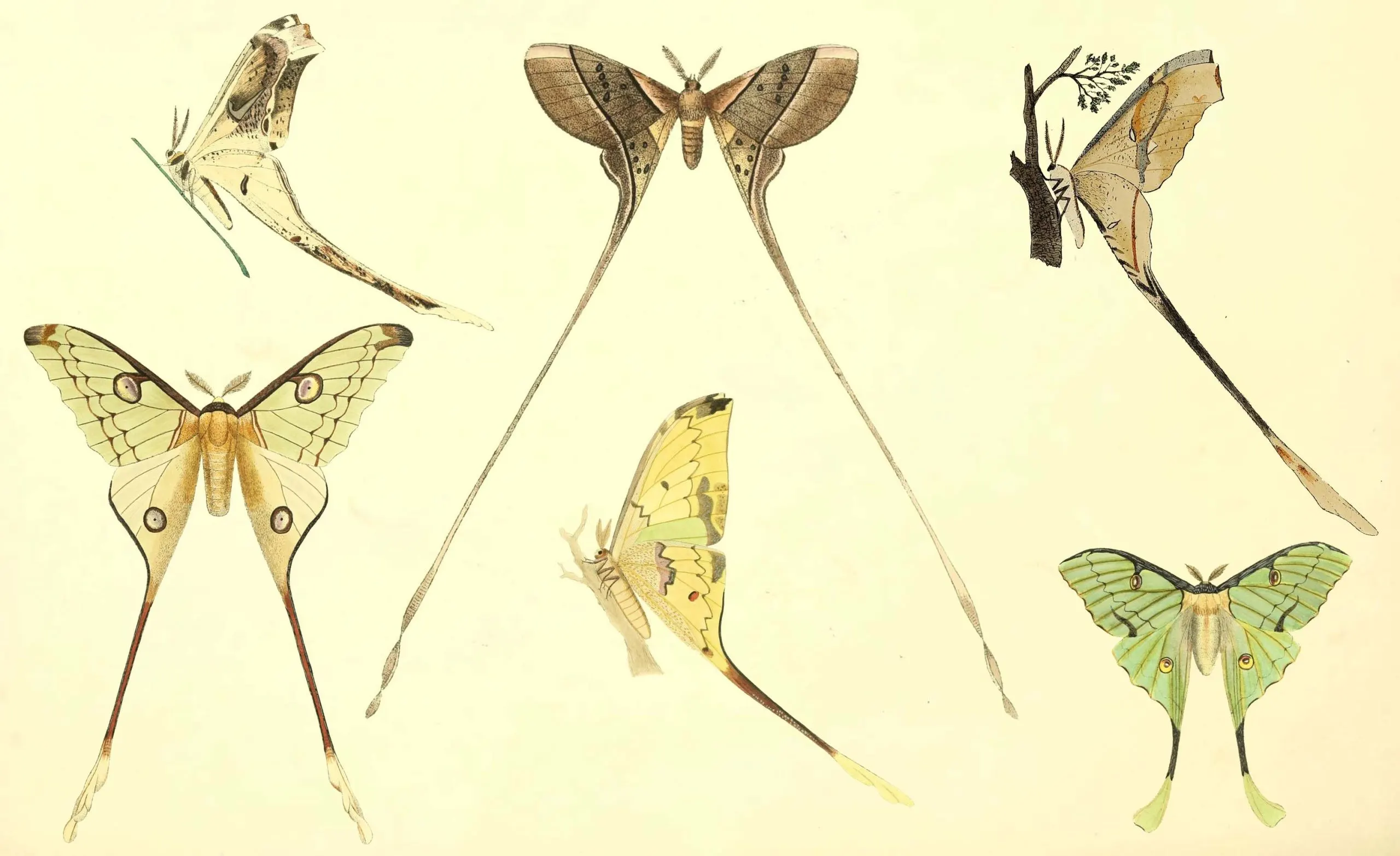
When a photo is not enough
A clear photo of the whole moth from above, with the tails in view, is usually enough to get to the right group. It may not be enough to separate closely related species, especially among the Asian moon moths, where several similar green species share overlapping ranges.
If you want a confident species name, note your exact location and date, and share the photo with a local moth recording scheme, natural history society or online community where experienced observers can check it.
Is a moth with tails harmful?
No. Tailed moths are outdoor visitors that are drawn to lights at night. They are not pantry moths or clothes moths, they do not damage food or fabric, and the adults of moon moths cannot even feed. If one lands on your wall or window, the kindest thing is to leave it alone or switch off the outside light.
Sources
- Actias luna — Butterflies and Moths of North America
- Barber et al. 2015, PNAS — luna moth tails divert bat attacks (PMC summary)
- Boise State University — Rubin et al., Science Advances, tails and bat evasion in silk moths
- Actias selene — The Moths of Borneo
- Madagascan moon moth — Natural History Museum, London
- Comet moth — Wikipedia
- Actias isabellae — lepidoptera.eu
- Graellsia isabellae — INPN Habitats Directive listing
- Swallow-tailed moth — Wikipedia
- Lyssa zampa — Wikipedia
- Lyssa zampa — Moths of India
- Urania fulgens — Wikipedia