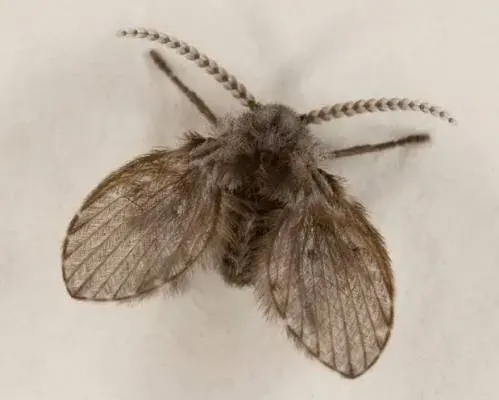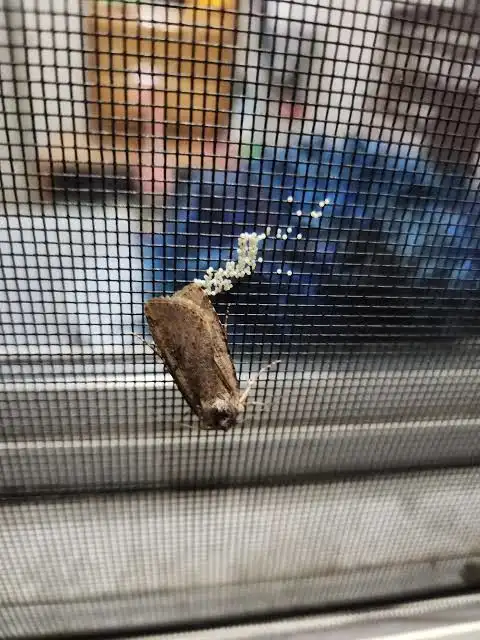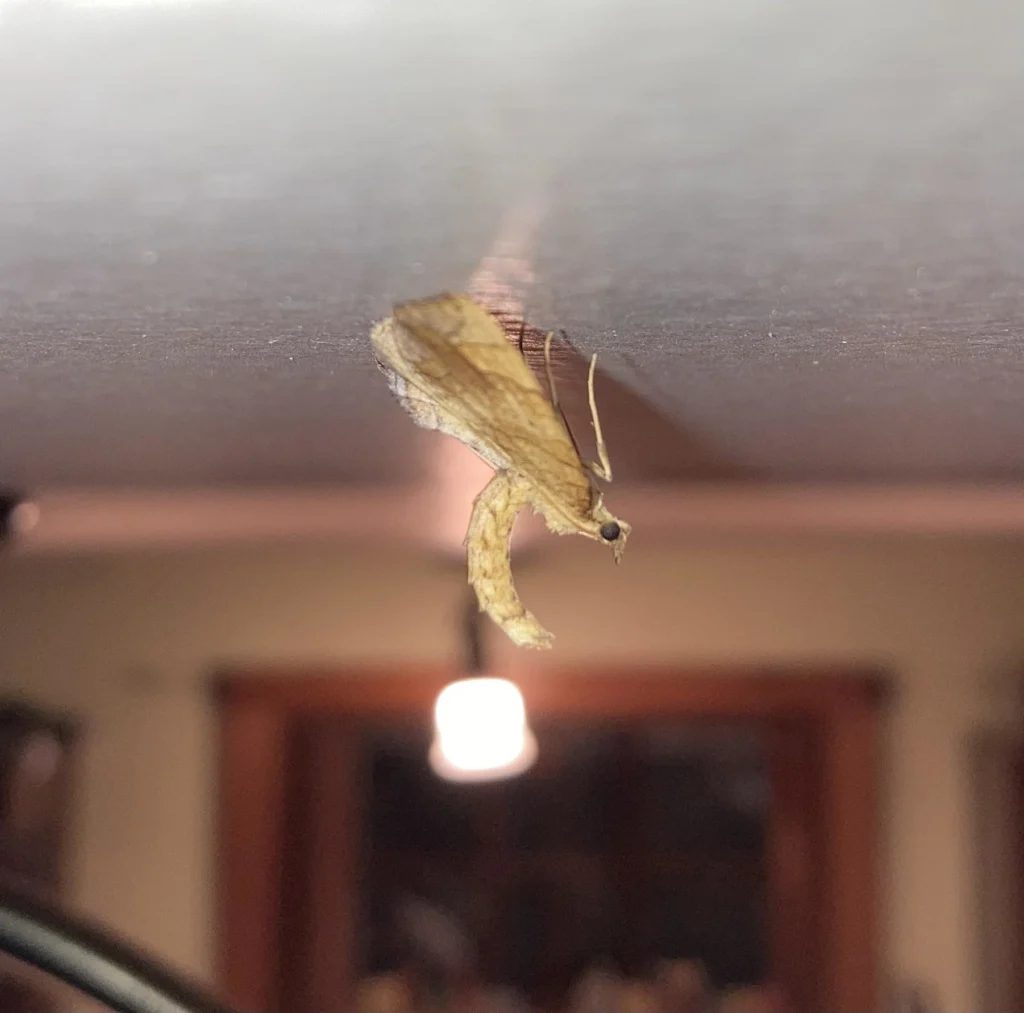
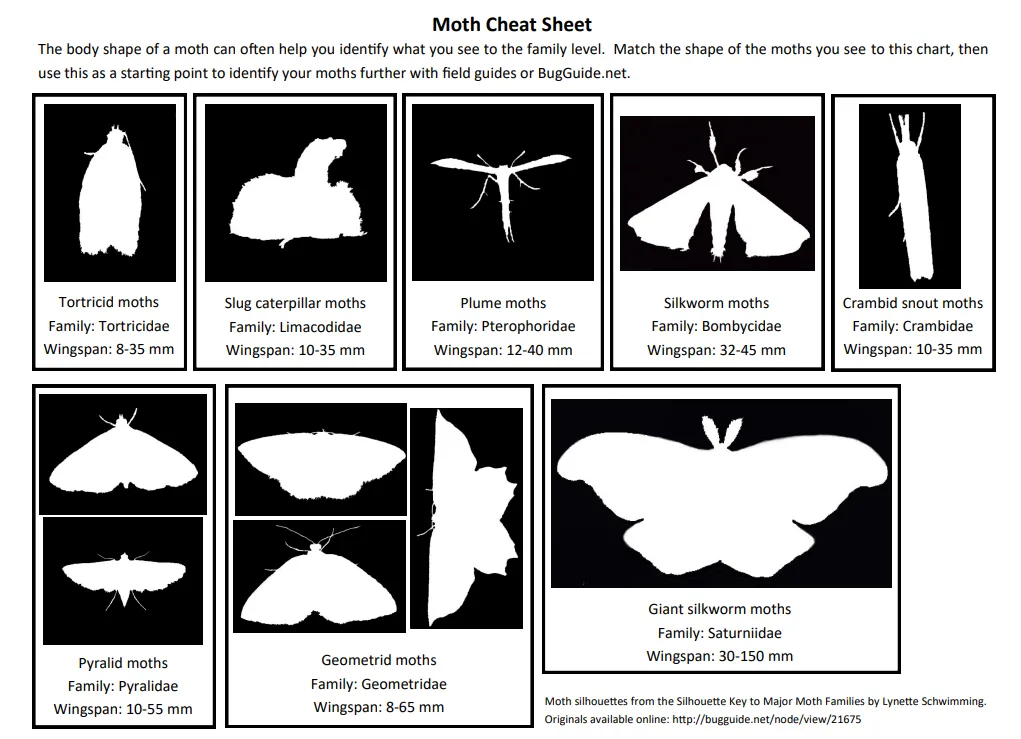
You can often narrow down a moth’s identity by looking at the shape of its wings and how it holds them while resting. A T-shaped moth may be a plume moth, a broad-winged moth resting flat may be a geometer, and a streamlined moth with sharply pointed wings may belong to the hawk moth family.
Wing shape is especially useful when colors are faded or markings are difficult to see. However, it is usually a clue to a family or group, not enough to identify an exact species.
The trick is to look at the moth’s entire outline before studying individual spots or stripes.
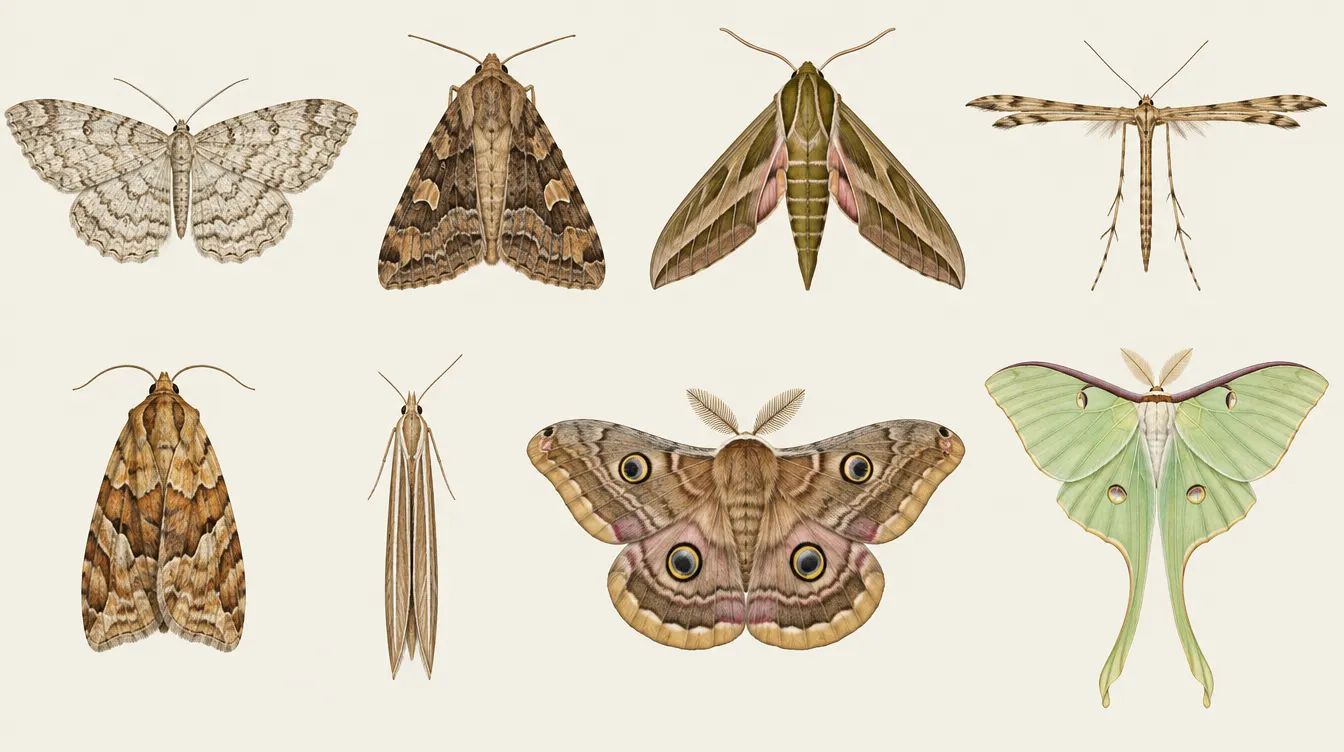
Moth Wing Shapes: Quick Identification Chart
Start with the shape that most closely matches the moth you found.
| Wing shape or resting silhouette | Possible moth group | What to look for |
|---|---|---|
| Broad wings spread flat | Geometer moths (Geometridae) | Slim body, forewings and hindwings often visible |
| Narrow triangle or roof shape | Many owlet moths (Noctuidae) | Overlapping forewings covering the hindwings |
| Long, pointed, swept-back wings | Hawk or sphinx moths (Sphingidae) | Streamlined body, tapered forewings |
| T-shaped silhouette | Plume moths (Pterophoridae) | Very slender body, long legs, narrow wings extending sideways |
| Bell-shaped or arrowhead-shaped | Leafroller moths (Tortricidae) | Small moth with slightly squared or flared forewing tips |
| Long, narrow, grass-like silhouette | Some crambid moths (Crambidae) | Slim resting posture, wings held closely around the body |
| Large, broad, rounded wings | Some giant silk moths (Saturniidae) | Stout body, often conspicuous eyespots or broad wing surfaces |
| Long tails extending from the hindwings | Certain silk moths, including Actias | Distinctive tapering hindwing extensions |
These are practical visual categories, not formal taxonomic divisions. Several moth families contain species with very different wing shapes, and unrelated families may look surprisingly similar.
1. Broad, Flat Wings: Geometer Moths
If a moth is resting against a wall or tree with its wings opened broadly to either side, geometer moths are a useful group to investigate.
Most adult geometrids have relatively slender bodies and often rest with all four wings visible. Their wings can form a broad, almost butterfly-like outline.
Look for:
- Wings held relatively flat against the resting surface
- A comparatively thin body
- Forewings and hindwings visible together
- Sometimes continuous lines across both pairs of wings
- Wing edges that may be smooth, pointed, or scalloped
Not every geometer rests flat. Some hold their wings upright or at an angle, and other moth families can spread their wings in similar ways.
The combination of posture, body proportions, and wing outline is more useful than any one characteristic.
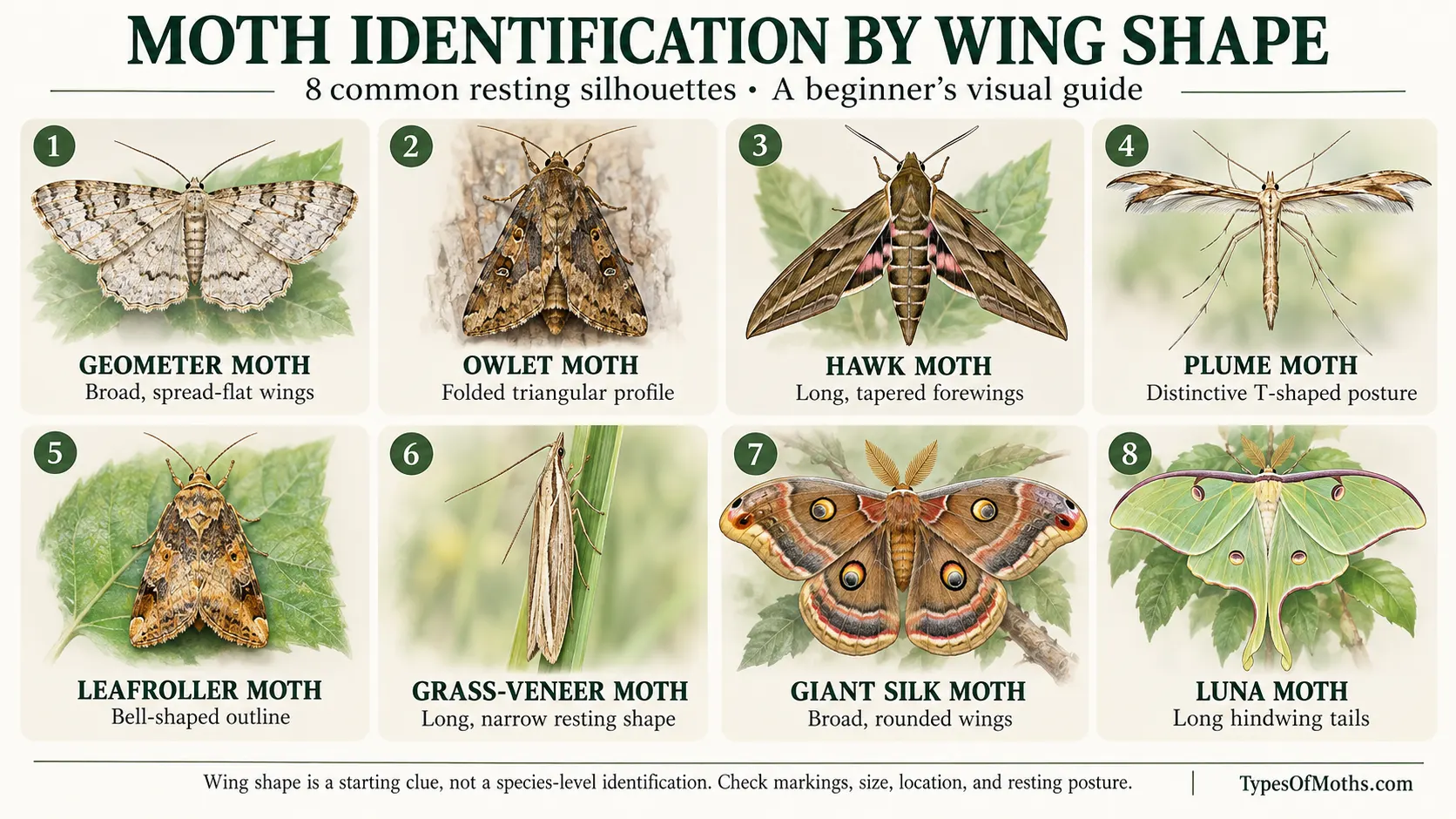
2. Narrow Triangular Wings: Many Owlet Moths
A moth resting with its forewings folded back over its body often forms a narrow triangle when viewed from above.
This shape is familiar among many owlet moths in the family Noctuidae.
The forewings overlap and conceal much of the hindwings, producing a compact outline. From the side, the wings may look like a shallow roof.
Typical features include:
- A triangular outline from above
- Forewings held over the abdomen
- A moderately stout body
- Hidden or partly concealed hindwings
But a triangular resting shape is widespread among moths. Some crambids, pyralids, and other groups can look similar.
If your moth forms a triangle, check the size, antennae, wing markings, and whether the wing tips are pointed or squared off before deciding which family is most likely.
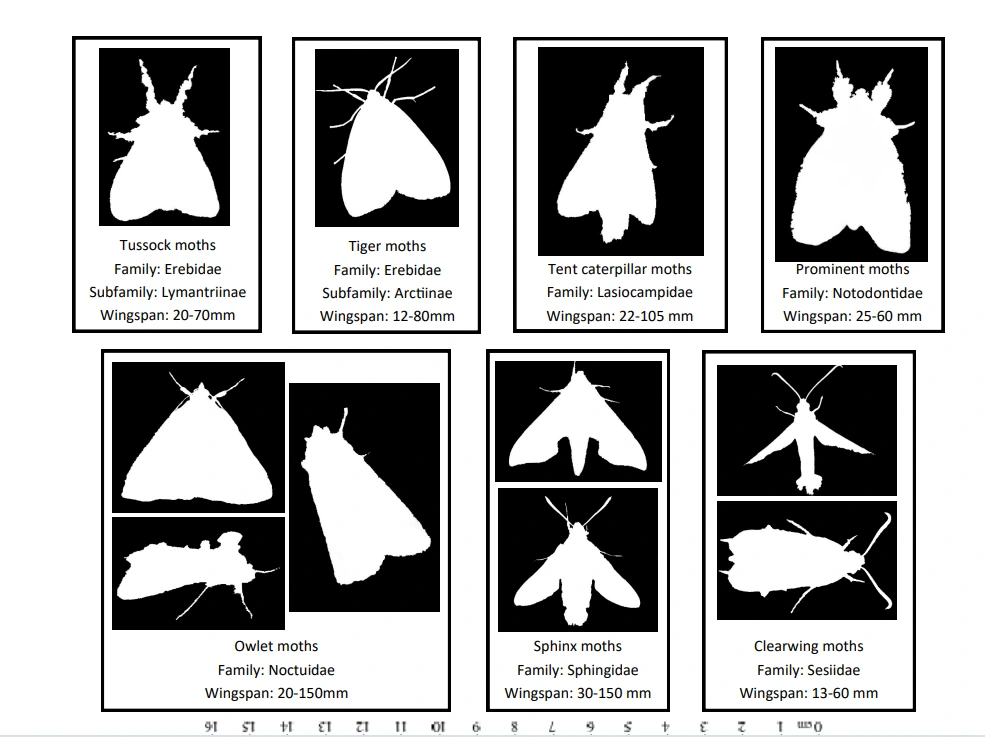
3. Long, Pointed Wings: Hawk and Sphinx Moths
Hawk moths, also called sphinx moths, are often recognizable by their streamlined appearance.
Many have long, relatively narrow forewings with pointed tips. When resting, these wings may sweep back along the sides of the body, giving the insect a sleek, tapered outline.
Their bodies are often substantial and muscular compared with those of many smaller moths.
Useful clues include:
- Long or pointed forewings
- A stout, streamlined body
- A frequently tapering abdomen
- Wings positioned backward when resting
- Strong or rapid flight in many species
Some hawk moths hover near flowers while feeding, but others behave differently. Flight behavior is helpful when observed, not a requirement for identifying the family.
Also, pointed wings are not exclusive to sphinx moths. Body proportions and other morphological details are important.
4. T-Shaped Wings: Plume Moths
One of the most recognizable moth silhouettes is a narrow horizontal bar sitting across a slim body.
This creates a shape resembling the letter T.
Many plume moths in the family Pterophoridae adopt this distinctive posture.
Unlike the broad-winged moths people commonly imagine, plume moths can look almost like tiny pieces of dry grass or twigs.
Look for:
- Narrow wings extending sideways
- An unusually slender body
- Long, delicate legs
- A clear T-shaped resting silhouette
Their wings are especially interesting. In many plume moths, the wing margins are deeply divided into narrow, featherlike lobes. These divisions may be difficult to see when the wings are tightly rolled at rest.
A T-shaped silhouette is a particularly useful starting clue, but it is not exclusive to plume moths. Confirm the slender body and other characteristics rather than relying on the letter shape alone.
5. Bell-Shaped or Arrowhead Wings: Leafroller Moths
Some small moths look like miniature bells or arrowheads while resting.
This silhouette is characteristic of many leafroller moths in the family Tortricidae.
The forewings can be somewhat broadened or squared toward the tips. When the moth folds them over its body, the resulting outline may be narrow near the head and wider toward the rear.
Things to check include:
- Small, compact body size
- Bell-like or arrowhead-shaped outline
- Forewing tips that appear squared or slightly flared
- Rooflike resting posture
- Often mottled brown, gray, or rusty coloration
Wing shape is particularly helpful for separating some leafrollers from other small moths, although the distinction is not always straightforward.
A close photograph showing the forewing tips can be more useful than a distant picture showing only color.
6. Long, Narrow Wings: Grass Moths and Other Micro-Moths
A small moth resting on grass or a wall may look like a thin cigar, narrow leaf, or short piece of straw.
This appearance occurs in some crambid moths, especially grass-veneer moths.
Their wings may be held close to the abdomen, creating a remarkably narrow outline.
Look for:
- An elongated resting silhouette
- Wings folded closely along the body
- Relatively small size
- Sometimes forward-projecting mouthparts that look like a short snout
Crambidae is a very diverse family. Other members spread their wings into broad triangles, so a narrow shape does not describe the entire family.
Similar silhouettes also occur in several other micro-moth groups. If the moth is especially small, a close-up photograph may be needed to examine its head, wing tips, and antennae.
7. Broad, Rounded Wings: Giant Silk Moths
Some of the most striking moths have broad wings that extend well beyond a thick, furry-looking body.
Certain giant silk moths in the family Saturniidae fit this appearance.
Species such as the polyphemus moth and cecropia moth can show large wing surfaces and distinctive overall proportions.
Useful clues include:
- Broad forewings and hindwings
- A relatively heavy body
- Often conspicuous eyespots or bold markings
- Feathery antennae in many species, especially males
However, Saturniidae contains substantial diversity. Not every species is enormous, rounded, or decorated with prominent eyespots.
Wing shape can direct your search toward giant silk moths, but the family should be confirmed with additional features.
8. Wings With Long Tails: Luna Moths and Relatives
Some moths have hindwings that extend into long, thin tails.
The luna moth, Actias luna, is a familiar North American example.
Its hindwing extensions produce an unmistakable outline when the wings are fully visible. The shape is often easier to recognize than individual color markings.
Look for:
- Long extensions from the hindwings
- Broad main wing surfaces
- A relatively large, slender-looking silhouette
- Additional markings such as eyespots
The presence of tails is a strong visual clue, but it does not automatically establish a luna moth identification. Other tailed moths exist, and the relevant possibilities depend on where the specimen was found.
Location, overall wing proportions, coloration, and other characters are essential.
How to Identify a Moth by Wing Shape: Step by Step
You do not need to memorize dozens of moth families to start identifying an unfamiliar moth.
Follow this simple sequence.
Step 1: Observe the moth without disturbing it
Look at the natural resting position.
Does it resemble a triangle, a broad fan, a T, a bell, or a narrow blade of grass?
Try to photograph it before it flies away. Avoid touching or spreading its wings.
Step 2: Check whether the wings are folded or open
This is one of the most important distinctions.
A moth with folded forewings can look much narrower than the same moth with both pairs of wings open.
Try to determine whether you are seeing the true wing outline or simply the shape produced by overlapping wings.
Step 3: Examine the wing tips and edges
Look closely at the margins.
Are they:
- Sharply pointed?
- Smooth and rounded?
- Squared off?
- Scalloped?
- Irregular or notched?
- Extended into tails?
These details can help distinguish similar candidates, although they are not always diagnostic at the family level.
Step 4: Compare the body with the wings
A broad-winged moth with a very slim body may suggest a different group from one with a thick body and narrow, swept-back wings.
Pay attention to body length, thickness, antennae, and the relative proportions of the forewings and hindwings.
Step 5: Add wing markings
Once you have a likely shape category, study the patterns.
Look for lines, spots, eyespots, pale bands, dark borders, and other markings.
Our moth identification by wing pattern guide explains how to examine these features.
Step 6: Use location, season, and size
Where you found the moth matters.
Record the country or region, approximate date, habitat, and estimated size. A moth seen in a European garden may have a different set of likely identities from a similar-looking moth in North America or Australia.
It is also useful to know whether the insect was flying in daylight, visiting flowers, or resting near a light.
Step 7: Compare photographs of likely groups
Once you have narrowed the possibilities, compare the moth with verified photographs from an identification guide appropriate to your region.
Make sure the photographs show the same angle and resting position. Otherwise, the comparison can be misleading.
You can also use our general moth identification guide to combine shape with other visible characteristics.
Wing Shape Versus Resting Position: What’s the Difference?
These two characteristics are related, but they are not identical.
Wing shape describes the actual outline and proportions of the wings themselves.
Resting position describes how the moth arranges those wings when it is not flying.
A moth with broad wings can appear narrow when the wings are folded over the abdomen.
Likewise, a moth with relatively pointed forewings may appear to have a much broader silhouette when it spreads them sideways.
This explains why two photographs of the same moth can sometimes look surprisingly different.
For identification, record both features whenever possible.
Can Wing Shape Identify the Exact Species?
Sometimes a very distinctive silhouette can make a small number of species strong candidates. But most moth species cannot be confirmed by wing shape alone.
Several factors complicate identification:
Similar families: Different moth families may share triangular or narrow-winged resting postures.
Variation within families: Members of the same family can have dramatically different shapes.
Sex differences: Males and females may differ in size, wing proportions, or even whether they have functional wings.
Damaged wings: A moth with worn or missing wing edges may appear to have a different outline.
Photograph angle: A side view may hide the shape of the hindwings or make the forewings appear shorter.
When shape and pattern still leave several possibilities, a genus-level or family-level identification may be the most responsible conclusion.
Some species require detailed examination of structures that ordinary photographs cannot show.
Common Mistakes When Comparing Wing Shapes
Assuming every triangular moth belongs to one family
Triangular resting silhouettes are extremely common. The shape alone is not reliable enough to separate all owlet, snout, or leafroller moths.
Confusing wing markings with wing edges
A zigzag stripe is a pattern. A genuinely scalloped or jagged wing margin is part of the wing’s outline.
The two clues should be recorded separately.
Comparing different resting positions
A moth photographed with its wings fully spread should not be compared directly with one photographed with its wings folded tightly.
Look for images showing similar postures.
Ignoring the hindwings
In many moths, the forewings conceal most of the hindwings at rest.
A useful diagnostic feature may simply be invisible in your photograph.
Identifying a household pest by silhouette
A small moth found inside a house is not necessarily a clothes moth or pantry moth. Many outdoor moths enter homes accidentally.
Household pest identification requires additional evidence, such as repeated sightings, larvae, webbing in stored foods, or fabric damage.
Frequently Asked Questions
What moth has T-shaped wings?
Plume moths (Pterophoridae) are particularly well known for their T-shaped resting silhouette. Their slender bodies, long legs, and narrow, rolled wings help distinguish them from other moths that may also hold their wings sideways.
What moth has long, pointed wings?
Many hawk or sphinx moths have elongated, tapered forewings and streamlined bodies. However, pointed wings also occur in other families, so body proportions and markings should be checked.
What moth has triangular wings?
A triangular resting outline can occur in several families, including Noctuidae, Pyralidae, and Crambidae. Size, wing position, forewing tips, and pattern help narrow the identification.
What moth has wings shaped like a bell?
Many tortricid or leafroller moths form a bell-shaped or arrowhead-shaped silhouette at rest. Their forewing tips may look squared or slightly flared.
What moth has scalloped wing edges?
Scalloped margins occur in different moth groups, including some geometer and sphinx moths. Examine the exact shape of the scallops alongside the body, posture, and pattern.
Is wing shape more reliable than wing color?
Neither feature is universally more reliable. Shape can remain useful when colors fade or markings are unclear, while a distinctive color pattern may be highly informative for another species. The strongest identification combines multiple characters.
Final Identification Checklist
Before assigning a name to a moth, check whether you have recorded:
- Overall resting silhouette
- Actual wing outline, where visible
- Whether the hindwings are exposed
- Wing tips and outer margins
- Relative body and wing proportions
- Antenna shape
- Wing pattern
- Approximate size
- Geographic location and date
Moth identification by wing shape works best as the first step in a process of elimination. The silhouette helps you decide where to begin; the smaller details help you determine how far the identification can go.
If you are still unsure, browse moth species with pictures and compare your observations with regionally appropriate, verified photographs.