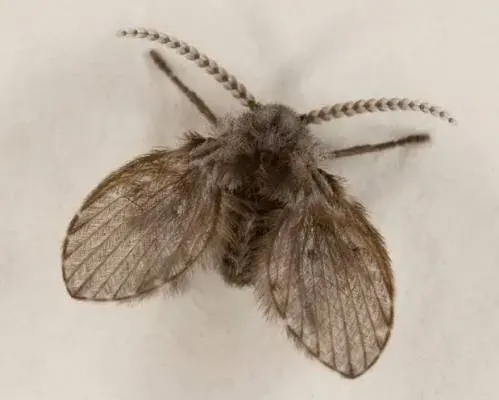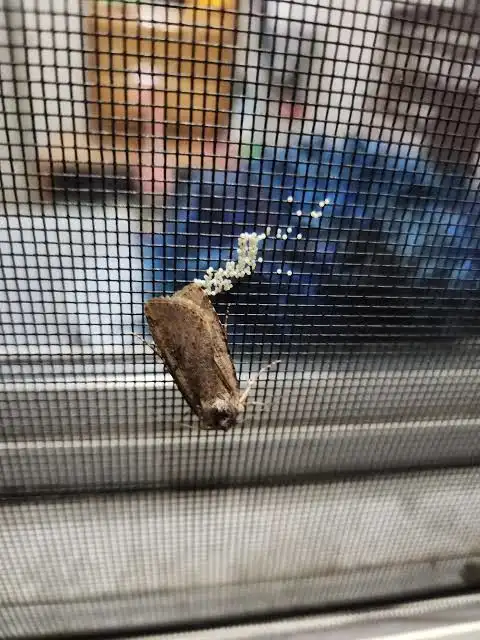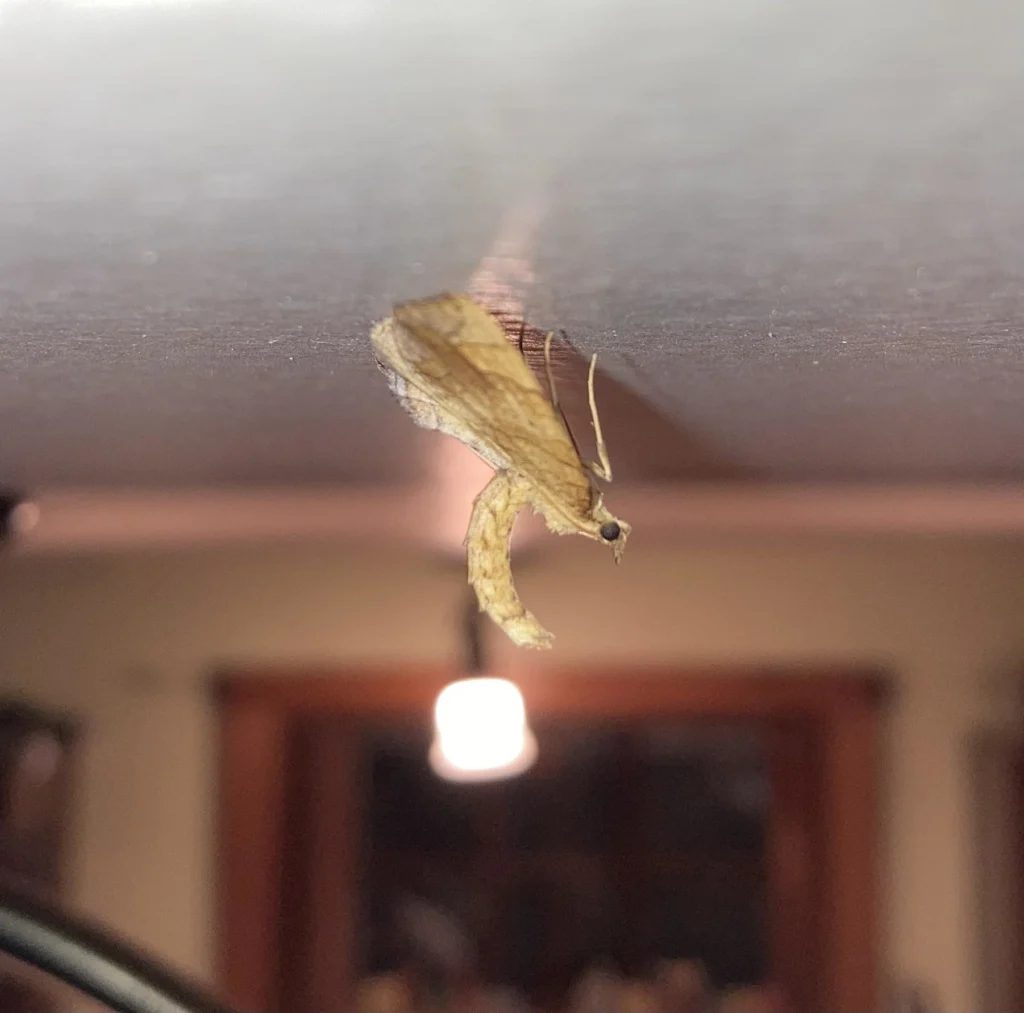
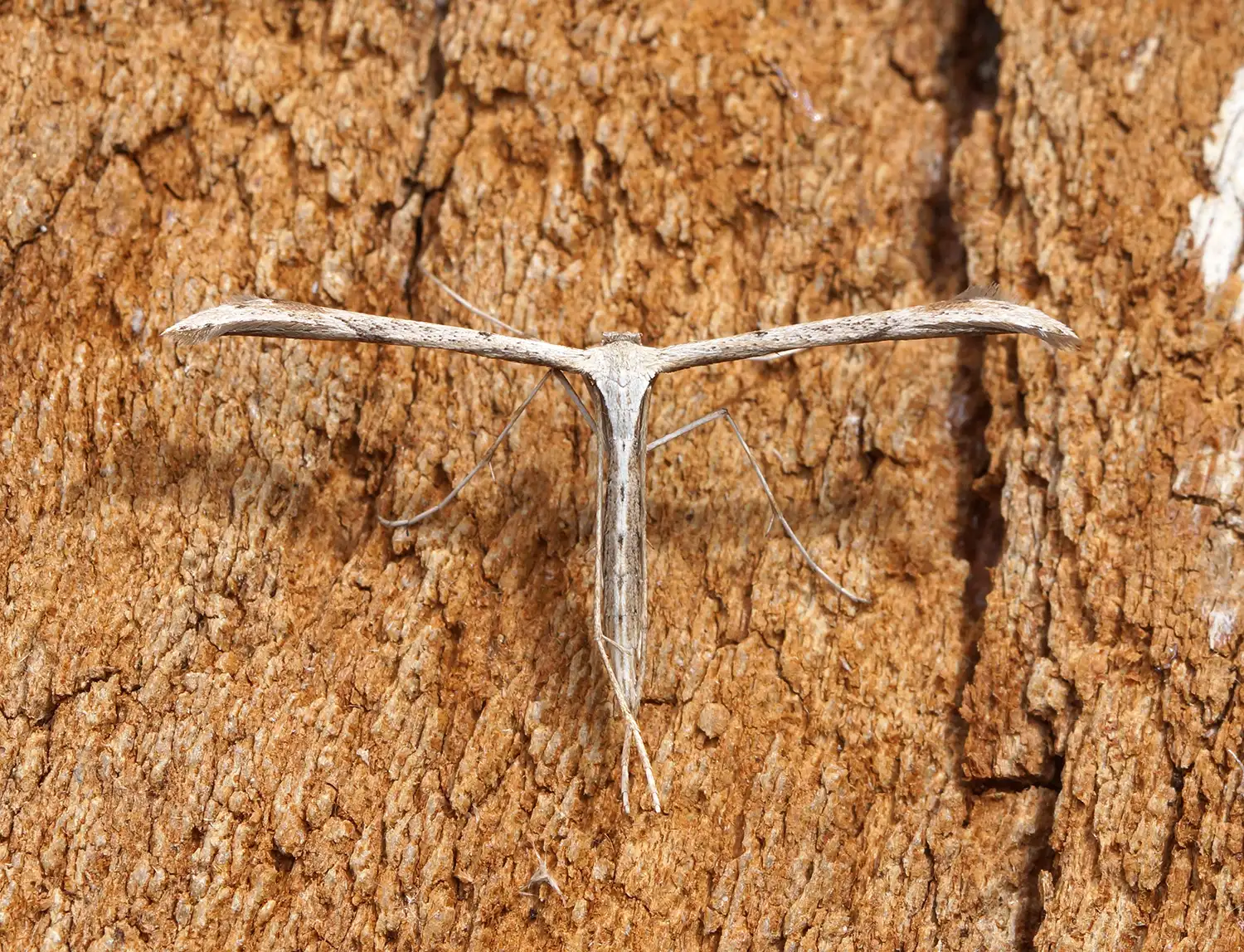
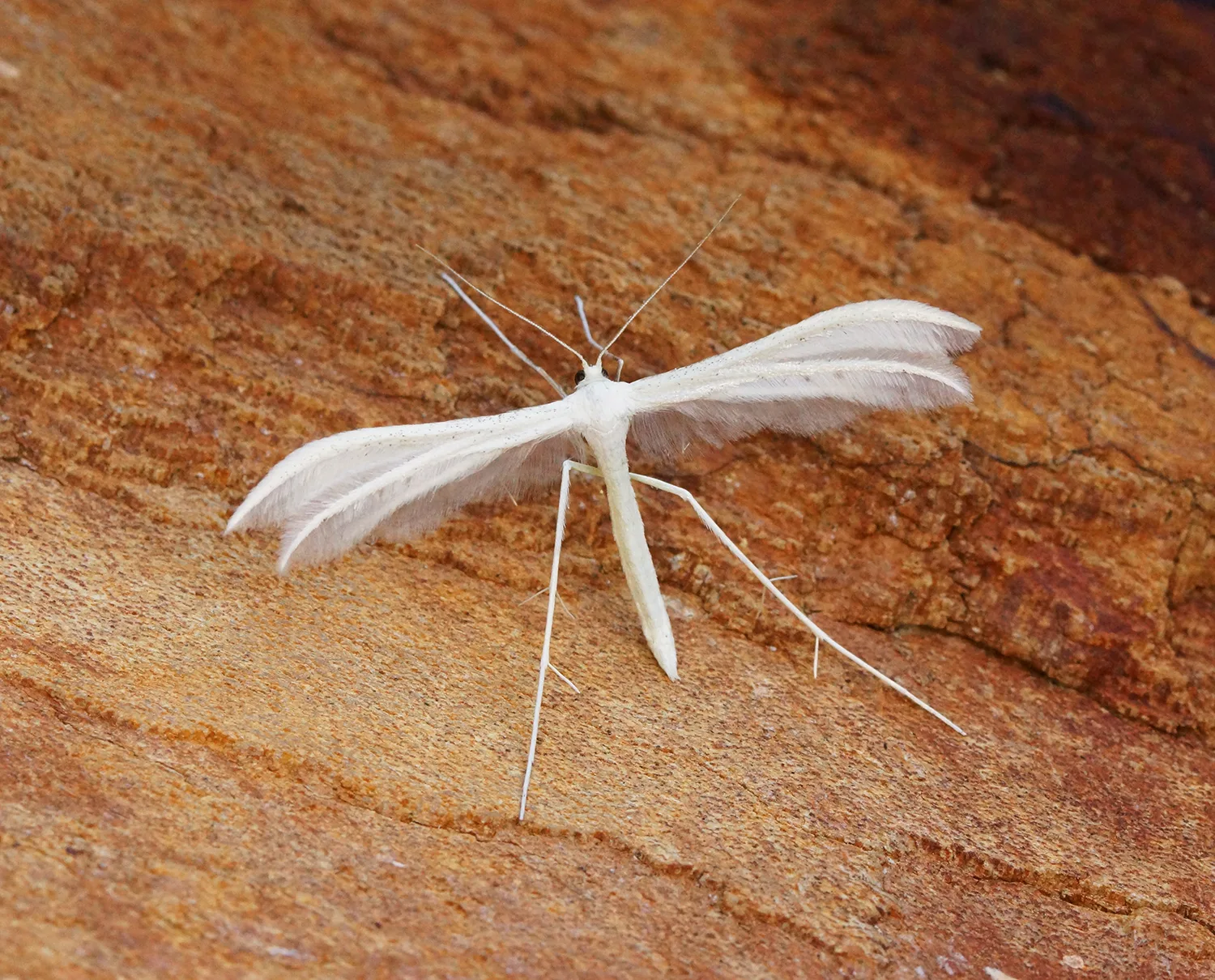
A tiny moth sitting with its wings stretched sideways like the letter T may be a plume moth. These slender insects belong to the family Pterophoridae. Most have long legs and unusually narrow wings that conceal delicate, feather-fringed lobes when folded. Their appearance can resemble a miniature airplane or a twig with legs.
The quickest identification clue is the combination of a T-shaped resting posture, narrow wings, and a slim body. That is often enough to recognize a plume moth at the family level. Identifying the exact species takes more information: location, wing color, spots or scale patches, size, and sometimes details too small to see in an ordinary photograph.
How to Identify a Plume Moth: Five Useful Clues
1. Look for the T-shaped resting posture
Many plume moths rest with their narrow forewings extended almost straight out from the body. Viewed from above, the body forms the stem of a T while the wings make the crossbar. This is the feature most people notice first.
Not every individual will pose at a perfect right angle. Wing position changes when a moth moves, prepares to fly, or settles on an uneven surface. A T shape is a strong clue, not a complete species identification.
2. Check the wing shape, not just the color
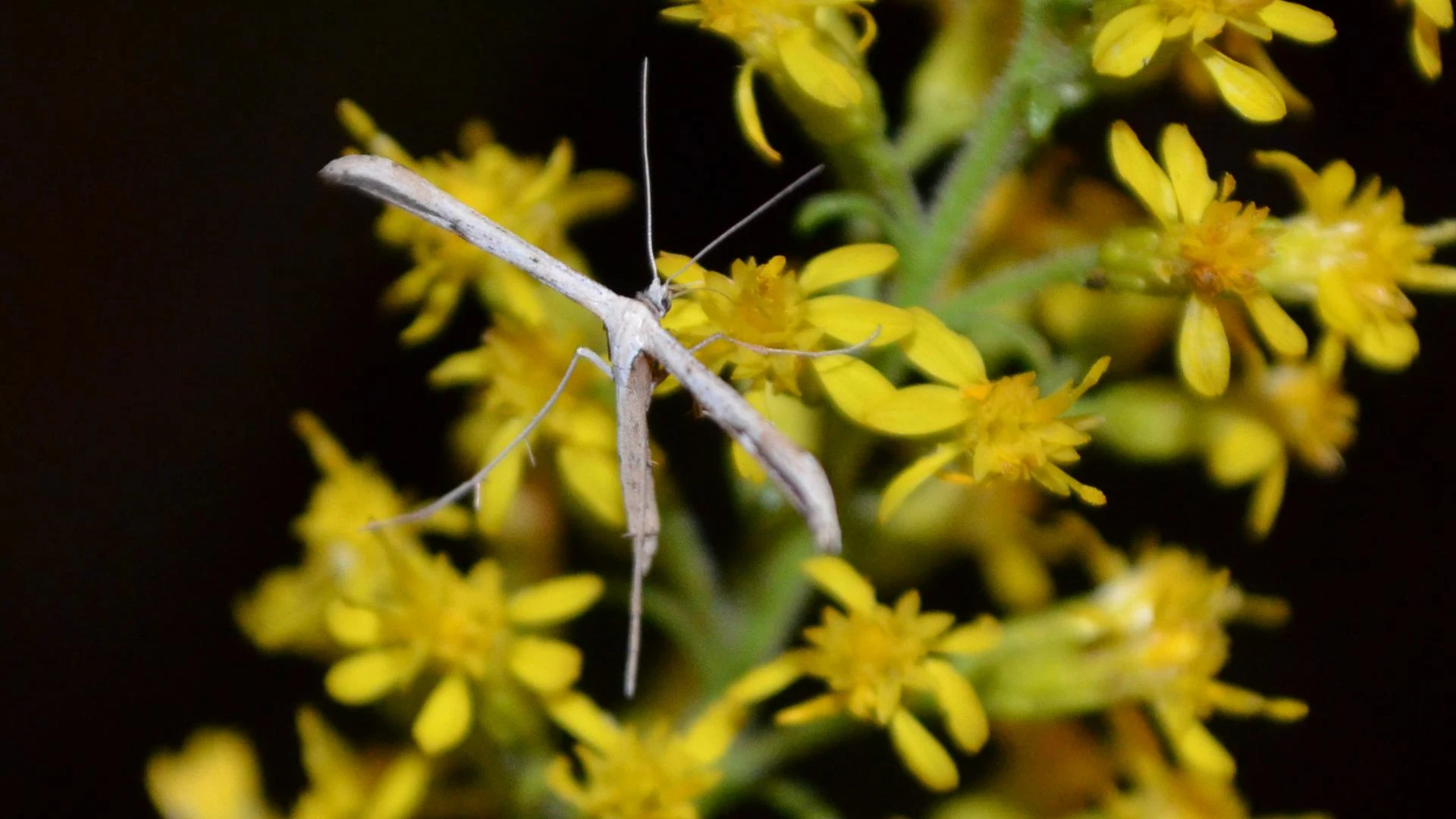
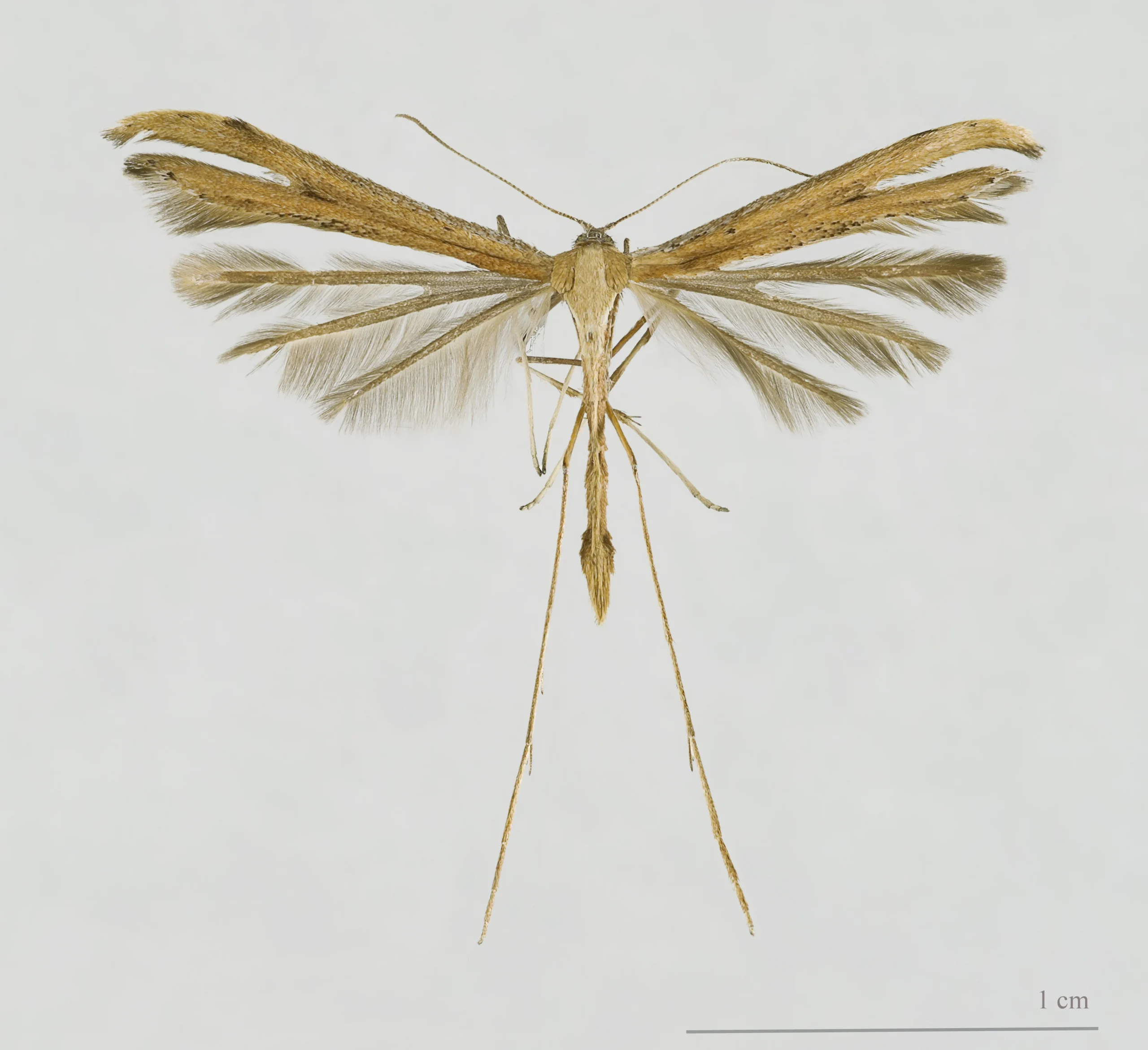
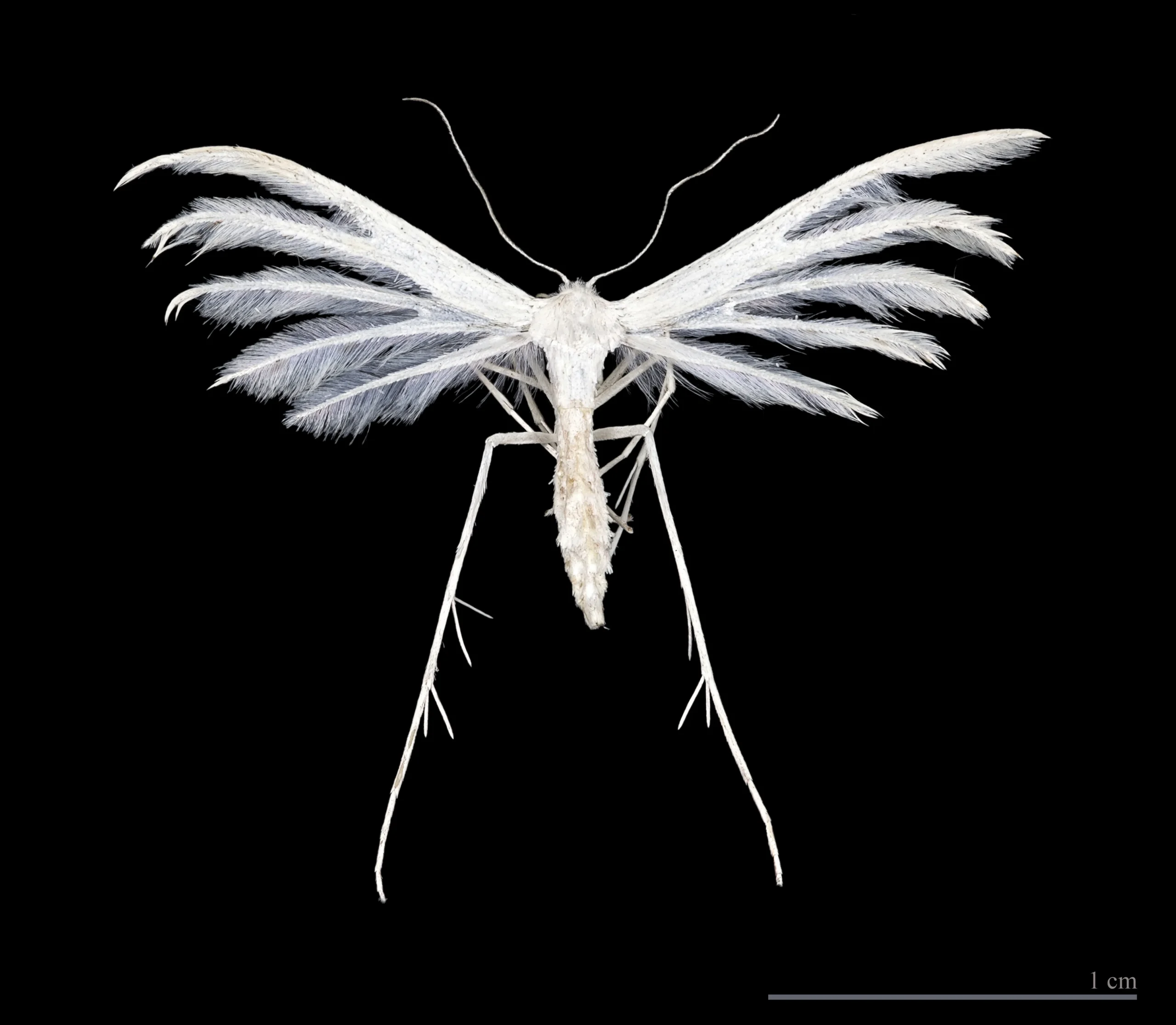
Plume moth wings are not built like the broad, flat wings people usually associate with moths. In many species, each forewing is divided into two lobes and each hindwing into three lobes, with long fringes of scales along the edges. When the moth rests, the wings are held narrowly or rolled, hiding much of the featherlike structure.
The lobe pattern describes the typical five-lobed plume moths, not every member of Pterophoridae. Some less familiar plume moths have wings that are not deeply split. For a general identification, the overall wing shape and resting posture are more useful than attempting to count lobes in a blurry image.
3. Notice the narrow body and long legs
The body is usually slender and elongated. The legs are disproportionately long and thin, often with noticeable spurs or small tufts of scales. These features make a resting plume moth look unlike a typical triangular moth.
4. Record the color and markings
Plume moths come in pale tan, buff, gray, brown, reddish brown, and white. Some have darker streaks on the forewings or contrasting scale patches close to the wing cleft. Color can narrow the options, but lighting and camera exposure can make a moth look paler or darker than it is.
5. Use location, date, and size
Where and when you found the moth matter. A bright white plume moth photographed in Britain should not automatically be given the same species name as a similar-looking moth photographed in North America. Several species can also share nearly identical colors and silhouettes. If possible, record your region, date, approximate wingspan, and the setting in which the moth was found.
For broader guidance on interpreting wing patterns, see our moth identification by wing pattern guide.
Plume Moth Species: A Practical Comparison
The following examples are useful starting points, not a complete worldwide checklist. Their ranges and identifying details differ, and some require expert examination to confirm.
| Candidate | What to look for | Geographic context and caution |
|---|---|---|
| Common plume / morning-glory plume moth (Emmelina monodactyla) | Usually buff or light brown, very narrow wings, clear T-shaped posture | Widespread in Britain and recorded across North America; often associated with bindweeds and other plants in the morning-glory family. |
| White plume moth (Pterophorus pentadactyla) | Bright white wings with conspicuous, delicate featherlike divisions | A well-known European species, including Britain. Do not use this name for every white T-shaped moth worldwide. |
| Beautiful plume (Amblyptilia acanthadactyla) | Warm reddish-brown wing color, dark scale patches associated with the hindwings | A British and European example; may resemble the brindled plume. |
| Brindled plume (Amblyptilia punctidactyla) | Grayer, often more speckled than the beautiful plume | Found in Britain; color is helpful but not always definitive. |
| Plain plume moth (Hellinsia homodactylus) | White ground color; fine leg-scale characters can matter | North American example; several similar white Hellinsia species cannot be separated confidently from ordinary photos. |
Common plume moth (Emmelina monodactyla)
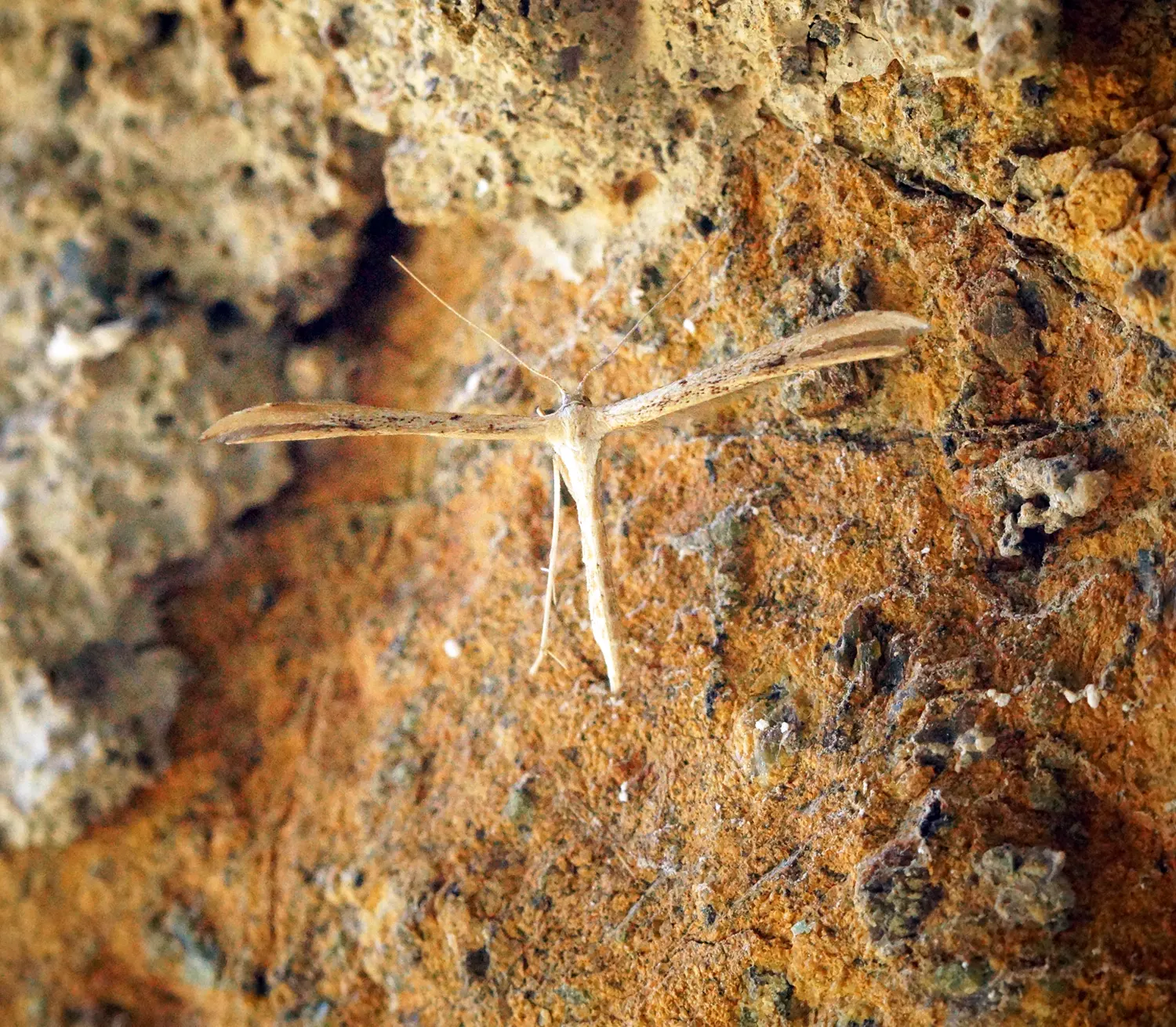
If you saw a pale brown, T-shaped moth on a garden wall, fence, or leaf, Emmelina monodactyla is worth comparing—provided it occurs in your region. In Britain it is called the common plume; in North America it is generally called the morning-glory plume moth. Published UK identification guidance gives a wingspan of approximately 18–27 mm.
The wings may look like narrow brown rods when tightly rolled. This species is associated with bindweeds, with larvae feeding on their leaves and flowers. Still, a moth sitting on a bindweed leaf has not necessarily been confirmed as this species.
White plume moth (Pterophorus pentadactyla)
This is the striking white plume moth often pictured in European moth guides. Its long, finely divided wings can appear like floating feathers. UKMoths records a wingspan of roughly 26–34 mm and notes that the species occurs in grassland, gardens, and other open habitats in Britain.
The important distinction is white plume moth as a species-specific common name versus a white-colored plume moth, which could be something else. North American white plume moths may belong to other genera, including Hellinsia.
Beautiful plume and brindled plume (Amblyptilia species)
Two European plume moths that can confuse beginners are the beautiful plume (Amblyptilia acanthadactyla) and brindled plume (Amblyptilia punctidactyla). The beautiful plume tends toward warm reddish-brown coloration; the brindled plume is typically grayer and more speckled. Both may show dark scale patches that are important during closer examination.
These comparisons are useful for narrowing possibilities in Britain, but a small photo may not show enough detail to settle the identification.
Plume Moth or Something Else?
Plume moths can resemble other small, long-legged insects, especially when photographed from a distance.
| Lookalike | How it differs |
|---|---|
| Crane fly | A fly rather than a moth; it has one functional pair of wings and a different head-and-wing structure. |
| Many-plumed moth (Alucitidae) | Its wings spread in a more fanlike arrangement when resting, rather than the classic narrow T shape. It belongs to a different moth family. |
| Ordinary small brown moth | Often rests with broader wings folded rooflike over the body, though resting postures vary among moth families. |
| Damaged-wing moth | Torn or worn wings can look split; check the full body shape, wings, and posture rather than treating a ragged edge as proof. |
If the insect has long dangling legs and seems almost mosquito-like, look closely at whether its wings have the narrow scaled edges expected of a moth. For unfamiliar insects, a clear dorsal photograph is usually more useful than color alone.
How to Identify a Plume Moth From a Photo
You do not need to capture or handle the insect to collect useful identification details.
- Take a top-down photo. Try to show both wings and the entire body in one frame. This is the best view for the typical T shape.
- Get a closer view of the wing tips. Look for dark spots, scale patches, and whether the wings are rolled or partly opened.
- Photograph the side if possible. Long legs, spurs, and body shape may help separate similar groups.
- Estimate the size. Note the approximate wingspan without placing a ruler directly on the insect.
- Write down the location and date. Country and region are often as important as the image itself.
- Check multiple verified examples. Compare your observation with species records from the same region rather than with one unlabeled social media image.
If your picture shows only a pale T shape without visible markings, Pterophoridae (plume moth) may be the most defensible identification. It is perfectly reasonable to stop at family or genus level.
For more general methods, visit our moth identification guide.
Why Is a Plume Moth in My House?
A single plume moth indoors is usually an accidental visitor. Many species are active at night and may be attracted to lights, so one can enter through an open door or window and rest on a nearby wall.
Finding one plume moth does not mean your pantry, clothes, or carpets are infested. Plume moths are not the usual stored-food or fabric-feeding household moths. The larvae of different plume moth species feed on particular plants, although a few species can be garden or agricultural pests.
If you find one inside, you can gently guide it outdoors using a container and a piece of paper. Repeated indoor moth sightings accompanied by larvae or damaged stored materials call for a separate, evidence-based check. See moths around the home for help with that distinction.
What Do Plume Moth Caterpillars Eat?
Host plants depend on species. Some feed on leaves, flowers, or buds, while others develop in plant stems. Examples include bindweeds for Emmelina monodactyla and Pterophorus pentadactyla, and a wider variety of herbaceous plants for Amblyptilia acanthadactyla.
A nearby plant can support an identification when the larva is actually observed feeding on it, but proximity alone does not prove the plant is a host. A caterpillar found on a rose, geranium, or bindweed cannot safely be assigned a species solely from that plant.
Frequently Asked Questions
What is the little moth shaped like a T?
It may be a plume moth in the family Pterophoridae. Look for narrow wings held sideways, a slender body, and long legs. A photograph and your location can help narrow the identification.
Are plume moths harmful to people?
Adult plume moths do not pose a biting or stinging threat to people. Some species’ caterpillars feed on cultivated plants, but that is a different question from human safety or indoor infestations.
Are all plume moths brown?
No. Many are tan, brown, or gray, but some are white or show reddish coloration and contrasting patches. Color alone rarely provides a reliable species identification.
Is every white plume moth Pterophorus pentadactyla?
No. Pterophorus pentadactyla is one well-known European white plume moth. Other white plume moth species occur elsewhere, including lookalike Hellinsia species in North America.
Can you identify a plume moth from one photo?
Often you can recognize the family from a clear view of the posture and wing shape. Identification to species is less certain, and some lookalike species require examination of very small structures or other specialist methods.
The Takeaway
Start with the silhouette: a small moth with narrow sideways wings and an elongated body is often a plume moth. Then compare wing color, markings, size, location, and season. Treat a confident family identification as useful progress rather than guessing a precise species name from a single image.
References
- BugGuide — Family Pterophoridae — family morphology, identification limitations, and comparison with Alucitidae.
- North Carolina State University — Family Pterophoridae — characteristic wings, legs, and larvae.
- UKMoths — Emmelina monodactyla — common plume identification, size, and host plants.
- BugGuide — Emmelina monodactyla — North American common name and family placement.
- UKMoths — Pterophorus pentadactyla — European white plume moth.
- UKMoths — Amblyptilia acanthadactyla and A. punctidactyla — similar species comparison.
- BugGuide — Hellinsia homodactylus — white-species confusion and diagnostic limits.
How this article was prepared
This identification guide was compiled by comparing university entomology resources and specialist moth references. Species names and range-related examples were checked against the listed sources. The article does not claim that a species can be identified from wing posture alone.