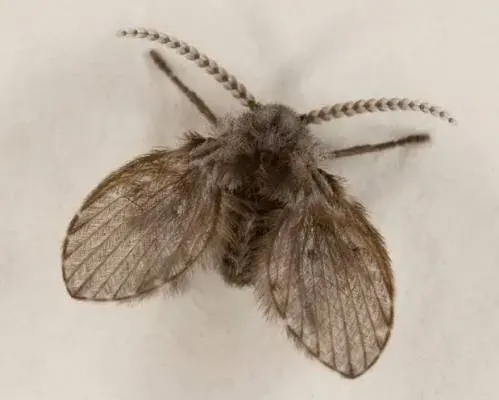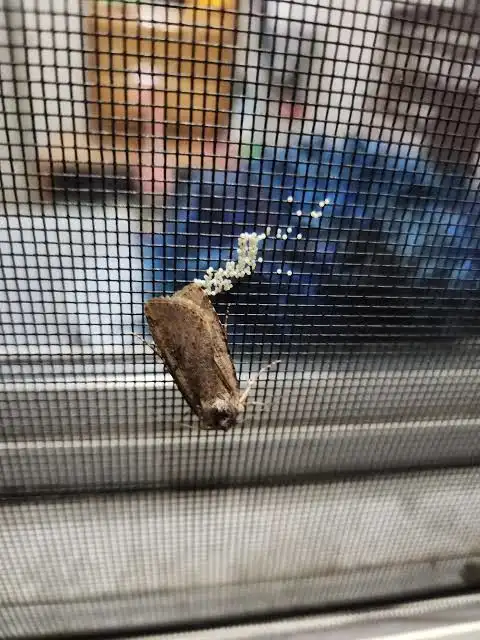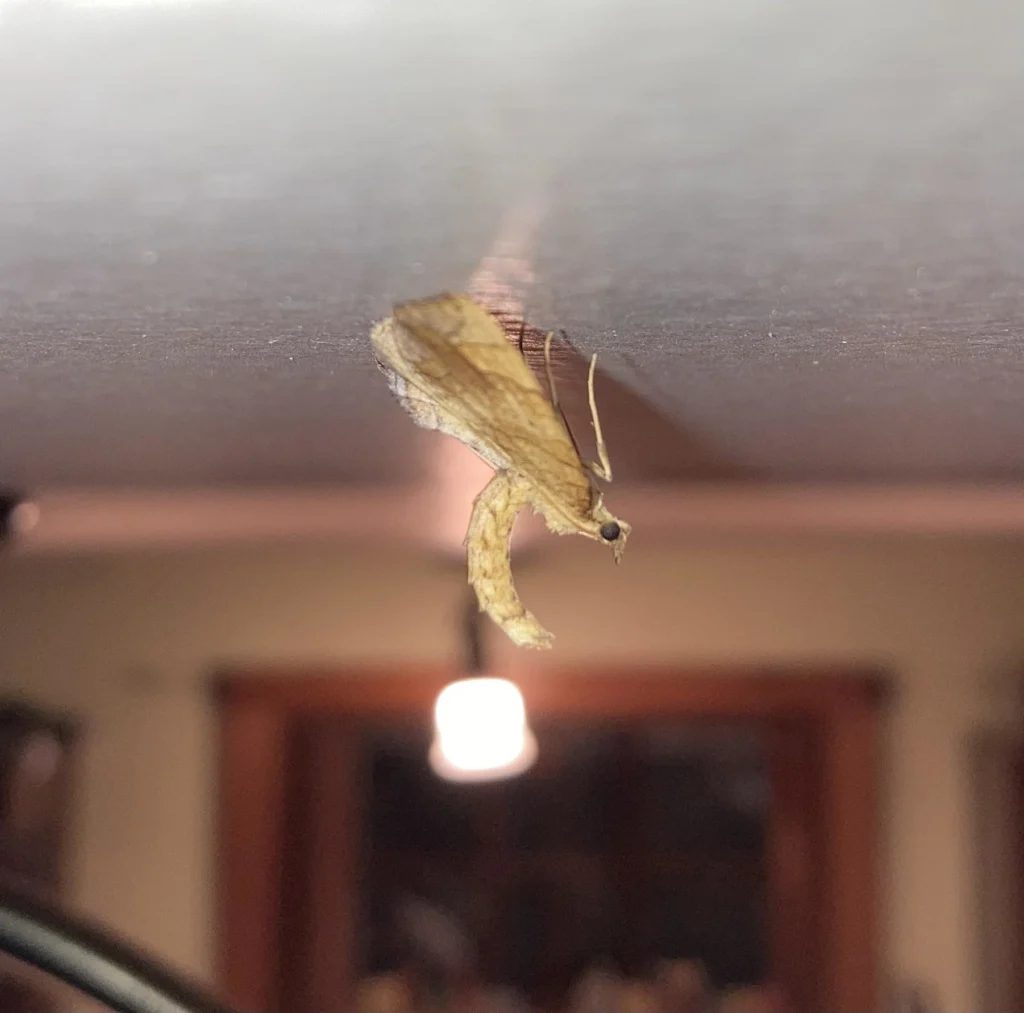
A moth with eye spots on its wings is most often a giant silk moth or one of the “eyed” sphinx moths. In eastern North America the usual candidates are the Polyphemus moth, the Io moth and the Luna moth. In Britain and Europe, think Emperor moth or Eyed Hawk-moth. The eyespot gets you to a short list quickly, but it takes a few more details to get from that list to a name: where you are, how big the moth is, which wings carry the spots, and what the spots actually look like.
What an eyespot can and cannot tell you
An eyespot is a round or oval mark built from rings of contrasting color, often with a dark or clear center that reads like a pupil. That is different from the small dots and kidney-shaped marks many brown moths carry on their forewings. Those are ordinary wing spots, and they point to a completely different set of moths.
A true eyespot is a strong clue because relatively few moth groups have them. In North America and Europe, a large, ringed eyespot nearly always means one of two families: the giant silk moths (Saturniidae) or the sphinx or hawk moths (Sphingidae).
What the eyespot cannot do alone is name the species. Several moths share the feature, some butterflies have it too, and in many species the eyespots sit on the hindwings and stay hidden while the moth rests. A moth that looks plain on your wall may be carrying eyespots you cannot see, and a moth photographed with its wings shut may not be identifiable from that photo.
The most likely moths with eyespots
These are the species beginners most often meet. Treat the table as a starting list for your region, not a complete one.
| Moth | Where it lives | Wingspan | Eyespots | Other clues |
|---|---|---|---|---|
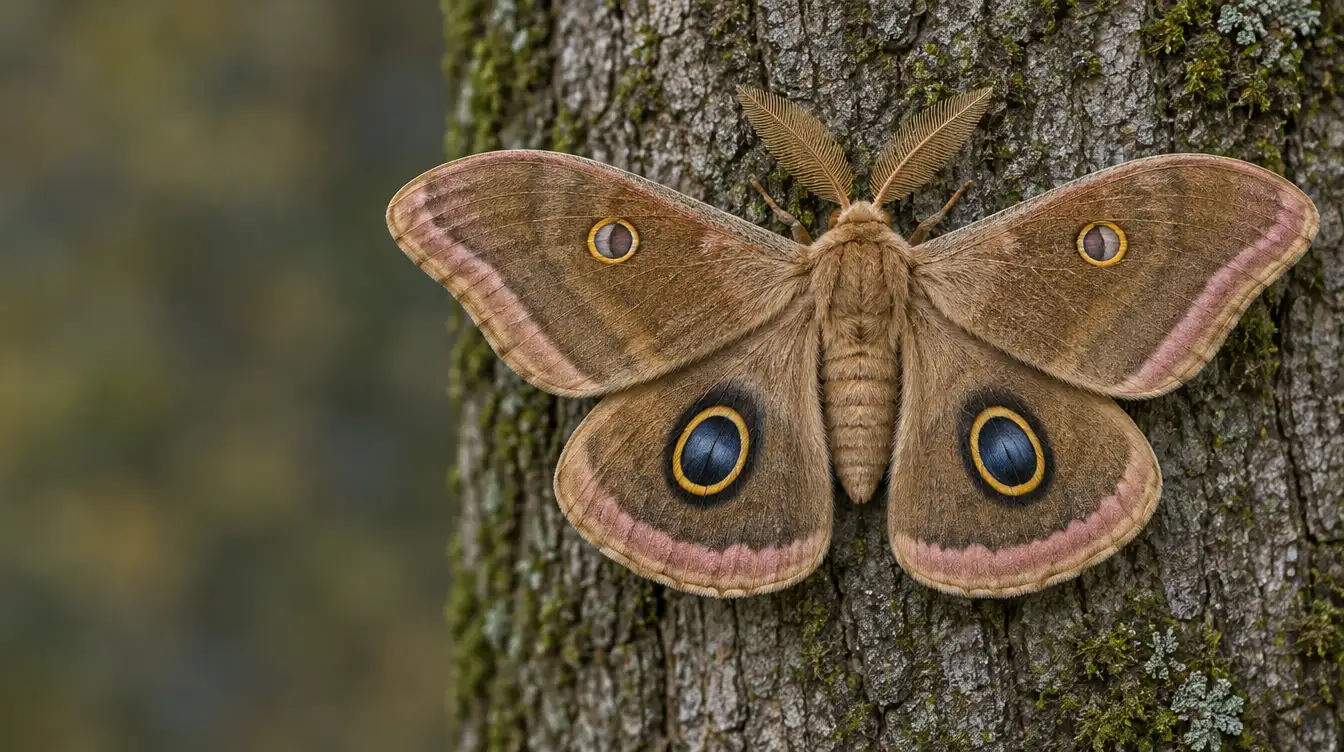
| Polyphemus moth (Antheraea polyphemus) | Most of the United States and Canada, into Mexico | 10–15 cm (about 4–6 in) | One on each of the four wings; the hindwing pair is large and set in black | Tan to reddish brown, very large, feathery antennae |
| Io moth (Automeris io) | Eastern North America, west to the Great Plains and Colorado, south into Mexico | 5–8 cm (2–3 in) | One large black-and-blue spot on each hindwing, with a white dash in the center | Males have yellow forewings, females brown to reddish; spots hidden at rest |
| Luna moth (Actias luna) | Eastern North America, from southern Canada to Florida and eastern Texas | 7.5–10.5 cm (3–4 in) | One small, partly transparent spot on each wing | Pale green wings and long curving hindwing tails |
| Twin-spotted sphinx (Smerinthus jamaicensis) | Widespread in North America | 4.5–8.3 cm (1¾–3¼ in) | One on each hindwing: a blue patch usually split by a black bar | Pink to red hindwings, narrow forewings with a scalloped edge |
| Blinded sphinx (Paonias excaecata) | Most of the United States and southern Canada | 5.5–9.5 cm (2–3¾ in) | One on each hindwing: blue set in black, with no dark “pupil” | Brown forewings with a strongly scalloped edge, pink on the hindwing |
| Emperor moth (Saturnia pavonia) | Britain, Ireland and much of Europe | 5.5–8 cm; females can reach about 10 cm | One on each of the four wings | Fluffy grey-brown body; males fly by day in spring |
| Eyed Hawk-moth (Smerinthus ocellata) | Britain and Europe | 7–8 cm (about 3 in) | One on each hindwing only | Spots stay hidden until the moth is disturbed |
Giant silk moths
The Polyphemus moth is the one people most often mean when they describe a huge brown moth with eyes on its wings. Each wing has a clear, oval “window” ringed in yellow, and the hindwing pair is surrounded by blue and black, which makes it look like a staring eye. It is named after the one-eyed giant of Greek myth.
The Io moth is smaller and easy to underestimate. At rest the forewings cover everything, and the moth looks like a plain yellow or brown triangle. When it is disturbed, the forewings swing forward and two bold eyespots appear on the yellow hindwings.
The Luna moth also has an eyespot on each wing, but it is rarely the feature people notice first. If your moth is pale green with long tails, the eyespots simply confirm what the color and shape already told you.
Eyed sphinx moths
Several North American sphinx moths carry a single blue-and-black eyespot on each hindwing. They rest with the hindwings tucked away, so the spots often show only when the moth is nudged or takes off.
The detail inside the spot helps separate them. The Twin-spotted sphinx usually has its blue patch divided by a black bar. The Blinded sphinx has plain blue with no dark center, which is where its name comes from. The One-eyed sphinx (Smerinthus cerisyi) has a dark pupil-like mark inside the blue. The Small-eyed sphinx (Paonias myops) has yellow-orange hindwings rather than pink.
In Britain and Europe
The Emperor moth is the only large British moth with eyespots on all four wings. Males fly fast in daylight from March to May over heaths, moors and scrubby grassland, and are sometimes taken for butterflies. The Eyed Hawk-moth has eyespots on the hindwings only and keeps them covered until it is disturbed.
Other parts of the world have their own eyespotted silk moths and hawk moths. If you are outside North America and Europe, start with a regional guide rather than this list.
How to narrow it down
- Start with where you are. A Polyphemus moth is a reasonable guess in Ohio and an impossible one in England. Country and state or region remove most of the list before you look at a single marking.
- Estimate the size. Compare the moth with your hand or a nearby object. A moth as wide as your palm points toward the giant silk moths. Something closer to the length of a finger fits the Io moth or the eyed sphinx moths.
- Count the eyespots and note which wings carry them. Four wings or two? Forewings, hindwings or both? Hindwing-only spots suggest the Io moth or a sphinx moth. Spots on all four wings suggest Polyphemus, Luna or, in Europe, the Emperor moth.
- Look inside the spot. Is the center clear like a window, solid blue, split by a bar, or marked with a white dash? This is often the detail that separates close candidates.
- Check the rest of the moth. Base color, tails, scalloped wing edges and body shape all matter. Sphinx moths have narrow forewings and a thick, tapered body. Giant silk moths have broad wings and a furry body.
- Note the date and the setting. Many of these moths fly for only part of the year, and several are drawn to porch lights. A daytime sighting on a heath in April points somewhere very different from a July night at a lit window.
If the moth is resting with its wings closed and you only glimpsed the spots, say so when you ask for help. Do not try to open the wings by hand. A photo of the resting moth plus a note such as “flashed pink hindwings with a blue spot” is useful evidence.
For the wider method, see how to identify a moth and the guide to moth identification by wing pattern.
Lookalikes and common mistakes
It may be a butterfly. Some butterflies have bold eyespots, including the Common Buckeye in North America and the Peacock in Europe. If the insect was active in daylight, check the antennae. Butterflies have thin antennae ending in a small club, while moth antennae are usually feathery or tapered. The guide to moth vs butterfly antennae shows the difference.
Not every round mark is an eyespot. Many brown and grey moths have a small dot or a kidney-shaped mark in the middle of each forewing. These are flat, single-colored marks without rings, and they belong to a much larger and more varied set of moths.
Crescents are not eyes. The Cecropia moth, another North American giant, has a crescent-shaped mark on each wing rather than a ringed spot. It is often described as having eyes, but the shape is different once you look closely.
Hidden hindwings fool people in both directions. An Io moth at rest shows no eyespots at all. A sphinx moth may flash its spots for a second and then cover them again. If you saw the spots only briefly, your memory of their color and number may be less reliable than it feels.
Worn moths lose detail. Older moths shed scales, and an eyespot can fade to a pale smudge. Shape, size and location still count when the pattern has worn.
For photo comparisons of the big silk moths, see moth species with pictures.
Why moths have eyespots
Eyespots are a defence against predators, mainly birds. The long-standing explanation is that a pair of large “eyes” appearing suddenly looks like the face of a bigger animal and makes a bird hesitate. That fits the way moths such as the Io moth and Eyed Hawk-moth keep their spots hidden and reveal them only when disturbed.
Researchers still debate how the effect works. Some experiments support the idea that birds react to the resemblance to real eyes. Others, including a 2024 analysis that pooled many studies, suggest that any bold, high-contrast pattern may put a predator off, whether or not it looks like an eye. Small eyespots near the wing edge may do something different again and draw a peck away from the body.
For identification, the practical point is that eyespots are often a hidden, flash-and-cover feature. Whether you saw them depends on what the moth was doing.
Is a moth with eyespots dangerous?
No. The adult moths in this guide do not bite or sting, and the eyespots are a bluff. Adult giant silk moths do not even feed. They live for a short time on reserves built up as caterpillars.
They are not household pests either. A large eyespotted moth on a wall or window screen has almost certainly been drawn in by a light, and it has no interest in food cupboards or clothing. The guide to a large moth on an outside wall at night covers that situation in more detail.
One caution applies to a different life stage. The caterpillar of the Io moth is covered in branching spines that can give a painful sting. Admire it without touching, and seek medical advice if a sting causes a strong or lasting reaction.
When a photo is not enough
Some sightings cannot be taken to species. A blurred photo, a moth with closed wings, or a description from memory may only support “a sphinx moth with hindwing eyespots” or “probably a giant silk moth”. That is still a sound answer. If you want a firmer one, add your location, the date and a size estimate, and post the photo to a regional recording scheme or a community platform where local observers can check it.
More guides are in the moth identification section.
Frequently asked questions
What is the big brown moth with eyes on its wings?
In most of the United States and Canada, a very large tan or brown moth with an eyespot on each wing is most likely a Polyphemus moth. Check the size and location before settling on it.
What moth is yellow with eyespots on the back wings?
A yellow moth of medium size that reveals one black-and-blue eyespot on each hindwing matches a male Io moth, provided you are within its range in eastern and central North America.
Do all moths with eyespots show them all the time?
No. Luna and Emperor moths show at least some of their spots at rest. Io moths and the eyed sphinx and hawk moths usually keep theirs covered by the forewings, and a Polyphemus moth often rests with its large hindwing spots hidden too.
Are eyespots found on butterflies too?
Yes. Eyespots are widespread in butterflies, so an eyespot alone does not tell you whether you are looking at a moth or a butterfly.
References
- Butterflies and Moths of North America: Polyphemus moth, Io moth, Luna moth, Twin-spotted sphinx, Blinded sphinx, Cecropia silkmoth
- Pacific Northwest Moths: Smerinthus jamaicensis, Paonias excaecatus
- University of Alberta E.H. Strickland Entomological Museum: Paonias myops
- Sphingidae of the United States of America: Smerinthus jamaicensis
- Colorado State University, Colorado Insect of Interest: Io Moth
- The Wildlife Trusts: Emperor moth
- Butterfly Conservation: Eyed Hawk-moth
- De Bona, S., Valkonen, J. K., López-Sepulcre, A. and Mappes, J. (2015). Predator mimicry, not conspicuousness, explains the efficacy of butterfly eyespots. Proceedings of the Royal Society B.
- eLife (2024): A systematic review and meta-analysis of eyespot anti-predator mechanisms