If an insect looks like a wasp or a bumblebee but has see-through wings, a furry or scaly body and no narrow waist, it may be a clearwing moth. The name covers two unrelated groups. True clearwing moths are slim wasp mimics that rest on leaves and stems. The clearwing sphinx moths are plump, fuzzy bee and hummingbird mimics that hover at flowers. Working out which group you saw is the first step, and often the most a single sighting can support.
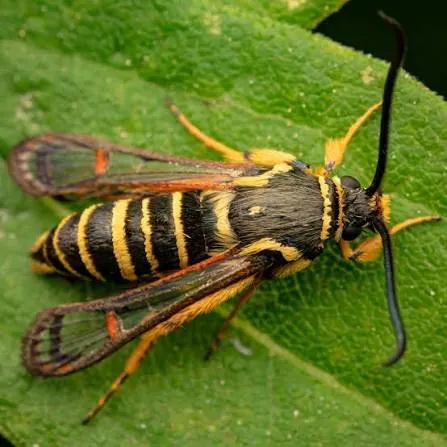
Two groups share the name
True clearwing moths (wasp mimics)
The family Sesiidae holds well over a thousand described species worldwide. Adults fly by day, which is unusual for moths, and most are built to pass as wasps or hornets. The forewings are long and narrow, the hindwings are largely transparent, and the abdomen usually carries narrow bands of yellow, gold or orange.
They are seen far less often than their numbers suggest. Many are small, fast, and active for only a few weeks a year. Their caterpillars live hidden inside stems, roots or wood, so most people only ever meet the adult.
Clearwing sphinx moths (bee and hummingbird mimics)
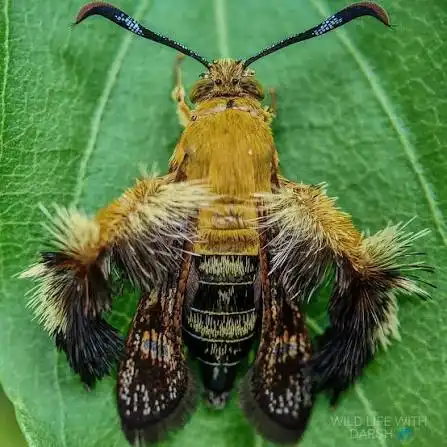
The genus Hemaris belongs to the sphinx or hawk moth family, Sphingidae. These moths are stout and furry, with a thick tapering abdomen and clear patches in wings that still have dark borders. They hover in front of flowers and feed through a long tongue without landing.
In North America they are called hummingbird clearwings and snowberry clearwings. In Britain and Europe the same genus is known as the bee hawk-moths.
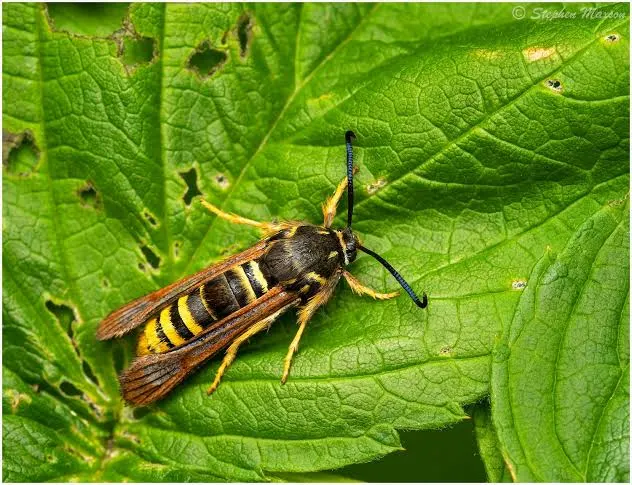
Is it a moth or a real wasp or bee?
Check these features before reaching for a species name. A clear photo from the side helps with most of them.
| Feature | Clearwing moth | Wasp or bee |
|---|---|---|
| Waist | Thorax joins the abdomen broadly | Narrow pinch between thorax and abdomen in wasps |
| Body surface | Scales or dense fur, often a fan or tuft at the tail tip | Smooth and shiny in wasps, hairy in bees |
| Wings | Clear panels with scaled veins and dark edges | Clear membrane with no scales |
| Mouthparts | A coiled tongue, or none visible | Jaws, sometimes with a short tongue |
| Feeding style | Sphinx types hover without landing | Bees and wasps land on the flower |
| Sting | None | Females of most species can sting |
No single row settles it. A worn moth can lose scales, and some bees are nearly hairless. Two or three features pointing the same way give a sound answer.
Clearwing moths people most often notice
These are the ones that turn up in gardens and get photographed. They are examples to compare against, not a full list. Every region has its own clearwings, and many small species cannot be named from a casual photo.
| Moth | Group | Region | What stands out |
|---|---|---|---|
| Hummingbird clearwing (Hemaris thysbe) | Sphinx moth | Much of North America, most familiar in the east | Olive back, dark burgundy abdomen, pale legs, wingspan about 4 to 5.5 cm |
| Snowberry clearwing (Hemaris diffinis) | Sphinx moth | United States and southern Canada | Yellow and black like a bumblebee, black legs, dark stripe through the eye and along the side |
| Broad-bordered bee hawk-moth (Hemaris fuciformis) | Sphinx moth | Britain and Europe | Golden body with a reddish-brown belt, wide dark wing borders |
| Narrow-bordered bee hawk-moth (Hemaris tityus) | Sphinx moth | Britain and Europe | Similar, with thin dark wing borders |
| Squash vine borer (Melittia cucurbitae) | True clearwing | North America | Orange abdomen with black dots, dark metallic forewings, about 1.3 cm long, seen around squash plants |
| Peachtree borer (Synanthedon exitiosa) | True clearwing | North America | Steel-blue to black; females have a broad orange band on the abdomen, males have narrow yellow bands |
| Hornet moth (Sesia apiformis) | True clearwing | Europe, including southern Britain | Large, hornet-yellow, yellow head and shoulder patches, found on poplar trunks |
| Lunar hornet moth (Sesia bembeciformis) | True clearwing | Britain and Europe | Like the hornet moth but with a black head and a yellow collar |
The two Hemaris pairs are the ones beginners can often separate. In North America, leg color is the quickest check: pale legs suggest a hummingbird clearwing, black legs suggest a snowberry clearwing. In Britain, look at the width of the dark wing border. Color alone is unreliable because these moths vary and fade as their fur wears.
How to narrow it down
- Decide whether it is a moth at all. Use the table above. Look for the missing waist, the scales or fur, and the scaled wing veins.
- Sort it into a group. A fat, fuzzy insect hovering at flowers is a clearwing sphinx moth. A slim, banded one sitting on a leaf, stem or trunk is more likely a true clearwing.
- Note where and when. Region rules out most candidates at once. The date matters too, because many true clearwings fly for only a few weeks in summer.
- Note what it was near. True clearwings stay close to the plants their caterpillars use. A moth on a squash plant, a poplar trunk or a fruit tree is a useful clue, though a moth resting on a plant does not prove it breeds there.
- Record the details that separate species. For sphinx types, photograph the legs, the side of the head and thorax, and the wing borders. For true clearwings, photograph the abdomen bands, the head and collar, and the tail tip.
- Check a regional source. Compare your photo with a guide or recording scheme for your own country or state before settling on a name.
Lookalikes and common mistakes
Hoverflies and bee flies. These are true flies with one pair of wings, very large eyes and short, stubby antennae. A bee fly is smaller than a bee hawk-moth and holds its long tongue pointing straight forward.
Other hovering hawk moths. The humming-bird hawk-moth of Europe and the white-lined sphinx of North America hover at flowers in daylight too, but their wings are fully scaled and patterned, not clear. The humming-bird hawk-moth shows orange-brown hindwings in flight.
Butterflies. Bee hawk-moths have long antennae that thicken toward the tip, which can suggest a butterfly. Our guide to moth and butterfly antennae explains why antenna shape helps but should not be used alone.
Fresh moths with cloudy wings. Clearwing sphinx moths emerge with a thin covering of loose scales on the wings, which is shed as they begin to fly. A newly emerged moth can look less clear-winged than the pictures.
Naming a species from color. Many true clearwings share the same black-and-yellow plan. Without location, date and a sharp photo, “a clearwing moth in the family Sesiidae” is often the honest answer.
Can clearwing moths sting or cause damage?
Adult clearwing moths cannot sting or bite. The wasp and bee colors are a bluff that makes predators hesitate. You can watch one at close range without risk.
The caterpillars are a different matter for gardeners. Clearwing sphinx caterpillars feed openly on leaves of plants such as honeysuckle and snowberry and rarely matter. True clearwing caterpillars bore inside stems, roots or wood, and a few are well-known pests. Squash vine borer larvae tunnel in squash and pumpkin stems, and peachtree borer larvae feed under the bark at the base of peach, plum and cherry trees.
Seeing one adult does not mean a plant is infested. Look for evidence on the plant itself, such as sudden wilting with sawdust-like frass at the stem base on squash, or gum oozing near the soil line on stone fruit. Your local extension service or garden advisory body can confirm the cause and advise on what works in your area. Our overview of moth life cycle stages explains why the adult and the caterpillar behave so differently.
When a photo is not enough
A blurred shot of a hovering moth usually supports the group and no more. That is still a useful result. For a firmer answer, add your location, the date, a size estimate and the plant it visited, then share the record with a regional moth recording scheme or a community identification platform.
Small true clearwings are hard even for experienced recorders, who often rely on close examination. If the general method is new to you, start with how to identify a moth. The hummingbird clearwing also appears in our moth species with pictures guide, and more feature-led guides are in the moth identification section.
Frequently asked questions
What is the moth that looks like a bumblebee?
In North America it is most often a snowberry clearwing, and in Britain and Europe one of the two bee hawk-moths. All belong to the genus Hemaris and hover at flowers instead of landing.
What is the moth that looks like a wasp?
A slim, banded, day-flying moth with clear wings is most likely a true clearwing in the family Sesiidae. Which species depends on your region, the date and the plants nearby.
Are clearwing moths and hummingbird moths the same thing?
Partly. “Hummingbird moth” is a loose name for hawk moths that hover at flowers. The hummingbird clearwing is one of them and has clear wings. Other hummingbird moths have fully scaled wings.
Are clearwing moths rare?
It depends on the species and the place. Some are common but overlooked because they are quick, short-lived as adults and easy to mistake for wasps. Others are scarce. In Britain, for example, the lunar hornet moth is widespread while the hornet moth is nationally scarce.
Why do these moths look like wasps and bees?
Birds and other predators learn to avoid insects that sting. A harmless moth that resembles one is more likely to be left alone, which lets it fly safely in daylight.
References
- Sesiidae: clearwing moths, NC State University General Entomology
- Hummingbird Clearwing, Hemaris thysbe, Butterflies and Moths of North America
- Snowberry Clearwing, Missouri Department of Conservation
- Narrow-bordered Bee Hawk-moth, Butterfly Conservation
- Broad-bordered bee hawk-moth, Kent Wildlife Trust
- Humming-bird Hawk-moth, Butterfly Conservation
- Hornet Moth and Lunar Hornet Moth, Butterfly Conservation
- Squash vine borers, University of Minnesota Extension
- Squash Vine Borer, UMass Extension
- Peachtree borer, Michigan State University
- Peachtree Borer, Oklahoma State University Extension